.83¢/min Intro Offer

We Charge 60% LESS than our competitors!

All Psychics tested before hire.

category: astrology

Explore the fascinating world of astrology through articles covering zodiac signs, planets, houses, aspects, compatibility, transits, and spiritual growth. Whether you are new to astrology or an experienced student, this category provides valuable insight into personality, relationships, life purpose, and the symbolic language of the stars.

Conjunction Aspect Meaning in Astrology: Natal, Transit, Synastry, and Chart Interpretation

Conjunction Aspect in Astrology: Meaning, Orb, Natal Charts, Transits, and Synastry
Conjunction aspect astrology meaning

Astrology works best when its symbols are read as part of a whole chart rather than as isolated labels. A planet describes what is acting, a zodiac sign describes how that planet expresses itself, a house describes where in life the action occurs, and an aspect describes how two planetary principles interact. This article is written for readers who want practical, grounded interpretation without losing the symbolic richness that makes astrology useful for reflection, counseling, and chart analysis.

Summary At A Glance

  • Aspect: Conjunction
  • Degree:
  • Quality: Fusion, concentration, amplification
  • Challenge: Intensity, dominance, over-identification
  • In Natal Charts: Shows how two planetary functions interact
  • Spiritual Lesson: Blending planetary energies consciously

What the Conjunction Means

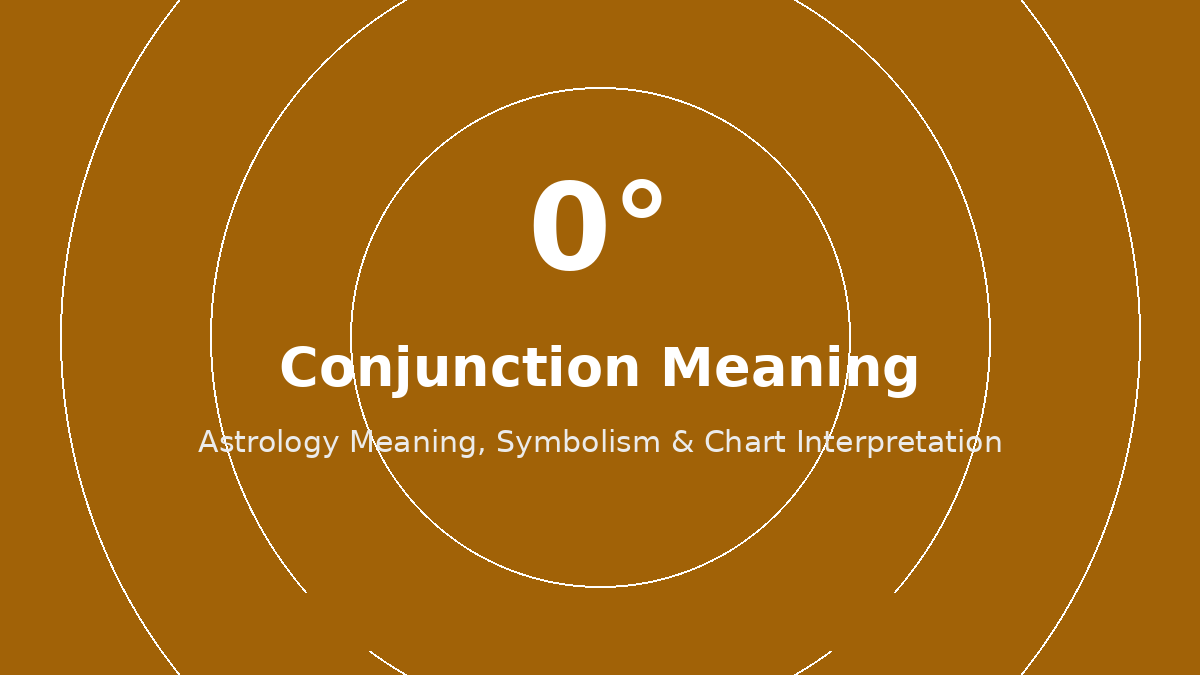
The Conjunction is an astrological aspect of 0 degrees. Its typical quality is fusion, concentration, amplification, and direct blending. In plain language, the planets act as one combined force. Aspects are relationships between planets. They show whether planetary functions blend, cooperate, strain, mirror each other, or require adjustment.

The Conjunction should not be interpreted as automatically good or bad. Its expression depends on the planets involved, their signs, houses, dignity, speed, and whether the aspect is applying or separating. A difficult aspect can produce remarkable strength through effort, while an easy aspect can remain underdeveloped if it is never consciously used.

Conjunction in the Natal Chart

In a birth chart, the Conjunction describes a permanent relationship between two planetary principles. It can become a recurring life pattern, talent, tension, attraction, or developmental task. If personal planets are involved, the aspect is usually felt more directly. If outer planets are involved, the pattern may feel more generational unless it strongly touches the Sun, Moon, Ascendant, Midheaven, or personal planets.

The houses involved show where the aspect plays out. For example, an aspect between a 2nd-house planet and a 10th-house planet may connect money and career. An aspect between the 4th and 7th houses may connect family patterns and partnership. This is why aspect interpretation must include house context.

Conjunction in Transits

In transits, the Conjunction can describe timing. A transit may activate a natal planet and bring its issues into awareness. Fast-moving planets may show brief moods or events, while slower planets can describe longer developmental periods. The Conjunction often marks the type of interaction: pressure, opportunity, culmination, integration, or adjustment.

Transits are most useful when interpreted with realism. They do not force one fixed outcome. Instead, they describe the weather. A person still chooses how to respond, prepare, act, rest, negotiate, or reorganize.

Conjunction in Synastry

In synastry, the Conjunction shows how one person’s planets interact with another person’s planets. Some contacts create ease, others create chemistry, others create friction, and some create a sense of destiny or unresolved tension. The Conjunction can be attractive, challenging, stabilizing, or confusing depending on the planets involved.

A relationship chart should never be judged by one aspect alone. Strong compatibility can include difficult aspects that create growth, and easy aspects can still lack commitment or direction. The Conjunction is one part of the relational pattern.

Orb and Strength

Orb describes how close the planets are to the exact Conjunction. The closer the aspect, the stronger and more obvious it usually is. Wider orbs may still matter, especially when the Sun, Moon, angles, or chart ruler are involved. Different astrologers use different orb rules, so consistency is important.

How to Use Conjunction in a Birth Chart

The meaning of Conjunction becomes clearer when it is connected to the rest of the chart. A beginner may be tempted to read one placement as a complete verdict, but astrology is a layered language. The sign, house, ruler, aspects, and overall chart condition all modify the interpretation. A strong placement may operate confidently, while a pressured placement may require patience, maturity, and conscious development.

In a practical reading, Conjunction should be treated as one voice in a larger conversation. Ask what it is trying to do, where it is trying to operate, and which other planets are supporting or challenging it. This method prevents the interpretation from becoming generic and helps the reader move from keywords into meaningful chart synthesis.

Traditional and Modern Layers

A helpful caution is that traditional and modern astrology do not always use the same language. Traditional astrology works strongly with the visible planets, essential dignity, sect, house strength, and concrete life topics. Modern astrology often adds psychological language, outer planets, developmental themes, and a stronger focus on personal integration. Both approaches can be useful when they are kept in their proper place and not flattened into one oversimplified system.

For Conjunction, the traditional layer gives structure and discipline, while the modern layer often gives psychological texture. The best readings use both carefully: the traditional framework keeps interpretation grounded, while the modern framework can describe motivation, inner conflict, and growth.

Love, Career, and Spiritual Growth

In love and relationships, Conjunction can describe needs, attractions, fears, patterns, or the style of connection that feels natural. In career matters, it can show talents, pressures, work habits, leadership style, or the kind of environment where a person performs well. Spiritually, it can point toward a lesson in balance: where to develop courage, where to soften, where to take responsibility, or where to trust the unfolding process.

The most useful question is not simply “Is Conjunction good or bad?” but “How is this energy being used?” A difficult placement can become a source of skill and depth when handled consciously. An easy placement can become lazy if taken for granted. Astrology becomes practical when it helps a person participate more intelligently in their own life.

Common Misunderstandings

One common mistake is to turn Conjunction into a fixed personality label. Astrology is symbolic, not mechanical. Another mistake is to assume that one keyword explains everything. A sign does not replace a planet, a house does not replace a sign, and an aspect does not cancel free will. Each factor adds context.

A second misunderstanding is to treat challenging symbolism as a sentence. A square, fall, difficult house, or afflicted planet may describe pressure, but pressure can become competence. Many people develop their greatest strengths through the very chart factors that first appear difficult.

Practical Examples in Chart Reading

A practical reading of Conjunction might begin with a simple keyword, but it should never end there. Suppose Conjunction is tied to the 10th house: the symbolism may become visible through work, reputation, public responsibility, or a major life direction. If it is tied to the 4th house, the same symbolism may become private, ancestral, domestic, or emotionally foundational. If it is tied to the 7th house, it may be encountered through partners, clients, contracts, or open conflict.

The next step is to ask whether Conjunction is supported or strained. A trine from Jupiter might make the energy easier to trust, while a square from Saturn might ask for maturity, patience, and realism. A connection to Mars may add heat or urgency. A connection to Venus may add attraction or negotiation. A connection to Neptune may make the pattern imaginative but also less concrete. A connection to Pluto may intensify the issue and make it harder to ignore.

How This Symbol Develops Over Time

People rarely live Conjunction the same way at every age. Early in life, the symbolism may be unconscious, inherited, reactive, or shaped by family expectations. Later, it may become a skill, vocation, healing path, or source of personal authority. This is why astrology should be read developmentally. The birth chart describes a pattern, but a person grows into that pattern through choices, experience, mistakes, and insight.

Transits and progressions can awaken Conjunction at important times. A Saturn transit may demand structure and accountability. A Jupiter transit may expand opportunity or confidence. A Uranus transit may disrupt old habits. A Neptune transit may blur certainty and ask for faith. A Pluto transit may expose deeper material and require transformation. In each case, the natal promise of Conjunction is activated in a new way.

Questions for Self-Reflection

When using Conjunction for self-reflection, avoid asking only what will happen. Better questions include: What pattern is being repeated? What strength is trying to develop? What fear is being exposed? What habit has become outdated? What would a more mature expression of this symbol look like? These questions make astrology useful rather than fatalistic.

A reader can also ask whether Conjunction is being expressed directly or indirectly. Direct expression tends to feel conscious and chosen. Indirect expression may appear through projection, avoidance, conflict, or repeated encounters with other people who carry the symbol for us. The more consciously the pattern is owned, the more flexible it becomes.

Reading This Symbol with Signs, Houses, and Aspects

The cleanest way to interpret Conjunction is to separate the layers. The planet or point describes the function, the sign describes the style, the house describes the life area, and aspects describe relationships with other chart factors. When these layers are mixed together too quickly, the reading becomes vague. When they are separated first and then recombined, the interpretation becomes much more precise.

For example, if Conjunction is connected with an earth sign, the expression may become practical, physical, financial, or craft-oriented. If it is connected with an air sign, the emphasis may move toward language, ideas, planning, or social exchange. Fire adds movement, courage, and inspiration, while water adds memory, feeling, intuition, and bonding. The same principle becomes even more specific when the house and ruler are added.

Using This Meaning in Psychic or Intuitive Readings

For intuitive readers, Conjunction can act as a symbolic doorway. The astrology gives a structure, while intuition supplies nuance, timing, tone, and emotional emphasis. A grounded reader does not simply repeat keywords. Instead, the reader listens for how the symbol is showing up in the client’s real life: as a relationship pattern, career issue, family inheritance, health routine, creative block, spiritual lesson, or decision point.

This is especially useful when a client feels stuck. Conjunction may reveal where energy is concentrated, where a person is avoiding a necessary change, or where an old strength needs to be used in a new way. The best readings are not frightening or overly deterministic. They help the client recognize the pattern and choose a more conscious response.

Keyword Bank

Helpful keywords for Conjunction include development, expression, pattern, timing, relationship, choice, integration, strength, challenge, awareness, and maturity. These broad words keep the interpretation flexible. They also remind the reader that astrology is not about reducing a person to one sentence. It is about recognizing symbolic patterns and then applying judgment, compassion, and context.

Quick Interpretation Checklist

  • What is Conjunction describing in this chart?
  • Which sign modifies the expression?
  • Which house shows the life area involved?
  • What aspects support or challenge the placement?
  • What does the ruler of the sign reveal?
  • Is this symbolism personal, relational, vocational, or spiritual?
  • Is the pattern being expressed consciously or reactively?
  • What would a mature expression look like?

Need Personal Guidance?

Astrology can provide valuable insight into your personality, relationships, career path, and life direction. A private reading can help you understand how these influences apply specifically to your unique birth chart.

For a private astrology or psychic reading, visit AbsolutelyPsychic.com or call 1-800-498-8777.

Final Thoughts on the Conjunction

The Conjunction is one of the main tools for understanding planetary relationships. It reveals not only what energies exist in the chart, but how they interact. Used carefully, it can explain conflict, talent, timing, attraction, and the deeper work of integration.
First House in Astrology: Meaning, Planets, Signs, and Natal Chart Interpretation

First House in Astrology: Meaning, Life Areas, Planets, and Chart Interpretation

First House astrology meaning

Astrology works best when its symbols are read as part of a whole chart rather than as isolated labels. A planet describes what is acting, a zodiac sign describes how that planet expresses itself, a house describes where in life the action occurs, and an aspect describes how two planetary principles interact. This article is written for readers who want practical, grounded interpretation without losing the symbolic richness that makes astrology useful for reflection, counseling, and chart analysis.

Summary At A Glance

  • House: 1st House
  • Keywords: Identity, body, vitality, appearance, beginnings
  • Natural Mnemonic: Aries / Mars
  • Life Area: How you meet life and how others first experience you
  • Main Question: Where does this life theme show up in the chart?
  • Spiritual Lesson: Developing authentic self-expression

What the First House Represents

The First House describes identity, body, vitality, appearance, temperament, and first impressions. In the chart, houses describe arenas of life. They do not behave exactly like signs. A sign shows style, a planet shows the actor, and a house shows where the story unfolds. The First House is therefore a life territory rather than a personality label.

The First House is connected with the Ascendant and the sign rising on the eastern horizon. Its deeper interpretive theme is how life begins through the person themselves. Planets placed here become active in this life area, and the sign on the cusp shows the style through which the house topics are approached.

Planets in the First House

When a planet falls in the First House, its symbolism becomes strongly involved with this house’s topics. The Sun may bring visibility and identity. The Moon may bring habit, memory, and emotional need. Mercury may bring communication or analysis. Venus may bring attraction and agreement. Mars may bring conflict or courage. Jupiter may expand the area. Saturn may create responsibility, delay, or mastery. Outer planets can intensify, disrupt, dissolve, or transform the house themes.

No planet in the First House should be judged alone. Its sign, aspects, dignity, and condition all matter. A difficult planet here can describe pressure, but it can also become expertise. A benefic planet here can bring ease, but it still needs conscious use.

The Sign on the First House Cusp

The sign on the cusp of the First House describes how a person enters this area of life. Aries may act quickly, Taurus may stabilize, Gemini may communicate, Cancer may protect, Leo may express, Virgo may organize, Libra may negotiate, Scorpio may intensify, Sagittarius may expand, Capricorn may structure, Aquarius may innovate, and Pisces may soften or spiritualize.

The ruler of that cusp sign is extremely important. It shows where the affairs of the First House are managed from. For example, if Gemini is on the cusp, Mercury becomes the house ruler, and Mercury’s sign, house, and aspects will describe how the house topics are handled.

Questions to Ask When Reading the First House

  • Which sign is on the cusp of the First House?
  • Where is the ruler of that sign placed?
  • Are there planets in the First House?
  • What aspects do those planets receive?
  • Is this house emphasized by transits or progressions?

How to Use First House in a Birth Chart

The meaning of First House becomes clearer when it is connected to the rest of the chart. A beginner may be tempted to read one placement as a complete verdict, but astrology is a layered language. The sign, house, ruler, aspects, and overall chart condition all modify the interpretation. A strong placement may operate confidently, while a pressured placement may require patience, maturity, and conscious development.

In a practical reading, First House should be treated as one voice in a larger conversation. Ask what it is trying to do, where it is trying to operate, and which other planets are supporting or challenging it. This method prevents the interpretation from becoming generic and helps the reader move from keywords into meaningful chart synthesis.

Traditional and Modern Layers

A helpful caution is that traditional and modern astrology do not always use the same language. Traditional astrology works strongly with the visible planets, essential dignity, sect, house strength, and concrete life topics. Modern astrology often adds psychological language, outer planets, developmental themes, and a stronger focus on personal integration. Both approaches can be useful when they are kept in their proper place and not flattened into one oversimplified system.

For First House, the traditional layer gives structure and discipline, while the modern layer often gives psychological texture. The best readings use both carefully: the traditional framework keeps interpretation grounded, while the modern framework can describe motivation, inner conflict, and growth.

Love, Career, and Spiritual Growth

In love and relationships, First House can describe needs, attractions, fears, patterns, or the style of connection that feels natural. In career matters, it can show talents, pressures, work habits, leadership style, or the kind of environment where a person performs well. Spiritually, it can point toward a lesson in balance: where to develop courage, where to soften, where to take responsibility, or where to trust the unfolding process.

The most useful question is not simply “Is First House good or bad?” but “How is this energy being used?” A difficult placement can become a source of skill and depth when handled consciously. An easy placement can become lazy if taken for granted. Astrology becomes practical when it helps a person participate more intelligently in their own life.

Common Misunderstandings

One common mistake is to turn First House into a fixed personality label. Astrology is symbolic, not mechanical. Another mistake is to assume that one keyword explains everything. A sign does not replace a planet, a house does not replace a sign, and an aspect does not cancel free will. Each factor adds context.

A second misunderstanding is to treat challenging symbolism as a sentence. A square, fall, difficult house, or afflicted planet may describe pressure, but pressure can become competence. Many people develop their greatest strengths through the very chart factors that first appear difficult.

Practical Examples in Chart Reading

A practical reading of First House might begin with a simple keyword, but it should never end there. Suppose First House is tied to the 10th house: the symbolism may become visible through work, reputation, public responsibility, or a major life direction. If it is tied to the 4th house, the same symbolism may become private, ancestral, domestic, or emotionally foundational. If it is tied to the 7th house, it may be encountered through partners, clients, contracts, or open conflict.

The next step is to ask whether First House is supported or strained. A trine from Jupiter might make the energy easier to trust, while a square from Saturn might ask for maturity, patience, and realism. A connection to Mars may add heat or urgency. A connection to Venus may add attraction or negotiation. A connection to Neptune may make the pattern imaginative but also less concrete. A connection to Pluto may intensify the issue and make it harder to ignore.

How This Symbol Develops Over Time

People rarely live First House the same way at every age. Early in life, the symbolism may be unconscious, inherited, reactive, or shaped by family expectations. Later, it may become a skill, vocation, healing path, or source of personal authority. This is why astrology should be read developmentally. The birth chart describes a pattern, but a person grows into that pattern through choices, experience, mistakes, and insight.

Transits and progressions can awaken First House at important times. A Saturn transit may demand structure and accountability. A Jupiter transit may expand opportunity or confidence. A Uranus transit may disrupt old habits. A Neptune transit may blur certainty and ask for faith. A Pluto transit may expose deeper material and require transformation. In each case, the natal promise of First House is activated in a new way.

Questions for Self-Reflection

When using First House for self-reflection, avoid asking only what will happen. Better questions include: What pattern is being repeated? What strength is trying to develop? What fear is being exposed? What habit has become outdated? What would a more mature expression of this symbol look like? These questions make astrology useful rather than fatalistic.

A reader can also ask whether First House is being expressed directly or indirectly. Direct expression tends to feel conscious and chosen. Indirect expression may appear through projection, avoidance, conflict, or repeated encounters with other people who carry the symbol for us. The more consciously the pattern is owned, the more flexible it becomes.

Reading This Symbol with Signs, Houses, and Aspects

The cleanest way to interpret First House is to separate the layers. The planet or point describes the function, the sign describes the style, the house describes the life area, and aspects describe relationships with other chart factors. When these layers are mixed together too quickly, the reading becomes vague. When they are separated first and then recombined, the interpretation becomes much more precise.

For example, if First House is connected with an earth sign, the expression may become practical, physical, financial, or craft-oriented. If it is connected with an air sign, the emphasis may move toward language, ideas, planning, or social exchange. Fire adds movement, courage, and inspiration, while water adds memory, feeling, intuition, and bonding. The same principle becomes even more specific when the house and ruler are added.

Using This Meaning in Psychic or Intuitive Readings

For intuitive readers, First House can act as a symbolic doorway. The astrology gives a structure, while intuition supplies nuance, timing, tone, and emotional emphasis. A grounded reader does not simply repeat keywords. Instead, the reader listens for how the symbol is showing up in the client’s real life: as a relationship pattern, career issue, family inheritance, health routine, creative block, spiritual lesson, or decision point.

This is especially useful when a client feels stuck. First House may reveal where energy is concentrated, where a person is avoiding a necessary change, or where an old strength needs to be used in a new way. The best readings are not frightening or overly deterministic. They help the client recognize the pattern and choose a more conscious response.

Keyword Bank

Helpful keywords for First House include development, expression, pattern, timing, relationship, choice, integration, strength, challenge, awareness, and maturity. These broad words keep the interpretation flexible. They also remind the reader that astrology is not about reducing a person to one sentence. It is about recognizing symbolic patterns and then applying judgment, compassion, and context.

Quick Interpretation Checklist

  • What is First House describing in this chart?
  • Which sign modifies the expression?
  • Which house shows the life area involved?
  • What aspects support or challenge the placement?
  • What does the ruler of the sign reveal?
  • Is this symbolism personal, relational, vocational, or spiritual?
  • Is the pattern being expressed consciously or reactively?
  • What would a mature expression look like?

Need Personal Guidance?

Astrology can provide valuable insight into your personality, relationships, career path, and life direction. A private reading can help you understand how these influences apply specifically to your unique birth chart.

For a private astrology or psychic reading, visit AbsolutelyPsychic.com or call 1-800-498-8777.

Final Thoughts on the First House

The First House becomes meaningful when it is read as part of the whole chart. Its topics may be simple on the surface, but the ruler, planets, and aspects can make the story rich, practical, and deeply personal.

Sun in Astrology: Meaning, Symbolism, Houses, Signs, and Aspects

Sun in Astrology: Meaning, Symbolism, and Chart Interpretation

Sun astrology meaning

Astrology works best when its symbols are read as part of a whole chart rather than as isolated labels. A planet describes what is acting, a zodiac sign describes how that planet expresses itself, a house describes where in life the action occurs, and an aspect describes how two planetary principles interact. This article is written for readers who want practical, grounded interpretation without losing the symbolic richness that makes astrology useful for reflection, counseling, and chart analysis.

Summary At A Glance

  • Planet: Sun
  • Keywords: Identity, vitality, purpose, leadership, visibility
  • Rules: Leo
  • Exalted In: Aries
  • Represents: Life direction, confidence, self-expression, authority
  • Challenge: Pride, ego wounds, difficulty trusting personal light

What Sun Represents

In astrology, Sun represents vitality, identity, purpose, visibility, leadership, father or authority symbolism. It is one of the major symbolic actors in the birth chart, showing a core function of life rather than a simple personality trait. When an astrologer studies Sun, the question is not only what it means by itself, but how it behaves through sign, house, dignity, motion, visibility, and aspect patterns.

Traditionally, Sun is connected with rulership by domicile in Leo. Its exaltation is commonly associated with Aries. These conditions matter because they describe whether the planet has an easy environment for its nature or whether it has to work harder to express itself clearly. Modern astrology adds a more psychological layer, emphasizing conscious direction and the desire to organize life around meaning.

Sun by Sign

The zodiac sign of Sun describes the style, tone, and method of expression. For example, a fiery placement tends to act quickly and visibly, while an earth placement may seek practical results. Air signs usually express through ideas and exchange, while water signs tend to move through feeling, intuition, memory, and bonding. This is why the same planet can feel very different from one chart to another.

A strong interpretation of Sun by sign should avoid stereotypes. The sign does not replace the planet. Instead, it colors how the planet functions. If Sun is in Aries, the expression may be direct and urgent; in Taurus it may become steady and embodied; in Gemini it may move through language; in Cancer it may become protective and emotionally responsive. Each sign gives the planet a different costume and strategy.

Sun by House

The house placement of Sun shows the life area where its symbolism becomes most active. A first-house placement may be visible in personality and physical presence. A fourth-house placement may work through family, home, roots, and private life. A seventh-house placement brings the planet into partnership, clients, contracts, or open opposition. A tenth-house placement often makes the planet public through career, reputation, or authority.

This house layer is essential because two people can have Sun in the same sign but live it in entirely different arenas. The sign explains style; the house explains location. The ruler of the house and aspects to Sun refine the story further.

Sun in Aspect

Aspects show how Sun interacts with other planetary functions. Conjunctions intensify and blend its meaning. Sextiles create workable opportunities. Squares demand effort and skill. Trines show ease and flow. Oppositions bring awareness through relationship or polarity. Quincunxes require adjustment and recalibration. A planet with many aspects becomes especially important because it participates in many parts of the chart conversation.

For example, Sun in a supportive aspect to Jupiter may expand confidence, perspective, or opportunity. In a hard aspect to Saturn, the same planet may feel tested, delayed, or disciplined. In contact with Neptune, symbolism may become imaginative, idealized, or unclear. The aspect does not erase the planet; it describes the relationship between different life functions.

How to Use Sun in a Birth Chart

The meaning of Sun becomes clearer when it is connected to the rest of the chart. A beginner may be tempted to read one placement as a complete verdict, but astrology is a layered language. The sign, house, ruler, aspects, and overall chart condition all modify the interpretation. A strong placement may operate confidently, while a pressured placement may require patience, maturity, and conscious development.

In a practical reading, Sun should be treated as one voice in a larger conversation. Ask what it is trying to do, where it is trying to operate, and which other planets are supporting or challenging it. This method prevents the interpretation from becoming generic and helps the reader move from keywords into meaningful chart synthesis.

Traditional and Modern Layers

A helpful caution is that traditional and modern astrology do not always use the same language. Traditional astrology works strongly with the visible planets, essential dignity, sect, house strength, and concrete life topics. Modern astrology often adds psychological language, outer planets, developmental themes, and a stronger focus on personal integration. Both approaches can be useful when they are kept in their proper place and not flattened into one oversimplified system.

For Sun, the traditional layer gives structure and discipline, while the modern layer often gives psychological texture. The best readings use both carefully: the traditional framework keeps interpretation grounded, while the modern framework can describe motivation, inner conflict, and growth.

Love, Career, and Spiritual Growth

In love and relationships, Sun can describe needs, attractions, fears, patterns, or the style of connection that feels natural. In career matters, it can show talents, pressures, work habits, leadership style, or the kind of environment where a person performs well. Spiritually, it can point toward a lesson in balance: where to develop courage, where to soften, where to take responsibility, or where to trust the unfolding process.

The most useful question is not simply “Is Sun good or bad?” but “How is this energy being used?” A difficult placement can become a source of skill and depth when handled consciously. An easy placement can become lazy if taken for granted. Astrology becomes practical when it helps a person participate more intelligently in their own life.

Common Misunderstandings

One common mistake is to turn Sun into a fixed personality label. Astrology is symbolic, not mechanical. Another mistake is to assume that one keyword explains everything. A sign does not replace a planet, a house does not replace a sign, and an aspect does not cancel free will. Each factor adds context.

A second misunderstanding is to treat challenging symbolism as a sentence. A square, fall, difficult house, or afflicted planet may describe pressure, but pressure can become competence. Many people develop their greatest strengths through the very chart factors that first appear difficult.

Practical Examples in Chart Reading

A practical reading of Sun might begin with a simple keyword, but it should never end there. Suppose Sun is tied to the 10th house: the symbolism may become visible through work, reputation, public responsibility, or a major life direction. If it is tied to the 4th house, the same symbolism may become private, ancestral, domestic, or emotionally foundational. If it is tied to the 7th house, it may be encountered through partners, clients, contracts, or open conflict.

The next step is to ask whether Sun is supported or strained. A trine from Jupiter might make the energy easier to trust, while a square from Saturn might ask for maturity, patience, and realism. A connection to Mars may add heat or urgency. A connection to Venus may add attraction or negotiation. A connection to Neptune may make the pattern imaginative but also less concrete. A connection to Pluto may intensify the issue and make it harder to ignore.

How This Symbol Develops Over Time

People rarely live Sun the same way at every age. Early in life, the symbolism may be unconscious, inherited, reactive, or shaped by family expectations. Later, it may become a skill, vocation, healing path, or source of personal authority. This is why astrology should be read developmentally. The birth chart describes a pattern, but a person grows into that pattern through choices, experience, mistakes, and insight.

Transits and progressions can awaken Sun at important times. A Saturn transit may demand structure and accountability. A Jupiter transit may expand opportunity or confidence. A Uranus transit may disrupt old habits. A Neptune transit may blur certainty and ask for faith. A Pluto transit may expose deeper material and require transformation. In each case, the natal promise of Sun is activated in a new way.

Questions for Self-Reflection

When using Sun for self-reflection, avoid asking only what will happen. Better questions include: What pattern is being repeated? What strength is trying to develop? What fear is being exposed? What habit has become outdated? What would a more mature expression of this symbol look like? These questions make astrology useful rather than fatalistic.

A reader can also ask whether Sun is being expressed directly or indirectly. Direct expression tends to feel conscious and chosen. Indirect expression may appear through projection, avoidance, conflict, or repeated encounters with other people who carry the symbol for us. The more consciously the pattern is owned, the more flexible it becomes.

Reading This Symbol with Signs, Houses, and Aspects

The cleanest way to interpret Sun is to separate the layers. The planet or point describes the function, the sign describes the style, the house describes the life area, and aspects describe relationships with other chart factors. When these layers are mixed together too quickly, the reading becomes vague. When they are separated first and then recombined, the interpretation becomes much more precise.

For example, if Sun is connected with an earth sign, the expression may become practical, physical, financial, or craft-oriented. If it is connected with an air sign, the emphasis may move toward language, ideas, planning, or social exchange. Fire adds movement, courage, and inspiration, while water adds memory, feeling, intuition, and bonding. The same principle becomes even more specific when the house and ruler are added.

Using This Meaning in Psychic or Intuitive Readings

For intuitive readers, Sun can act as a symbolic doorway. The astrology gives a structure, while intuition supplies nuance, timing, tone, and emotional emphasis. A grounded reader does not simply repeat keywords. Instead, the reader listens for how the symbol is showing up in the client’s real life: as a relationship pattern, career issue, family inheritance, health routine, creative block, spiritual lesson, or decision point.

This is especially useful when a client feels stuck. Sun may reveal where energy is concentrated, where a person is avoiding a necessary change, or where an old strength needs to be used in a new way. The best readings are not frightening or overly deterministic. They help the client recognize the pattern and choose a more conscious response.

Keyword Bank

Helpful keywords for Sun include development, expression, pattern, timing, relationship, choice, integration, strength, challenge, awareness, and maturity. These broad words keep the interpretation flexible. They also remind the reader that astrology is not about reducing a person to one sentence. It is about recognizing symbolic patterns and then applying judgment, compassion, and context.

Quick Interpretation Checklist

  • What is Sun describing in this chart?
  • Which sign modifies the expression?
  • Which house shows the life area involved?
  • What aspects support or challenge the placement?
  • What does the ruler of the sign reveal?
  • Is this symbolism personal, relational, vocational, or spiritual?
  • Is the pattern being expressed consciously or reactively?
  • What would a mature expression look like?

Need Personal Guidance?

Astrology can provide valuable insight into your personality, relationships, career path, and life direction. A private reading can help you understand how these influences apply specifically to your unique birth chart.

For a private astrology or psychic reading, visit AbsolutelyPsychic.com or call 1-800-498-8777.

Final Thoughts on Sun

Sun is best understood as a living symbol. It describes a function that can be immature, reactive, skilled, refined, wounded, or highly developed depending on the whole chart and the person’s life. When interpreted carefully, it offers insight into both practical behavior and deeper purpose.

Over 6000 Psychic Video Library

These are now available in seven additional languages: Portuguese, German, Italian, Tagalog, Spanish, French, and Hindi. This brings our total psychic video library to over 6,000!

With this ever-expanding collection, users can immerse themselves in a rich library of specialized content—designed to build deeper knowledge, broaden perspective, and deliver a more informed understanding of intuitive and metaphysical practices. From tarot and astrology to dream interpretation, numerology, psychic phenomena, and other divination tools, this growing library offers viewers the opportunity to explore a wide range of subjects at their own pace.

Whether someone is new to these topics or already familiar with them, the collection is designed to be both accessible and informative. By expanding this content into multiple languages, we are making these educational resources available to a much broader audience around the world. This not only increases accessibility, but also helps users engage more comfortably and deeply with material presented in their preferred language.

As the library continues to grow, it becomes an even more valuable destination for those seeking to learn more about intuitive, spiritual, and metaphysical subjects. With thousands of videos now available, users can return again and again to discover new ideas, deepen their understanding, and explore content across many different areas of interest.

Ready for something personal? Connect instantly with a live psychic and receive insight tailored specifically to you. While our video library offers a powerful source of knowledge and exploration, a live reading provides a more personal experience—giving you direct access to real-time insight focused on your unique questions and situation.

Ready for something personal? Connect instantly with a live psychic and receive insight tailored specifically to you.

2026 Astrological Forecast

Two cycles dominate the astrological landscape of 2026: the Saturn–Neptune conjunction, activated in February and July, and a rare multi-planet concentration around 4°, forming a tightly interwoven aspect pattern. Other important cycles will come into focus as the year unfolds.

Saturn Conjunct Neptune: Meaning & Experience February 7- March 6:

A Saturn–Neptune conjunction marks a period when reality and idealism are forced into direct contact. Saturn represents structure, boundaries, accountability, and material reality. Neptune represents faith, imagination, ideals, illusion, and dissolution. When they meet, neither can dominate — instead, they test one another.

This transit often coincides with the dissolving of dreams that lack structure and the restructuring of those that remain meaningful. What once felt inspiring but vague must now become practical, defined, and lived — or quietly fade away. Confusion gives way to clarity, but often through disappointment first.

Psychologically, Saturn–Neptune can feel sobering. Many people experience uncertainty, fatigue, or a sense that something they believed in no longer works the same way. At the same time, it can deepen compassion, spiritual maturity, and realism. Faith becomes less idealized and more embodied.

On a collective level, this conjunction correlates with the exposure of false narratives, institutional weaknesses, and unrealistic promises. Systems built on denial or fantasy tend to weaken, while those capable of reform can stabilize.

Handled consciously, Saturn–Neptune is not a loss of hope — it’s a refinement of it. It replaces escapism with purpose, illusion with discernment, and blind faith with lived integrity. The question it asks is simple but demanding: What is worth committing to once fantasy is removed?

Since Neptune rules oil, Saturn may bring structure to Venezeula’s oil around this period.  Expect more information in the media around this time.  The Jupiter–Neptune conjunction of 2022 corresponded with inflationary expansion and diffuse economic pressures.  The upcoming

Saturn–Neptune phase works to consolidate, regulate, and redefine the excesses seeded during that period.

June 1 – August 30: Jupiter Opposite Pluto, Trine Neptune, Sextile Uranus

July 2026 carries a sense of scale. Jupiter opposing Pluto tends to magnify power dynamics — who holds influence, who is pushing growth, and where excess has accumulated. This is not subtle energy. It exposes imbalances, especially around control, wealth, belief systems, and ideological authority. What has grown too large or too concentrated meets resistance.

At the same time, Jupiter’s harmonious aspects soften the confrontation. The trine to Neptune introduces meaning, vision, and moral framing. Conflicts are rarely just practical — they are about belief, faith, or the story being told. People search for purpose behind the pressure. This can inspire reform, forgiveness, or renewed commitment to ideals, but it can also blur boundaries if discernment is lost.

The sextile to Uranus adds an element of opportunity through change. Breakthroughs are possible, not by overthrowing everything, but by adjusting systems intelligently. Innovation, policy shifts, technological solutions, and unexpected alliances become viable under this configuration.

Taken together, July 2026 is not simply a crisis moment; it’s a pivot. Jupiter opposing Pluto demands recognition of power realities, while Neptune and Uranus offer pathways forward — imaginative, adaptive, and future-oriented. The challenge is avoiding extremes: moral absolutism, blind optimism, or power struggles disguised as progress.

Handled well, this period can mark a turning point where growth becomes more ethical, more conscious, and less compulsive. It asks not just what can expand, but what should.

I would expect continued change and accelerated innovation in driverless transportation (such as Waymo), robotics, technology, communications, travel, and related sectors.

Kite Configuration

In astrology, a kite configuration is a unique planetary pattern that looks—yes—like a kite in the chart.

Right now, the sky has a kite configuration that’s both exciting and a bit intense. This will last till mid week. The full moon this weekend is lighting up this configuration, amplifying its intensity.

We have a Grand Trine in air signs — Mars in Libra, Pluto in Aquarius, and Uranus in Gemini — bringing a natural flow of ideas, communication, and innovation.

But there’s also Saturn and Neptune together in Aries, directly opposite Mars. That’s the “tail” of the kite — the part that adds tension, focus, and direction. These two also form sextiles to Pluto and Uranus, tying the whole pattern together.

The Grand Trine gives you lift — like catching a steady breeze of insight, creativity, and motivation. Mars is the “nose” of the kite — the part that wants to take off fast. Saturn and Neptune are the anchor — acting as both a stabilizer and a drag. Saturn demands discipline, while Neptune seeks dreams; together they can feel foggy but purposeful.

With all this happening around the August 9 Full Moon in Aquarius, there’s an extra dose of emotional clarity and “aha!” moments about what (or who) belongs in your orbit — and what needs to go.

Bottom line: This is a “go for it” sky, but with a caveat — you’ll fly higher if you balance action (Mars) with vision (Neptune) and structure (Saturn). Push too fast without a plan, and you’ll just spin in circles.

One challenge of a kite configuration is that the opposition can either be ignored—letting problems fester—or get drowned out in “too much of a good time,” neglecting necessary work. The current Mars opposite Saturn/Neptune aspect demands effort. It’s a test of disciplined will. Saturn is about duty, responsibility, obligation, and getting real.

For example, musician, Kurt Cobain had a kite in his birth chart, but the opposition points were steeped in obsession, escape, nervous tension, and the challenge of balancing idealism with reality. In his case, Uranus and Pluto opposed Saturn and Venus, forming what you could call a “quadruple kite,” as each planetary pair carried its own themes:

Pluto (Virgo) Opposite Saturn (Pisces) – Control and compulsion (Pluto–Virgo) versus surrender, faith, and porous boundaries (Saturn–Pisces). Structures dissolved just as he tried to build them, creating guilt, pressure, and a chronic sense that “nothing is solid.”

Pluto (Virgo) Opposite Venus (Pisces) – Obsessive love, power dynamics, and creative intensity. The beauty/idealism of Venus–Pisces collided with Pluto’s shadow work in Virgo, resulting in all-or-nothing bonds, fear of loss, and artistic extremity.

Uranus (Virgo) Opposite Saturn (Pisces) – Freedom versus responsibility at full force. Uranus’s disruptions rattled the already-thin boundaries of Saturn–Pisces, producing erratic discipline, sudden changes, and inner whiplash.

Uranus (Virgo) Opposite Venus (Pisces) – Electrified romance and artistry — thrilling but unstable. This brought sudden breaks and reunions, attraction to the unconventional, and flashes of inspiration that vanished as quickly as they appeared.

Both Uranus and Pluto hammered Saturn and Venus, so instability and compulsion struck his security (Saturn) and his love/values/creative style (Venus) at once. His Grand Water Trine (Moon in Cancer, Venus/Saturn in Pisces, Neptune in Scorpio) gave him endless emotional flow and creative sensitivity, but the oppositions supercharged it — sometimes into genius, sometimes into overwhelm.

What might have helped him? Surrendering more to support, accepting help, and cultivating solid, dependable systems around him.

For the next four days, this same lesson applies: find the balance between duty and desire. A kite can create miracles — but only if you put in the effort.