.83¢/min Intro Offer

We Charge 60% LESS than our competitors!

All Psychics tested before hire.

category: Vedic Astrology

Discover Vedic Astrology (Jyotish), the ancient astrological tradition of India. Explore planets, zodiac signs, houses, nakshatras, dashas, yogas, divisional charts, karma, life purpose, relationship compatibility, and predictive forecasting techniques used by Vedic astrologers for centuries.

Vedic Astrology Houses: Understanding the Twelve Bhavas

Vedic Astrology Houses

Vedic Astrology Houses: Understanding the Twelve Bhavas

If the planets are the actors and the zodiac signs are the costumes, then the houses are the stages where life unfolds.

In Vedic Astrology, these houses are known as Bhavas, and they represent the various areas of life through which we experience growth, opportunity, challenge, and spiritual development.

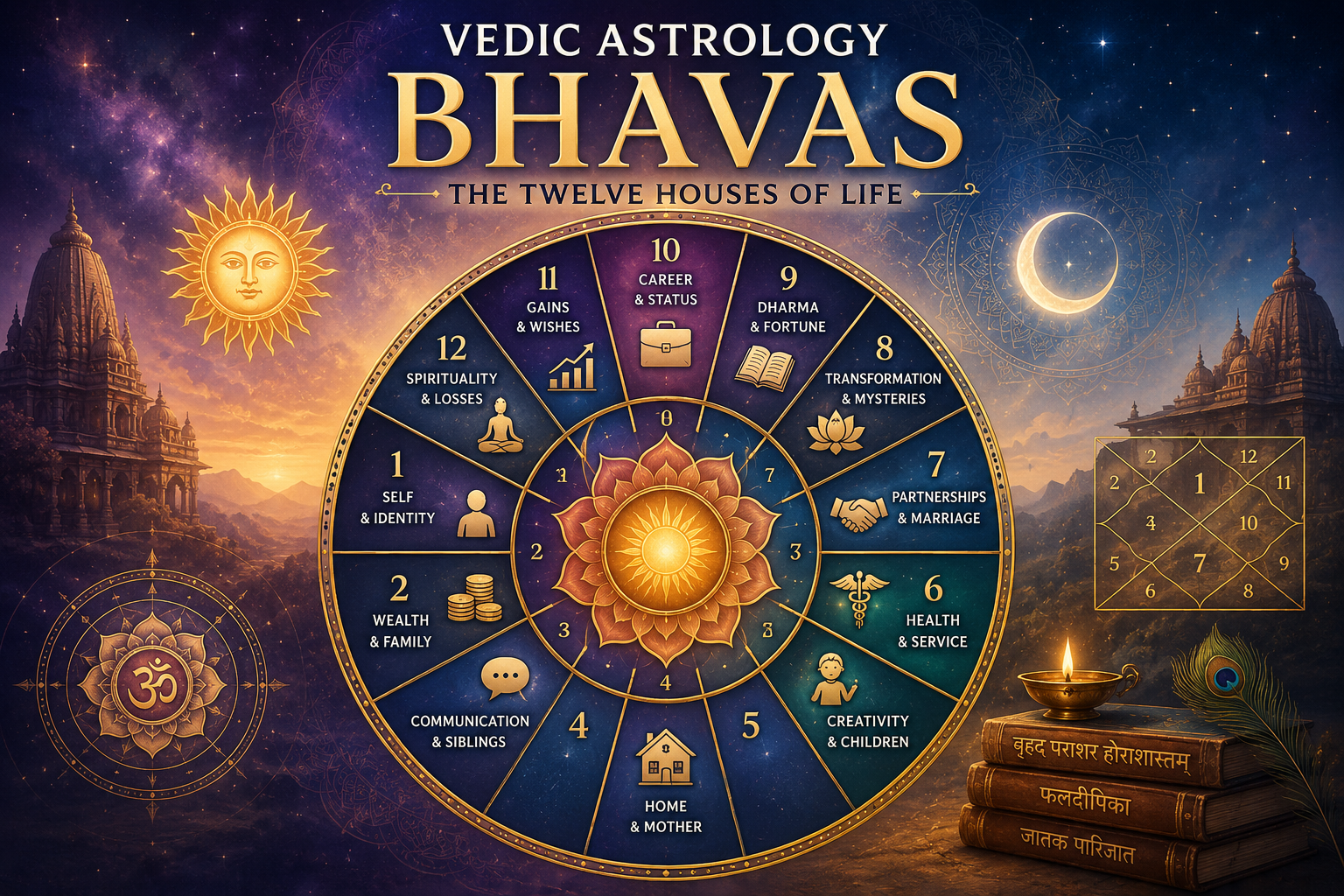
Every birth chart contains twelve houses. Each one governs a different aspect of existence, from personal identity and relationships to career, finances, family, and spiritual evolution.

While planets describe what energy is present, the houses reveal where that energy is likely to manifest.

This is one reason houses are considered among the most important components of chart interpretation.

🔮 Psychic Insight

Many astrologers compare the houses to chapters in the story of life. Every person experiences all twelve houses, but each chart emphasizes them differently.

What Are Bhavas?

The Sanskrit word Bhava can be translated as “state of being” or “field of experience.”

Each Bhava represents a specific area of life where lessons, opportunities, and growth take place.

Together, the twelve houses create a complete picture of human experience.

When astrologers interpret a birth chart, they examine:

  • Which planets occupy each house
  • The ruling planet of the house
  • Planetary aspects
  • The strength of the house itself

This helps reveal how different areas of life may unfold.

The First House: Self and Identity

The First House represents the self.

It governs:

  • Personality
  • Appearance
  • Self-image
  • Vitality
  • Approach to life

This house is often considered the foundation of the entire chart because it reflects how a person enters and experiences the world.

The Ascendant, or Rising Sign, begins here.

The Second House: Wealth and Values

The Second House relates to resources and stability.

It governs:

  • Finances
  • Income
  • Possessions
  • Speech
  • Personal values
  • Family resources

This house often reveals how an individual approaches security and material wellbeing.

The Third House: Communication and Courage

The Third House represents initiative and self-expression.

It governs:

  • Communication
  • Writing
  • Learning
  • Siblings
  • Short journeys
  • Courage
  • Personal effort

Strong Third House placements often appear in the charts of writers, speakers, marketers, and entrepreneurs.

✨ Did You Know?

In Vedic Astrology, the Third House is often associated with personal initiative and the willingness to create opportunities through effort and determination.

The Fourth House: Home and Emotional Foundations

The Fourth House governs inner security.

It relates to:

  • Home life
  • Family
  • Mother
  • Property
  • Emotional wellbeing
  • Roots and ancestry

This house often reveals where a person feels most comfortable and emotionally supported.

The Fifth House: Creativity and Self-Expression

The Fifth House is often associated with joy and personal expression.

It governs:

  • Creativity
  • Children
  • Romance
  • Education
  • Artistic pursuits
  • Personal talents

Many astrologers consider this one of the most inspiring houses in the chart.

The Sixth House: Service and Growth Through Challenge

The Sixth House represents daily responsibilities and personal improvement.

It governs:

  • Work routines
  • Health
  • Service
  • Discipline
  • Problem solving
  • Overcoming obstacles

Although sometimes viewed as challenging, this house often develops resilience and practical wisdom.

The Seventh House: Relationships and Partnership

The Seventh House governs one-to-one relationships.

It relates to:

  • Marriage
  • Romantic partnerships
  • Business partnerships
  • Contracts
  • Cooperation

This house often reveals what we seek in others and how we approach long-term commitment.

🌙 Spiritual Lesson

Relationships often become mirrors that help us understand ourselves more deeply. The Seventh House highlights many of those lessons.

The Eighth House: Transformation and Mystery

The Eighth House is one of the most misunderstood houses in astrology.

It governs:

  • Transformation
  • Shared resources
  • Inheritance
  • Psychological growth
  • Occult knowledge
  • Life transitions

This house often represents periods of profound change and personal evolution.

The Ninth House: Wisdom and Higher Learning

The Ninth House is associated with expansion and understanding.

It governs:

  • Spirituality
  • Philosophy
  • Higher education
  • Travel
  • Teachers
  • Life purpose

Many astrologers consider the Ninth House one of the most fortunate houses in the chart.

The Tenth House: Career and Public Life

The Tenth House represents achievement and visibility.

It governs:

  • Career
  • Reputation
  • Leadership
  • Recognition
  • Professional success

This house often reveals how a person contributes to society and pursues long-term goals.

The Eleventh House: Goals and Community

The Eleventh House governs expansion through connection.

It relates to:

  • Friendships
  • Networking
  • Groups
  • Long-term goals
  • Dreams and aspirations
  • Financial gains

This house often reflects the support systems that help us achieve success.

The Twelfth House: Spirituality and Liberation

The Twelfth House is often called the house of liberation.

It governs:

  • Spiritual growth
  • Meditation
  • Retreat
  • Intuition
  • Compassion
  • Inner healing

Many people discover profound spiritual insights through Twelfth House experiences.

It represents the journey inward.

The Four Goals of Life

One unique feature of Vedic Astrology is how the houses are grouped into four life purposes:

  • Dharma: Purpose and duty (1, 5, 9)
  • Artha: Wealth and resources (2, 6, 10)
  • Kama: Desires and relationships (3, 7, 11)
  • Moksha: Spiritual liberation (4, 8, 12)

These groupings add another layer of depth to chart interpretation and help reveal what motivates an individual throughout life.

Final Thoughts

The Twelve Bhavas form the framework upon which every Vedic birth chart is built.

Each house represents a different aspect of human experience, from personal identity and relationships to career, spirituality, and life purpose.

By understanding the houses, we gain a deeper appreciation for how life’s many experiences fit together as part of a larger journey.

🌟 Personalized Insight

Everyone has all twelve houses in their chart, but the planets occupying those houses create a unique life story. A personal Vedic Astrology reading can reveal which houses are most strongly influencing your relationships, career, finances, and spiritual path.


Related Vedic Astrology Topics

  • The Nine Grahas
  • What Are Nakshatras?
  • What Is Vimshottari Dasha?
  • The Navamsa Chart
  • Vedic Astrology Remedies

What Are Nakshatras? The Lunar Mansions of Vedic Astrology

What Are Nakshatras

What Are Nakshatras? The Lunar Mansions of Vedic Astrology

Have you ever met two people born under the same zodiac sign who seemed completely different?

Perhaps they shared the same Sun sign, yet one was outgoing and adventurous while the other was quiet and reflective.

This question has fascinated astrologers for centuries.

In Vedic Astrology, one of the answers lies in a powerful system known as the Nakshatras.

While many people are familiar with zodiac signs, far fewer have heard of the twenty-seven lunar mansions that add remarkable depth and detail to a birth chart.

In fact, many Vedic astrologers consider the Nakshatras to be among the most revealing components of chart interpretation.

If zodiac signs describe the broad landscape of life, Nakshatras often reveal the finer details that make each individual unique.

🔮 Psychic Insight

Many experienced Vedic astrologers begin chart analysis with the Moon’s Nakshatra because it often reveals emotional patterns, motivations, and life lessons that may not be obvious from zodiac signs alone.

What Is A Nakshatra?

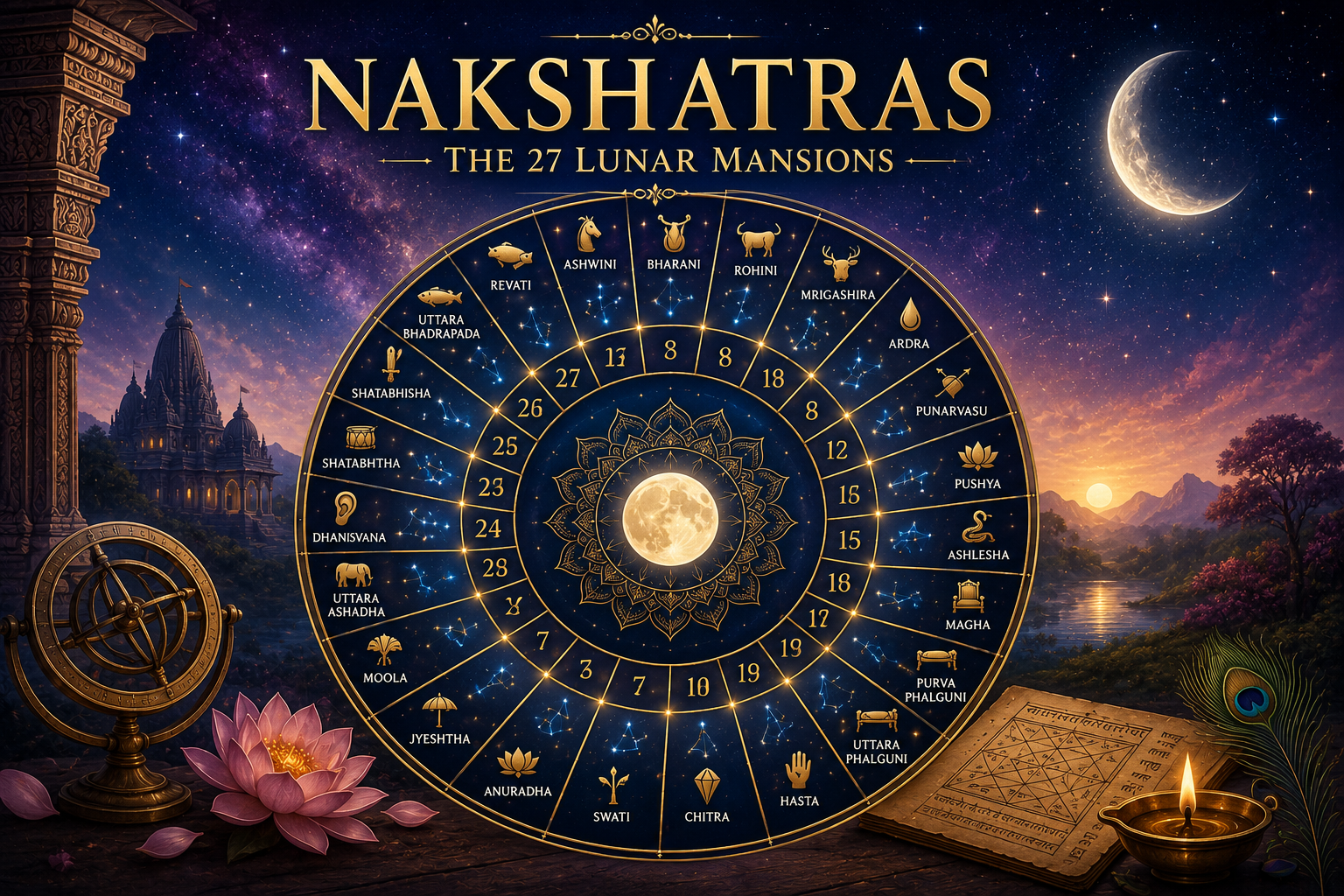
The word Nakshatra is often translated as “lunar mansion.”

In simple terms, the Nakshatras divide the zodiac into twenty-seven smaller sections.

Each Nakshatra spans approximately 13 degrees and 20 minutes of the zodiac.

As the Moon travels through the sky, it moves through these twenty-seven star fields during its monthly cycle.

Ancient Vedic astrologers carefully observed these movements and noticed that each section possessed its own distinct qualities and symbolism.

Over time, a sophisticated system developed linking each Nakshatra to mythology, personality traits, life lessons, spiritual themes, and karmic patterns.

Why Nakshatras Matter

Many people first encounter astrology through their Sun sign.

While this provides valuable insight, Vedic Astrology often places tremendous importance on the Moon.

The Moon represents:

  • Emotions
  • Instincts
  • Habits
  • Mental patterns
  • Relationships
  • Daily experience

Because the Nakshatras are closely connected to the Moon, they provide a deeper understanding of how an individual experiences life internally.

This additional layer helps explain why people with the same zodiac sign can express themselves in dramatically different ways.

The 27 Nakshatras

The Nakshatra system contains twenty-seven lunar mansions:

  • Ashwini
  • Bharani
  • Krittika
  • Rohini
  • Mrigashira
  • Ardra
  • Punarvasu
  • Pushya
  • Ashlesha
  • Magha
  • Purva Phalguni
  • Uttara Phalguni
  • Hasta
  • Chitra
  • Swati
  • Vishakha
  • Anuradha
  • Jyeshtha
  • Mula
  • Purva Ashadha
  • Uttara Ashadha
  • Shravana
  • Dhanishta
  • Shatabhisha
  • Purva Bhadrapada
  • Uttara Bhadrapada
  • Revati

Each possesses its own symbolism, ruling deity, planetary ruler, strengths, and life lessons.

Collectively they form one of the most detailed personality systems found in astrology.

✨ Did You Know?

Many astrologers consider the Nakshatra of the Moon to be more personally revealing than the Sun sign because it reflects how a person experiences life emotionally and psychologically.

Examples Of Nakshatra Energy

Each Nakshatra carries a unique flavor.

For example:

Ashwini is associated with speed, healing, new beginnings, and initiative.

Rohini is linked to creativity, beauty, growth, and attraction.

Magha often emphasizes ancestry, leadership, and personal authority.

Swati is associated with independence, flexibility, and personal freedom.

Revati frequently reflects compassion, guidance, protection, and spiritual awareness.

Even this brief overview demonstrates how much depth exists within the Nakshatra system.

Nakshatras And Relationships

Nakshatras play an important role in relationship analysis.

Traditional Vedic astrologers often examine Nakshatra compatibility when evaluating partnerships and marriage.

This process goes far beyond simply comparing zodiac signs.

Compatibility assessments may consider:

  • Emotional harmony
  • Communication styles
  • Shared values
  • Spiritual compatibility
  • Long-term relationship potential

Because the Nakshatras reveal deeper emotional tendencies, they often provide valuable insight into relationship dynamics.

Nakshatras And Life Purpose

Many astrologers believe the Nakshatras contain important clues about a person’s purpose and direction.

The Moon’s Nakshatra may highlight:

  • Natural talents
  • Motivations
  • Spiritual lessons
  • Personal strengths
  • Areas of growth

Rather than defining a fixed destiny, Nakshatras help illuminate the themes most likely to shape an individual’s journey.

🌙 Spiritual Lesson

The Nakshatras remind us that every soul expresses itself differently. Even people who share the same zodiac sign possess unique gifts, motivations, and spiritual lessons.

Nakshatras And Dashas

The Nakshatras also play an important role in Vedic predictive techniques.

The Moon’s Nakshatra at birth helps determine the starting point for the Vimshottari Dasha system.

This means the Nakshatras influence not only personality but also the timing of important life chapters.

Understanding this connection allows astrologers to gain deeper insight into how and when certain themes may unfold.

Why Nakshatras Feel So Accurate

One reason many people are drawn to Nakshatras is their remarkable specificity.

Traditional zodiac signs divide the sky into twelve sections.

Nakshatras divide it into twenty-seven.

This finer level of detail often creates interpretations that feel highly personal and surprisingly accurate.

Many students of astrology discover that their Nakshatra description resonates even more strongly than their zodiac sign.

Final Thoughts

The Nakshatras are among the greatest treasures of Vedic Astrology.

They add depth, nuance, and personality to the birth chart while providing valuable insight into emotions, relationships, life purpose, and spiritual growth.

For many astrologers, understanding the Moon’s Nakshatra opens the door to a deeper level of chart interpretation.

And for many individuals, it offers a fascinating glimpse into the unique story of the soul.

🌟 Personalized Insight

While learning about the Nakshatras is fascinating, discovering your own Moon Nakshatra often reveals the most meaningful insights. A complete birth chart can show how your Nakshatra influences relationships, career choices, emotional patterns, and spiritual development.


Related Vedic Astrology Topics

  • What Is Vedic Astrology?
  • The Nine Grahas
  • What Is Vimshottari Dasha?
  • Rahu and Ketu: The Karmic Nodes of Destiny
  • The Navamsa Chart

The Navamsa Chart Explained: Vedic Astrology’s Hidden Blueprint of the Soul

The Navamsa Chart in Vedic Astrology

The Navamsa Chart Explained: Vedic Astrology’s Hidden Blueprint of the Soul

Imagine reading only the cover of a book and believing you understand the entire story.

That’s how many Vedic astrologers view birth chart interpretation without examining the Navamsa Chart.

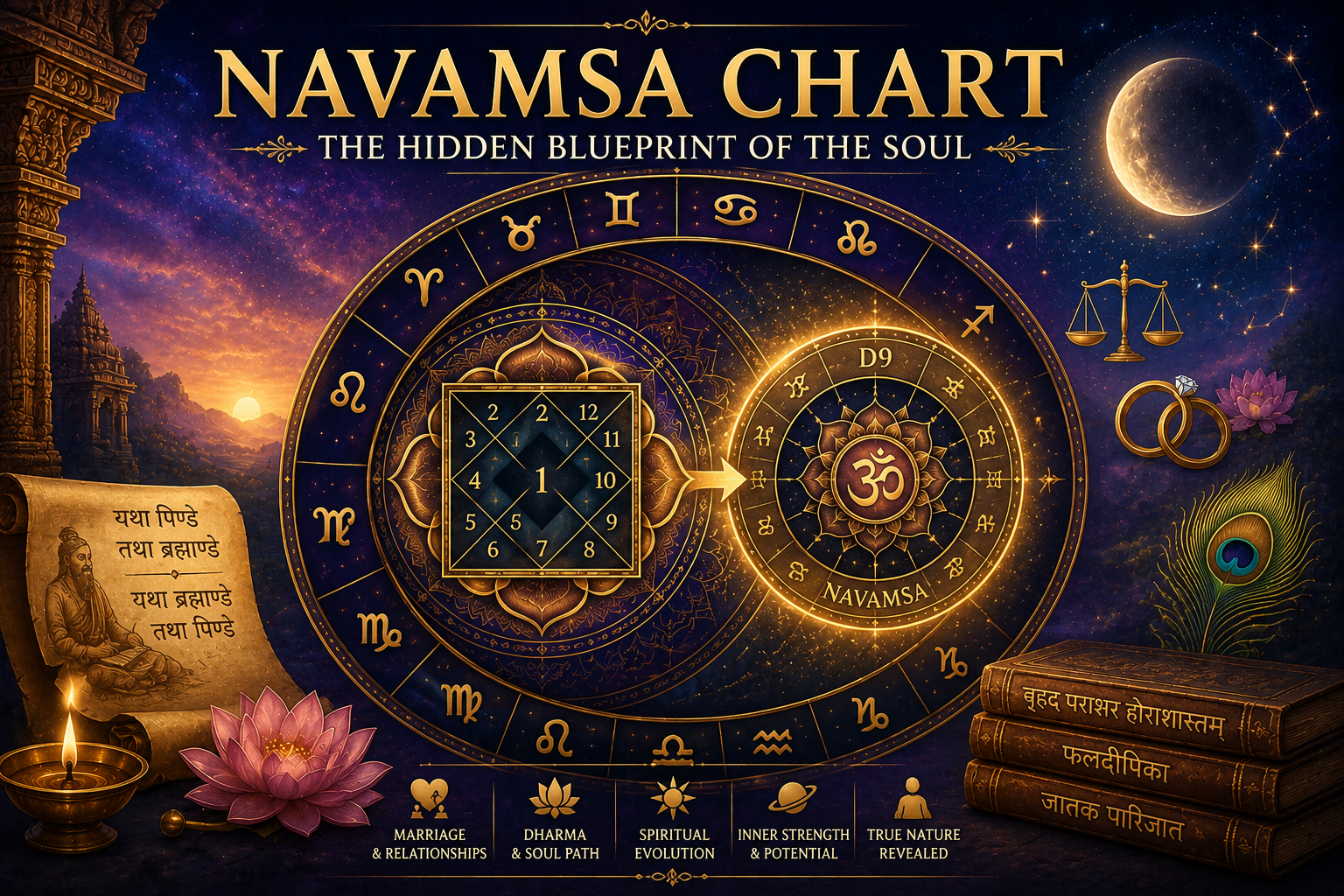
Known as the D9 Chart, the Navamsa is one of the most important and respected divisional charts in all of Vedic Astrology.

Many astrologers consider it so important that they refuse to interpret a birth chart without it.

Why?

Because the Navamsa often reveals the deeper layer beneath the surface.

While the birth chart shows what is visible, the Navamsa frequently reveals hidden strengths, spiritual development, relationship patterns, and the soul’s unfolding potential.

Some astrologers even refer to it as the chart of destiny within the chart of destiny.

🔮 Psychic Insight

Many Vedic astrologers believe the birth chart describes the vehicle, while the Navamsa reveals the driver. Together they provide a far more complete picture than either chart alone.

What Is The Navamsa Chart?

The word Navamsa means “one-ninth division.”

In this system, each zodiac sign is divided into nine equal sections.

These divisions create a secondary chart known as the D9 or Navamsa Chart.

While this may sound technical, the purpose is surprisingly simple.

The Navamsa provides a more refined view of planetary strength and expression.

Think of the birth chart as a wide-angle photograph.

The Navamsa acts like a zoom lens, allowing astrologers to examine details that may not be immediately visible.

Why Is The Navamsa So Important?

Many charts appear straightforward at first glance.

A planet may seem strong.

A relationship indicator may appear favorable.

A career placement may look promising.

However, the Navamsa often reveals whether those potentials can fully develop over time.

This is why experienced astrologers frequently say:

“The birth chart shows promise. The Navamsa shows maturity.”

In many ways, the Navamsa reveals how planetary energies evolve as a person grows and gains life experience.

✨ Did You Know?

Many classical astrologers consider the Navamsa nearly as important as the birth chart itself. Some even view it as the chart that reveals the deeper purpose behind life’s experiences.

The Navamsa And Relationships

One reason the Navamsa receives so much attention is its connection to relationships and marriage.

Traditionally, the D9 Chart is closely associated with:

  • Marriage
  • Long-term partnerships
  • Relationship growth
  • Commitment
  • Emotional maturity

This does not mean the Navamsa only concerns marriage.

However, many astrologers use it to better understand how relationship patterns may unfold throughout life.

In some cases, a challenging birth chart placement becomes significantly more supportive when examined through the Navamsa.

In other situations, the Navamsa may reveal lessons that require patience and growth.

The Soul Beneath The Personality

The birth chart often describes how we interact with the outer world.

The Navamsa frequently reveals the inner person developing beneath that surface.

For this reason, many astrologers associate the D9 Chart with:

  • Spiritual development
  • Personal evolution
  • Inner wisdom
  • Character formation
  • Soul growth

As people mature, they often begin expressing more of their Navamsa qualities.

This is one reason individuals sometimes feel dramatically different at age fifty than they did at age twenty.

The deeper layers of the chart gradually emerge.

Planetary Strength In The Navamsa

One of the most valuable uses of the Navamsa involves evaluating planetary strength.

A planet may appear strong in the birth chart but weaker in the Navamsa.

Alternatively, a planet that seems average in the birth chart may become significantly more powerful when viewed through the D9 Chart.

This additional perspective helps astrologers avoid oversimplified interpretations.

Instead of judging a placement from only one angle, they examine how it performs across multiple layers of the chart.

🌙 Spiritual Lesson

The Navamsa reminds us that true character develops over time. What appears hidden today may become one of tomorrow’s greatest strengths.

Vargottama: A Special Navamsa Condition

One of the most celebrated conditions involving the Navamsa is known as Vargottama.

This occurs when a planet occupies the same sign in both the birth chart and the Navamsa Chart.

Many astrologers view this as a sign of consistency and strength.

The planet’s qualities may express themselves more clearly because its energy remains aligned across multiple chart layers.

While not automatically positive or negative, Vargottama placements often attract special attention during chart analysis.

The Navamsa And Destiny

Some astrologers describe the Navamsa as a chart of destiny.

Others view it as a chart of spiritual evolution.

Both perspectives contain truth.

The Navamsa often reveals how life’s experiences shape a person over time.

Rather than focusing only on external events, it highlights internal growth and long-term development.

This makes it particularly valuable for individuals seeking deeper understanding rather than simple prediction.

Why Beginners Overlook The Navamsa

Many astrology students spend years studying planets, signs, and houses before discovering divisional charts.

Once they encounter the Navamsa, however, everything changes.

Relationships become easier to understand.

Planetary strengths become clearer.

Spiritual themes become more visible.

The chart gains an entirely new dimension.

For this reason, many astrologers consider the Navamsa one of the most rewarding subjects within Vedic Astrology.

Final Thoughts

The Navamsa Chart is far more than a technical calculation.

It is a powerful tool for understanding relationships, personal growth, spiritual development, and the deeper expression of planetary energies.

While the birth chart provides the foundation, the Navamsa often reveals the hidden blueprint guiding life’s evolution.

Together, these two charts create one of the most sophisticated systems of self-understanding found in astrology.

🌟 Personalized Insight

Your Navamsa Chart may reveal strengths, relationship patterns, and spiritual themes that are not immediately visible in your birth chart alone. Examining both charts together often provides a much deeper understanding of your life’s purpose and potential.


Related Vedic Astrology Topics

  • Vedic Astrology Houses
  • What Are Nakshatras?
  • What Is Vimshottari Dasha?
  • Vedic Astrology Yogas
  • Vedic Astrology Remedies

Vedic Astrology Remedies: Mantras, Gemstones, Charity, and Spiritual Practices

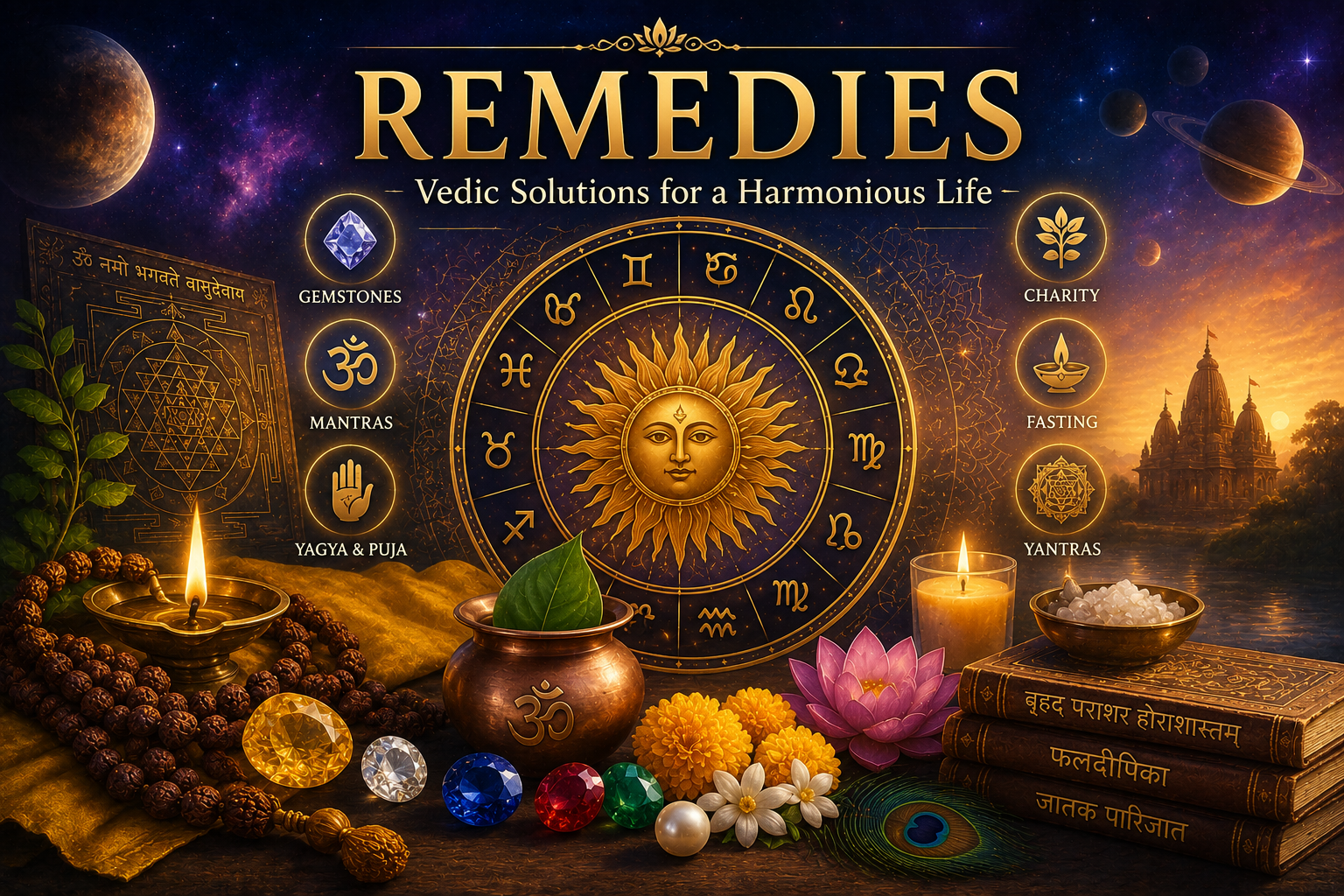
Vedic Astrology Remedies

Vedic Astrology Remedies: Mantras, Gemstones, Charity, and Spiritual Practices

One of the most unique aspects of Vedic Astrology is that it does not stop at identifying challenges.

Many systems of astrology focus primarily on describing personality traits, strengths, weaknesses, and future possibilities.

Vedic Astrology certainly does those things, but it also goes one step further.

It offers remedies.

For thousands of years, astrologers, spiritual teachers, and practitioners have used specific techniques designed to strengthen beneficial influences while helping individuals navigate difficult planetary periods.

These practices are known as Vedic Remedies.

Whether viewed as spiritual tools, symbolic rituals, or methods for increasing awareness and focus, remedies remain one of the most fascinating and widely discussed subjects within Vedic Astrology.

🔮 Psychic Insight

Vedic remedies are not designed to “erase” karma. Instead, many astrologers view them as tools that help individuals work more consciously with the lessons and opportunities indicated in their birth chart.

Why Are Remedies Used?

Imagine receiving a weather forecast that predicts heavy rain tomorrow.

The forecast itself does not create the weather.

It simply provides information.

You still have choices.

You can bring an umbrella.

You can adjust your plans.

You can prepare in advance.

Vedic remedies are often viewed in a similar way.

Astrology identifies potential influences.

Remedies provide methods for responding consciously to those influences.

The goal is not fear.

The goal is awareness, balance, and spiritual growth.

The Philosophy Behind Remedies

Traditional Vedic Astrology teaches that life contains both free will and karma.

While certain life lessons may be indicated within the birth chart, individuals are not powerless.

Actions matter.

Intentions matter.

Choices matter.

Remedies are based upon the belief that conscious effort can help align a person with more constructive expressions of planetary energy.

Rather than passively waiting for events to occur, remedies encourage participation in one’s own growth and development.

✨ Did You Know?

Many traditional remedies focus less on changing external circumstances and more on developing inner qualities such as patience, generosity, discipline, gratitude, and spiritual awareness.

Mantras: The Power Of Sacred Sound

Among the most common Vedic remedies are Mantras.

A mantra is a sacred sound, word, or phrase repeated during meditation or spiritual practice.

Each Graha has mantras traditionally associated with it.

For example:

  • Sun (Surya) Mantras may emphasize confidence and vitality.
  • Moon (Chandra) Mantras may encourage emotional balance.
  • Jupiter (Guru) Mantras may support wisdom and spiritual growth.
  • Saturn (Shani) Mantras may promote patience and discipline.

Many practitioners believe regular mantra practice helps focus the mind while strengthening positive planetary qualities.

Gemstones In Vedic Astrology

One of the most widely known Vedic remedies involves gemstones.

Traditional astrology associates certain gemstones with specific planets.

Examples include:

  • Ruby – Sun
  • Pearl – Moon
  • Red Coral – Mars
  • Emerald – Mercury
  • Yellow Sapphire – Jupiter
  • Diamond – Venus
  • Blue Sapphire – Saturn

The theory behind gemstone remedies is that properly selected stones may strengthen beneficial planetary influences.

However, most experienced astrologers caution against choosing gemstones without proper chart analysis.

A gemstone that benefits one person may not be appropriate for another.

Yantras: Sacred Geometric Symbols

Another traditional remedy involves the use of Yantras.

A Yantra is a sacred geometric design associated with specific spiritual principles or planetary energies.

These symbols are often used during meditation, prayer, or ritual practices.

Many practitioners view Yantras as visual tools that help focus intention and awareness.

While less familiar to Western audiences than gemstones, Yantras remain an important part of traditional Vedic practice.

🌙 Spiritual Lesson

The most powerful remedies often begin within. Self-awareness, compassion, discipline, and conscious action remain among the most valuable tools for personal transformation.

Charity And Service

One of the most respected remedies in Vedic Astrology is surprisingly simple:

Helping others.

Acts of charity and service are frequently recommended because they encourage generosity, humility, and positive action.

Examples may include:

  • Supporting charitable organizations
  • Volunteering
  • Helping those in need
  • Donating food
  • Contributing to community projects

Many astrologers consider charitable actions among the most effective remedies because they create positive impact while encouraging personal growth.

Fasting And Spiritual Discipline

Traditional remedies sometimes include fasting or observing special spiritual practices on days associated with particular planets.

For example:

  • Sunday – Sun
  • Monday – Moon
  • Tuesday – Mars
  • Wednesday – Mercury
  • Thursday – Jupiter
  • Friday – Venus
  • Saturday – Saturn

These practices are often less about restriction and more about cultivating mindfulness, discipline, and intentional living.

Remedies During Difficult Dashas

Remedies are frequently recommended during challenging planetary periods.

For example, a person experiencing a difficult Saturn or Rahu Dasha may seek guidance regarding:

  • Meditation practices
  • Mantras
  • Charitable activities
  • Spiritual study
  • Personal development

The objective is not to avoid life’s lessons but to navigate them more consciously.

Do Remedies Really Work?

This question has been debated for centuries.

Some people view remedies as sacred spiritual practices.

Others see them as psychological tools that encourage positive habits and personal responsibility.

Many people combine both perspectives.

Regardless of one’s beliefs, remedies often encourage reflection, discipline, gratitude, and intentional action—qualities that can benefit virtually anyone.

The Most Important Remedy Of All

Among all remedies discussed in Vedic Astrology, one consistently stands above the rest:

Self-awareness.

The birth chart may reveal patterns.

Dashas may reveal timing.

Yogas may reveal potential.

Yet personal growth ultimately depends upon how we respond to life’s experiences.

Awareness transforms knowledge into wisdom.

And wisdom often becomes the greatest remedy of all.

Final Thoughts

Vedic remedies represent one of the most practical dimensions of Vedic Astrology.

Rather than focusing solely on prediction, they encourage active participation in personal growth and spiritual development.

Whether through mantras, meditation, charity, gemstones, Yantras, or simple acts of kindness, remedies remind us that awareness and conscious action remain powerful forces for transformation.

Ultimately, the purpose of astrology is not merely to understand life—it is to live it more wisely.

🌟 Personalized Insight

Not every remedy is appropriate for every chart. A personalized Vedic Astrology reading can help identify which planetary influences are most significant in your life and which remedies may be most meaningful for your unique circumstances.


Related Vedic Astrology Topics

  • What Is Vimshottari Dasha?
  • The Nine Grahas
  • Vedic Astrology Yogas
  • The Navamsa Chart
  • Understanding Karma Through Vedic Astrology

Rahu and Ketu: The Karmic Nodes of Destiny in Vedic Astrology

Rahu and Ketu in Vedic Astrology

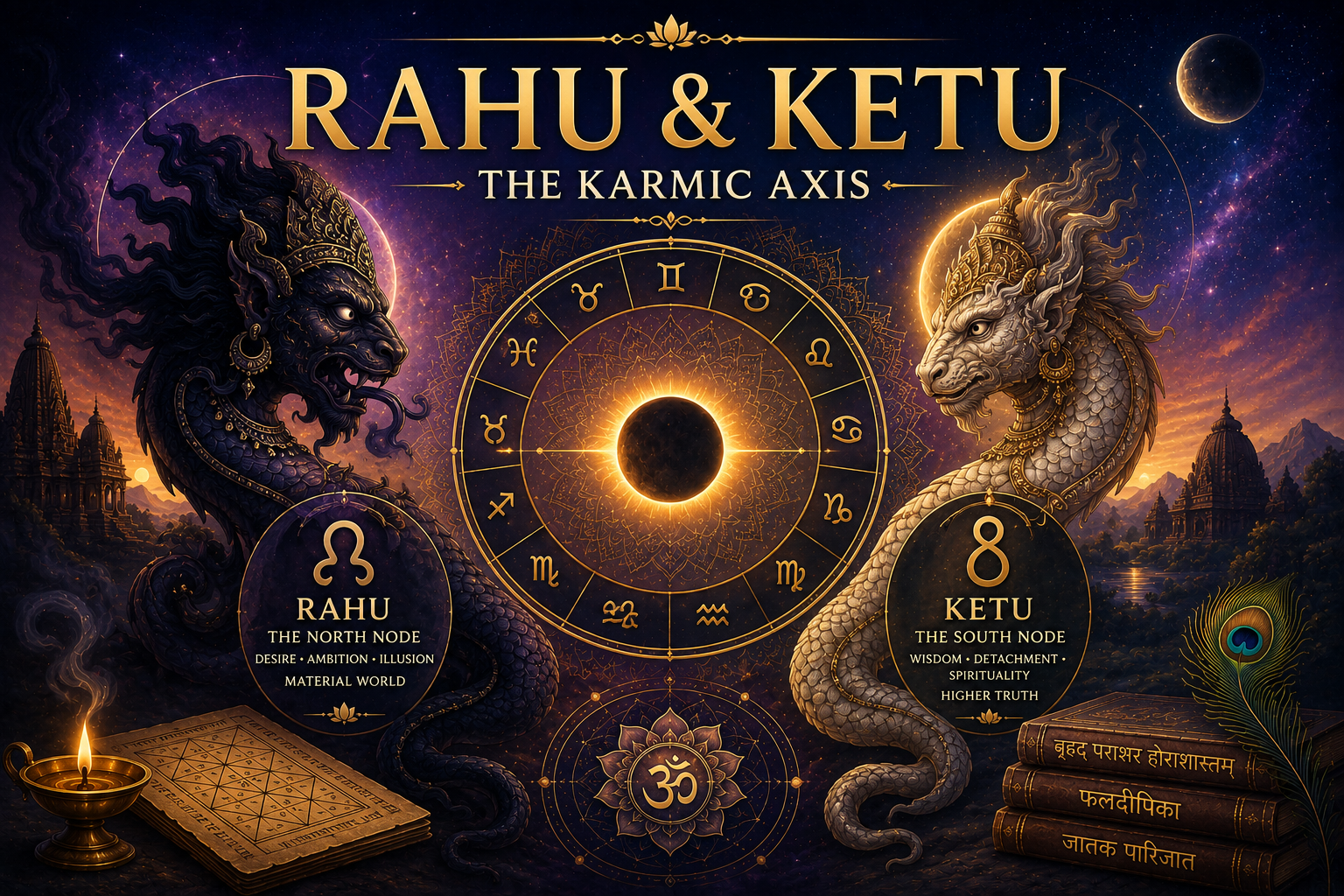
Rahu and Ketu: The Karmic Nodes of Destiny

Among all the influences found in a Vedic birth chart, few generate more fascination than Rahu and Ketu.

Unlike the Sun, Moon, or planets, Rahu and Ketu are not physical celestial bodies. You cannot see them through a telescope. Yet many astrologers consider them among the most important factors in an entire chart.

Why?

Because Rahu and Ketu are believed to reveal the soul’s journey between what is familiar and what is still waiting to be learned.

They form what astrologers often call the Karmic Axis, a symbolic line connecting past experiences, present challenges, and future growth.

While every planet contributes to the story of a birth chart, Rahu and Ketu often reveal why that story is unfolding in the first place.

🔮 Psychic Insight

Many Vedic astrologers view Rahu and Ketu as indicators of the soul’s evolutionary path. Together they highlight where growth is needed and where wisdom has already been gained.

What Are Rahu and Ketu?

Astronomically, Rahu and Ketu represent the points where the orbit of the Moon intersects the apparent path of the Sun.

These points are known as the lunar nodes.

In Western Astrology they are often called the North Node and South Node.

In Vedic Astrology, however, Rahu and Ketu are far more than mathematical points. They are treated as powerful Grahas that influence destiny, life direction, and spiritual development.

Rahu is known as the North Node.

Ketu is known as the South Node.

Together they always appear directly opposite one another in the birth chart.

The Story Behind Rahu and Ketu

Ancient Vedic mythology tells the story of a celestial being who disguised himself among the gods in order to drink the nectar of immortality.

Before he could fully consume it, he was discovered.

The god Vishnu severed his head from his body.

Because the nectar had already touched him, both parts remained immortal.

The head became Rahu.

The body became Ketu.

This symbolism remains deeply embedded within Vedic Astrology.

Rahu, the head without a body, constantly desires more.

Ketu, the body without a head, often represents detachment, wisdom, and experiences that no longer require conscious pursuit.

Rahu: The Great Desire

Rahu is often associated with ambition, obsession, curiosity, innovation, and worldly achievement.

It represents areas where the soul seeks new experiences and unfamiliar lessons.

Rahu wants growth.

Rahu wants expansion.

Rahu wants to explore territory that feels exciting, uncomfortable, and unknown.

Depending on its placement, Rahu may create strong desires involving:

  • Career success
  • Recognition
  • Relationships
  • Wealth
  • Technology
  • Travel
  • Spiritual knowledge
  • Personal achievement

Because Rahu is associated with desire, it can sometimes create restlessness.

No matter how much is achieved, Rahu often continues searching for more.

✨ Did You Know?

Many astrologers associate Rahu with innovation, foreign cultures, technology, media, and unconventional life paths. Rahu often encourages people to explore experiences outside their comfort zone.

Ketu: The Wise Sage

If Rahu represents the future, Ketu often represents the past.

Ketu is associated with wisdom, detachment, spirituality, introspection, and inner understanding.

Where Rahu seeks experience, Ketu seeks meaning.

Where Rahu says “I want more,” Ketu often says “I’ve already been there.”

Ketu may indicate natural talents or areas where the soul already possesses experience and familiarity.

Because of this, Ketu can create both strengths and challenges.

While it often grants insight and intuition, it can also produce feelings of boredom or detachment toward areas that once seemed important.

Its lessons frequently involve learning when to release attachment and trust inner wisdom.

The Karmic Axis

The true power of Rahu and Ketu emerges when viewed together.

They form a single axis connecting past and future.

Comfort and growth.

Wisdom and exploration.

Familiarity and discovery.

Imagine a person who feels naturally comfortable in one area of life but repeatedly encounters opportunities pushing them toward something entirely different.

That tension often reflects the dynamic relationship between Rahu and Ketu.

The soul may already understand one side of the axis while still learning the lessons represented by the other.

🌙 Spiritual Lesson

Growth often requires moving beyond what feels comfortable. Rahu invites exploration, while Ketu reminds us to carry wisdom from the past into the future.

Rahu and Ketu Through The Houses

The house placement of Rahu and Ketu reveals where these karmic themes are most likely to appear.

For example:

  • Rahu in the 10th House may emphasize career growth and public recognition.
  • Ketu in the 4th House may create lessons involving family, roots, and emotional security.
  • Rahu in the 7th House may intensify relationship experiences.
  • Ketu in the 1st House may encourage spiritual development and self-understanding.

Every placement tells a different story, which is why the entire chart must be considered before drawing conclusions.

Rahu and Ketu During Dashas

The influence of Rahu and Ketu often becomes especially noticeable during their planetary periods, known as Dashas.

Many people report significant life changes during Rahu or Ketu Dashas.

These periods may involve:

  • Major career shifts
  • New relationships
  • Spiritual awakenings
  • Unexpected opportunities
  • Changes in priorities
  • Life-changing decisions

Because Rahu and Ketu operate on a karmic level, their Dashas often feel particularly meaningful and transformative.

Are Rahu and Ketu Good or Bad?

This is one of the most common questions asked by astrology students.

The answer is surprisingly simple:

Neither.

Rahu and Ketu are not inherently positive or negative.

They are teachers.

Like all teachers, they may challenge us.

They may push us beyond familiar territory.

Yet those very experiences often produce tremendous growth and self-awareness.

Understanding Rahu and Ketu requires looking beyond simple labels and recognizing their role in the soul’s evolution.

Final Thoughts

Rahu and Ketu occupy a unique place within Vedic Astrology.

They represent the tension between where we have been and where we are going.

One points toward growth and new experiences.

The other points toward wisdom and understanding already gained.

Together they create one of the most powerful indicators of destiny found within a birth chart.

By understanding this karmic axis, we gain insight into the lessons, opportunities, and experiences shaping our life’s journey.

🌟 Personalized Insight

The placement of Rahu and Ketu is highly personal. While general interpretations provide useful guidance, a complete birth chart reveals how these karmic forces uniquely influence your relationships, career, spiritual growth, and life direction.


Related Vedic Astrology Topics

  • The Nine Grahas
  • Understanding Karma Through Vedic Astrology
  • What Are Nakshatras?
  • What Is Vimshottari Dasha?
  • The Navamsa Chart

The Nine Grahas: Understanding the Planets of Vedic Astrology

The Nine Grahas of Vedic Astrology

The Nine Grahas: Understanding the Planets of Vedic Astrology

Imagine meeting nine powerful teachers, each carrying a different lesson about life.

One teaches confidence and leadership.

Another teaches patience and responsibility.

One inspires love and creativity.

Another pushes you toward growth through challenge.

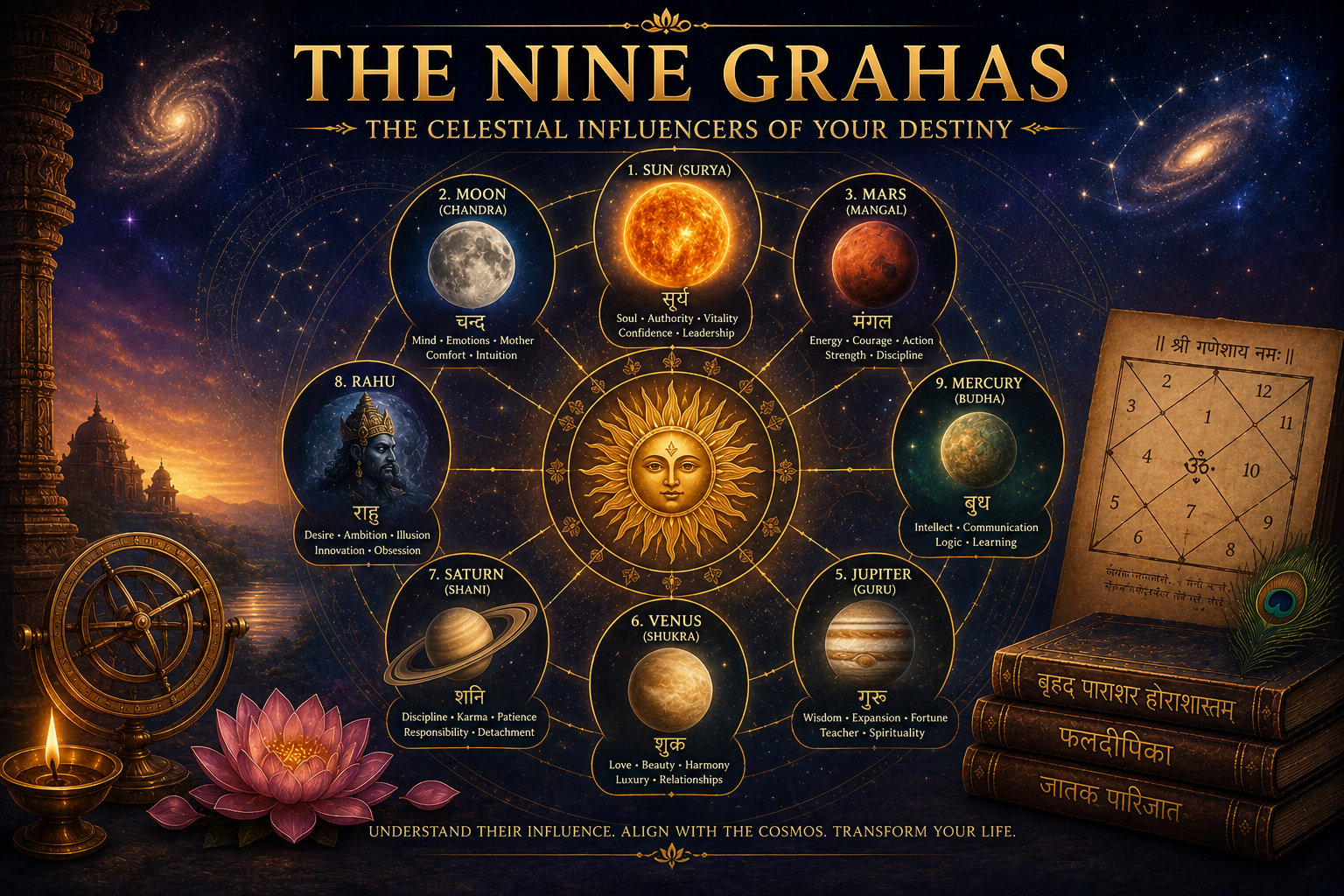
In Vedic Astrology, these cosmic teachers are known as the Nine Grahas.

The Sanskrit word Graha is often translated as “planet,” but its meaning is actually broader. Graha literally means “that which grasps” or “that which influences.”

Rather than viewing planets as giant rocks floating through space, Vedic Astrology sees them as symbolic forces that shape human experience.

Together, the Nine Grahas create the energetic blueprint that astrologers interpret within a birth chart.

🔮 Psychic Insight

In Vedic Astrology, planets are not considered “good” or “bad.” Each Graha represents a teacher. Some lessons are easier than others, but every Graha contributes to personal growth and spiritual evolution.

What Are The Nine Grahas?

The Nine Grahas include seven visible celestial bodies and two karmic points known as the lunar nodes.

Each Graha governs specific qualities, life experiences, and areas of personal development.

Surya: The Sun

The Sun represents identity, vitality, confidence, leadership, and personal authority.

It symbolizes the soul’s desire to shine and express its unique purpose.

A strong Sun often indicates natural leadership abilities, confidence, and a desire to make an impact.

When challenged, the Sun may bring lessons involving ego, pride, self-esteem, or personal recognition.

In many ways, the Sun asks:

“How will you express your true self?”

Chandra: The Moon

The Moon governs emotions, intuition, habits, memories, and daily experiences.

While the Sun reflects identity, the Moon reflects how life is emotionally experienced.

This is one reason the Moon plays such an important role in Vedic Astrology.

The Moon often reveals:

  • Emotional needs
  • Instinctive reactions
  • Comfort zones
  • Mental patterns
  • Inner security

Many astrologers consider the Moon one of the most important placements in an entire chart.

Mangala: Mars

Mars represents energy, ambition, courage, determination, and action.

It governs the drive to pursue goals and overcome obstacles.

A strong Mars can create confidence, leadership, and competitive spirit.

When poorly expressed, Mars may manifest as impatience, conflict, or impulsive behavior.

Mars constantly asks:

“What are you willing to fight for?”

✨ Did You Know?

Mars is often associated with warriors, athletes, entrepreneurs, and anyone willing to take decisive action toward their goals.

Budha: Mercury

Mercury governs communication, learning, reasoning, business, and intellectual pursuits.

It reflects how information is processed and shared.

People with strong Mercury placements often enjoy:

  • Writing
  • Teaching
  • Languages
  • Sales
  • Problem-solving
  • Negotiation

Mercury thrives on curiosity and adaptability.

Guru: Jupiter

Jupiter is considered one of the most beneficial planets in Vedic Astrology.

Known as Guru, Jupiter symbolizes wisdom, knowledge, growth, abundance, and spiritual understanding.

Jupiter encourages expansion in both material and spiritual dimensions of life.

Its lessons often involve:

  • Faith
  • Learning
  • Ethics
  • Teaching
  • Generosity
  • Personal growth

Jupiter reminds us that true success often begins with wisdom.

Shukra: Venus

Venus governs beauty, love, pleasure, relationships, art, creativity, and enjoyment.

It reflects what we value and how we connect with others.

Venus often influences:

  • Romance
  • Marriage
  • Aesthetics
  • Luxury
  • Artistic expression
  • Personal values

While Venus enjoys life’s pleasures, it also teaches the importance of balance and meaningful connection.

Shani: Saturn

Few planets inspire more curiosity than Saturn.

Known as Shani, Saturn is often associated with responsibility, discipline, structure, patience, and long-term growth.

Although Saturn sometimes receives a fearful reputation, many astrologers consider it one of life’s greatest teachers.

Saturn teaches:

  • Persistence
  • Commitment
  • Maturity
  • Accountability
  • Wisdom through experience

Its lessons may take time, but they often produce lasting results.

🌙 Spiritual Lesson

Saturn reminds us that some of life’s greatest rewards require patience, perseverance, and personal responsibility.

Rahu: The Great Desire

Rahu is not a physical planet.

It is one of the lunar nodes and represents ambition, desire, obsession, innovation, and unfamiliar experiences.

Rahu often pushes people beyond their comfort zones.

Its influence may create a strong desire for growth, achievement, recognition, or exploration.

In many charts, Rahu points toward areas where significant growth and learning will occur.

Ketu: The Wise Sage

Ketu forms the opposite end of the karmic axis.

While Rahu seeks new experiences, Ketu often represents wisdom gained through past experiences.

Ketu is associated with:

  • Detachment
  • Spirituality
  • Introspection
  • Past-life themes
  • Inner wisdom

Where Rahu says “more,” Ketu often says “you’ve already been here.”

Together, Rahu and Ketu reveal powerful clues about the soul’s journey.

Why The Grahas Matter

Every birth chart contains all nine Grahas.

Their positions, relationships, strengths, and timing cycles create a unique pattern that influences personality, relationships, career, finances, spiritual growth, and life experiences.

No single Graha determines destiny.

Instead, astrologers study how all nine interact with one another to understand the larger story unfolding within the chart.

Final Thoughts

The Nine Grahas form the foundation of Vedic Astrology.

Each represents a different aspect of life and consciousness.

Some teach through opportunity.

Others teach through challenge.

All contribute to the soul’s journey.

Understanding these cosmic influences provides a deeper appreciation for the complexity and wisdom contained within the Vedic birth chart.

🌟 Personalized Insight

While understanding the Nine Grahas provides valuable insight, their true meaning emerges through their placement in your unique birth chart. The same planet can express itself very differently depending on its sign, house, and relationships with other Grahas.


Related Vedic Astrology Topics

  • Rahu and Ketu: The Karmic Nodes of Destiny
  • What Are Nakshatras?
  • What Is Vimshottari Dasha?
  • Vedic Astrology Houses
  • The Navamsa Chart