.83¢/min Intro Offer

We Charge 60% LESS than our competitors!

All Psychics tested before hire.

Monthly Archives: June 2026

Root Chakra Meaning: Grounding, Psychic Protection, and Spiritual Stability

Root Chakra Meaning: Grounding, Psychic Protection, and Spiritual Stability

Root Chakra Meaning: Grounding, Psychic Protection, Spiritual Stability, and the Foundation of Intuition

Quick Summary

Sanskrit Name: Muladhara

Meaning: Root Support

Location: Base of the spine

Color: Red

Element: Earth

Mantra: Lam

Primary Themes: grounding, security, survival, stability, protection, physical vitality, boundaries, and belonging.

Psychic Connection: grounding before readings, psychic protection, energy boundaries, mediumship safety, preventing energetic overwhelm, and staying centered while working with tarot, runes, dreams, or spirit messages.

Associated Tarot Cards: The Emperor, The Hierophant, Four of Pentacles, Ten of Pentacles.

Associated Runes: Fehu, Uruz, Othala, Eihwaz.

Associated I Ching Hexagrams: Hexagram 2 – The Receptive, Hexagram 8 – Holding Together, Hexagram 24 – Return.

Key Takeaways

The Root Chakra forms the energetic foundation of the entire chakra system. While many spiritual seekers focus immediately on clairvoyance, spirit communication, or opening the Third Eye, experienced practitioners understand that spiritual growth begins with grounding.

A balanced Root Chakra helps create emotional stability, healthy boundaries, practical focus, and a sense of safety. For psychics, tarot readers, mediums, rune practitioners, and dream interpreters, the Root Chakra acts like an anchor. It helps keep awareness connected to reality while exploring intuitive or spiritual information.

Without grounding, intuition may become confusing. Without stability, spiritual experiences may become difficult to interpret. The Root Chakra teaches that true spiritual development begins with a strong foundation.

What Is the Root Chakra?

The Root Chakra, known in Sanskrit as Muladhara, is the first chakra in the traditional seven-chakra system. The Sanskrit word is commonly understood as Mula, meaning root, and Adhara, meaning support or foundation. Together, Muladhara means "root support."

This description perfectly reflects the role of the Root Chakra. Just as a tree requires strong roots to withstand storms, spiritual development requires a stable foundation. Every other chakra builds upon the qualities represented by the Root Chakra. When this center is balanced, a person often feels secure, grounded, resilient, and capable of handling life's challenges. When imbalanced, fear, insecurity, anxiety, and instability may become more noticeable.

The Root Chakra is not the most glamorous chakra. It does not promise dramatic visions or mystical revelations. Instead, it provides something far more important: a stable foundation upon which spiritual growth can safely occur.

Historical Origins of Muladhara

The chakra system originated within ancient Indian spiritual traditions. Early yogic and tantric teachings described subtle energy channels known as nadis, through which life-force energy was believed to move. Over time, practitioners identified major energetic centers along the body's central axis. Muladhara became associated with physical existence, survival, stability, incarnation, and connection to the earth.

Ancient teachings recognized a principle that remains useful today: spiritual growth cannot flourish when basic survival fears dominate awareness. Before a person can focus on wisdom, intuition, or spiritual awakening, they often need some sense of stability in the physical world. Modern concerns such as finances, health, housing, employment, family security, and personal safety all reflect Root Chakra themes.

Although the world has changed dramatically since ancient times, the fundamental human need for safety remains the same. The Root Chakra gives spiritual language to that need.

Traditional Symbolism

The Root Chakra is traditionally represented by a four-petaled lotus. Its color is red, its element is earth, and its bija mantra is Lam. The red color symbolizes vitality, strength, physical energy, courage, and life force. The earth element symbolizes stability, endurance, reliability, structure, and support.

Traditional Root Chakra symbols also often include a square. The square represents structure, order, stability, and foundation. It reminds us that growth requires support. Without a strong foundation, even the highest spiritual aspirations become unsteady.

Why the Root Chakra Matters for Psychic Development

One of the biggest misconceptions about psychic development is the belief that intuition exists separately from ordinary life. Many beginners immediately focus on Third Eye activation, clairvoyance, spirit communication, and psychic visions. Experienced practitioners often emphasize something very different: ground first.

Before attempting to expand awareness, it is essential to create stability. The Root Chakra helps psychics remain emotionally balanced, avoid energetic overwhelm, maintain objectivity, establish healthy boundaries, and interpret information more clearly. Many professional readers perform grounding exercises before and after every session. This simple habit helps separate personal emotions from client energy and reduces psychic fatigue.

Without grounding, intuitive impressions can become distorted by fear, anxiety, personal projection, or emotional reactivity. The Root Chakra supports clarity by keeping awareness centered in the present moment.

Root Chakra and Psychic Protection

Psychic protection is often misunderstood. Protection does not mean fear. Protection means maintaining healthy energetic boundaries. The Root Chakra contributes to protection by encouraging discernment, self-awareness, practical thinking, emotional stability, and grounded decision-making.

Many practitioners visualize roots extending into the earth before readings. Others carry grounding stones such as Black Tourmaline, Hematite, Obsidian, or Smoky Quartz. Still others rely on meditation, breathwork, movement, prayer, or simple physical routines. The specific method matters less than the underlying goal: remain grounded while remaining open.

This balance is one of the most important lessons of the Root Chakra.

Signs Your Root Chakra Is Awakening

Root Chakra development is often quiet and practical. Signs include greater stability, better boundaries, improved focus, more confidence in daily life, stronger connection to nature, and reduced psychic overwhelm. You may notice that situations which once created panic now feel manageable. You may become more comfortable saying no. You may feel less drained after helping others.

For intuitive people, one of the clearest signs is the ability to sense energy without absorbing it. You can remain compassionate without carrying another person's fear, grief, or confusion.

Signs of Root Chakra Imbalance

A Root Chakra imbalance may appear as chronic worry, insecurity, fear of change, difficulty trusting life, procrastination, financial anxiety, disconnection from the body, or the feeling of floating through life without direction. Spiritually, imbalance may show up as psychic exhaustion, over-absorption of other people's emotions, confusion during readings, or difficulty returning to ordinary life after meditation.

The goal is not perfection. The Root Chakra is affected by real-life circumstances. The important thing is to build practices that restore stability when life feels uncertain.

Root Chakra and Tarot Reading

The Root Chakra connects strongly to tarot cards that reflect structure, security, resources, protection, and long-term stability. The Emperor represents order, leadership, boundaries, and protection. The Hierophant reflects tradition, belonging, and established systems. Four of Pentacles speaks of security concerns and attachment to resources. Ten of Pentacles symbolizes family stability, inheritance, legacy, and long-term support.

When Root Chakra themes appear in tarot, ask: What foundation am I building? Where do I need more stability? What fears are limiting me? What practical action should I take?

Root Chakra and the Elder Futhark Runes

Several runes reflect Root Chakra energy. Fehu relates to resources, prosperity, and material well-being. Uruz symbolizes strength, vitality, endurance, and survival power. Othala relates to home, ancestry, inheritance, and belonging. Eihwaz symbolizes protection, endurance, and stability during times of change.

These runes are useful for grounding rituals, protection work, and readings involving home, money, family, health, and personal security.

Root Chakra and the I Ching

The Root Chakra resonates with I Ching hexagrams that emphasize support, stability, return, and belonging. Hexagram 2 – The Receptive emphasizes patience, support, and grounded receptivity. Hexagram 8 – Holding Together speaks of unity, trust, and community. Hexagram 24 – Return describes coming back to one's center after separation or confusion.

Root Chakra Crystals

Popular Root Chakra crystals include Black Tourmaline, Hematite, Red Jasper, Obsidian, Smoky Quartz, and Garnet. Black Tourmaline is often used for psychic protection and energetic boundaries. Hematite is associated with focus and physical grounding. Red Jasper symbolizes endurance and courage. Obsidian supports deep self-reflection and protection. Smoky Quartz is often used to release stress and return awareness to the body.

Crystals should be viewed as symbolic and spiritual tools, not medical treatments. Their value often lies in intention, ritual, and focused awareness.

Essential Oils and Earthy Scents

Common Root Chakra scents include cedarwood, patchouli, vetiver, sandalwood, frankincense, and myrrh. Earthy scents can help create a grounded atmosphere for meditation, tarot reading, or spiritual preparation.

Practical Grounding Exercises

Simple practices often work best. Walk slowly and focus on each step. Sit outside and observe natural sounds. Practice breath awareness. Stretch, clean your space, cook nourishing food, or hold a grounding stone while repeating an affirmation. Root Chakra work should bring you back into your body and into the present moment.

Root Chakra for Empaths

Empaths often face unique challenges. Many highly sensitive people naturally absorb emotional information from others. While this sensitivity can be a valuable intuitive gift, it becomes overwhelming when boundaries are weak. A strong Root Chakra helps empaths recognize their own emotions, distinguish personal feelings from external influences, remain grounded during emotional situations, and avoid energetic exhaustion.

The Root Chakra teaches an important lesson: compassion does not require carrying another person's burden.

Root Chakra and Mediumship Safety

Mediumship is often associated with the Heart, Third Eye, and Crown Chakras, but grounding is essential. Without grounding, emotional reactions may interfere with interpretation, boundaries may become unclear, and fatigue may increase. The Root Chakra helps mediums maintain awareness of both spiritual and physical realities at the same time.

Guided Root Chakra Meditation

Sit comfortably with your spine relaxed but upright. Bring awareness to the base of your spine. Imagine a warm red light glowing there. Visualize roots extending downward into the earth. With each breath, imagine stability rising through those roots. Allow fear, worry, and stress to drain downward and be transformed by the earth. Repeat: I am safe. I am grounded. I am protected. I stand firmly in my power.

Advanced FAQ

Can a strong Root Chakra improve psychic readings? Indirectly, yes. Grounding supports focus, emotional balance, and clarity.

Why do I feel exhausted after readings? Fatigue can have many causes, but lack of grounding is common among developing readers.

Should I work on the Root Chakra before the Third Eye? Many experienced practitioners recommend doing exactly that. A strong foundation makes advanced spiritual practices safer and clearer.

Key Lessons

Safety creates growth. Grounding enhances intuition. Boundaries are essential. Spirituality and reality work together. Stability is a spiritual practice.

Need Personal Guidance?
This article provides general spiritual information. For personalized psychic guidance, visit AbsolutelyPsychic.com or call 1-800-498-8777.

Final Thoughts

The Root Chakra is often overshadowed by more glamorous topics such as clairvoyance, mediumship, and psychic visions. Yet many experienced practitioners eventually discover a simple truth: the strongest psychics are often the most grounded.

Before reaching for the stars, remember the wisdom of the Root Chakra: grow your roots first.

Related Articles and Internal Linking Ideas

  • Psychic Readings: https://www.absolutelypsychic.com/telephone.php
  • Tarot Readings and Tarot Card Meanings
  • Elder Futhark Runes and Rune Meanings
  • I Ching Hexagram Meanings
  • Dream Interpretation and Symbol Meanings
  • Crystal Meanings for Psychic Development
The Sun Tarot Card Meaning: Symbolism, Love, Career, Spiritual Guidance, and Psychic Insight

The Sun Tarot Card Meaning

The Sun tarot card meaning with symbolic spiritual artwork for tarot readings.

The Sun is an important tarot card for understanding vitality, joy, clarity, warmth, success made visible.. In a reading, this card should never be treated as a fixed dictionary entry. Its meaning depends on the question, spread position, surrounding cards, and the emotional tone of the reading.

This article follows the Rider-Waite-Smith tradition as the main reference point, while keeping the interpretation practical for modern tarot, psychic readings, love questions, career guidance, spiritual development, and personal reflection.

Quick Meaning of The Sun

  • Arcana: Major Arcana
  • Element: Fire
  • Astrology: Sun
  • Number / Rank: 19
  • Upright Keywords: vitality, joy, clarity, warmth, success made visible.
  • Reversed Keywords: delayed joy, overexposure, inflated ego, temporary clouding of confidence.
  • Chakra Connection: Solar Plexus Chakra
  • Rune Connection: Sowilo
  • Crystal Connection: Citrine

Highlights

  • The Sun often points to vitality.
  • In reversed form, it may indicate delayed joy
  • In love readings, it should be interpreted through emotional context, timing, and the querent’s choices.
  • In career and money readings, it reveals how the card’s energy operates in practical life.
  • For psychic development, it can be used as a meditation image and intuitive study symbol.

Core Meaning

As a Major Arcana card, The Sun usually describes an archetypal lesson, turning point, or identity-level theme. It tends to carry more weight than an ordinary day-to-day card because it asks the reader to look beneath the surface event and consider the larger pattern at work.

Upright, The Sun commonly suggests vitality, joy, clarity, warmth, success made visible.. This does not mean the same thing in every situation. For example, the card may describe a person’s attitude, a developing event, an inner process, or the advice the reading is offering.

Reversed, The Sun may suggest delayed joy, overexposure, inflated ego, temporary clouding of confidence.. Reversals are not mandatory in tarot, but they are useful when read as blocked, delayed, excessive, internalized, or underdeveloped expressions of the upright energy.

Symbolism of The Sun

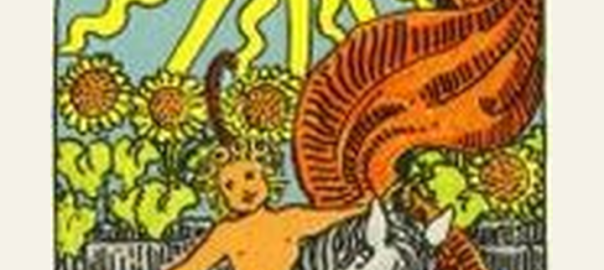
Key imagery: radiant sun, child on white horse, sunflowers, red banner, wall.

the child signals innocence restored after complexity; the wall marks protection rather than confinement.

The imagery of this card is important because tarot works through visual language. A strong tarot reader learns not only memorized keywords but also how the image speaks in context. When this card appears, pause and notice which symbol draws your eye first. That symbol may reveal the most important part of the message.

Upright Meaning

When The Sun appears upright, it usually encourages the querent to engage consciously with the card’s main lesson. The upright meaning emphasizes vitality, joy, clarity, warmth, success made visible.. It can show a helpful influence, an active process, or a path that is opening.

In a practical reading, this card asks: What is developing now? What quality should be strengthened? What opportunity or lesson is being shown?

Reversed Meaning

When reversed, The Sun does not simply mean the opposite of the upright card. It may show that the card’s energy is blocked, delayed, misused, hidden, or expressed in an unhealthy way. The reversed meaning may point to delayed joy, overexposure, inflated ego, temporary clouding of confidence..

A helpful approach is to ask whether the querent is resisting the card’s lesson, overusing it, underusing it, or experiencing it internally rather than externally.

The Sun in Love Readings

In love and relationship readings, The Sun should be read with sensitivity. It may describe attraction, emotional patterns, communication issues, commitment questions, or the stage a relationship is moving through.

If the card appears upright, the relationship may be working with the healthier expression of the card. If reversed, the reading may be pointing to confusion, imbalance, fear, delay, or the need for honest reflection.

The Sun in Career and Money Readings

In career readings, The Sun shows how this card’s energy appears in work, ambition, responsibility, leadership, conflict, creativity, and practical decision-making. It can represent a job situation, a professional attitude, a financial pattern, or advice about the next step.

In money readings, look carefully at whether the card suggests growth, risk, caution, planning, delay, or a changing cycle. Tarot does not replace financial advice, but it can help clarify patterns, habits, and choices.

Spiritual Meaning

Spiritually, The Sun asks the reader to look beyond surface events. It may reveal a lesson about awareness, discipline, courage, compassion, truth, patience, surrender, or trust. The spiritual message becomes clearer when the reader asks what this card is trying to teach rather than what it is trying to predict.

Psychic Development Meaning

For psychic development, The Sun can be used as a meditation symbol. Sit with the card, observe the imagery, and allow impressions to arise without forcing them. Notice colors, emotions, body sensations, and memories. This practice strengthens symbolic perception, which is essential for tarot, dreams, clairvoyance, and intuitive readings.

The card also supports divination by teaching the reader to blend structure with intuition. Keywords provide the structure; psychic awareness brings the interpretation alive.

Reading Positions

  • Past: The Sun may describe a previous pattern, lesson, influence, or turning point that shaped the present.
  • Present: The card shows the current energy, challenge, opportunity, or focus.
  • Future: It may indicate a likely direction if present patterns continue.
  • Advice: The card advises the querent to work consciously with its healthiest expression.
  • Obstacle: The card may show where the same energy has become blocked, excessive, or misunderstood.

Astrology, Numerology, and Correspondences

Astrological connection: Sun.

Numerology / rank note: 19/10/1 completes and renews in one movement.

Chakra connection: Solar Plexus Chakra. This chakra connection can be used for meditation, energy reflection, and intuitive development.

Rune connection: Sowilo. This rune resonates with the card’s symbolic theme and can be used for cross-divination study.

Crystal connection: Citrine. This crystal can be used as a symbolic meditation tool when studying the card.

Practical Examples

a project finally being recognized; feeling physically alive again after burnout recovery.

In real readings, these examples should be adapted to the querent’s question. A card that describes a career opportunity in one spread may describe emotional growth in another. Context is always essential.

Journal Prompts

Where is life asking me to be visible? What simple truth is already enough?

  • Where is this card already active in my life?
  • What is the healthiest expression of this card?
  • What does this card reveal about my intuition?

Frequently Asked Questions

Is The Sun a good tarot card?

It depends on the question and position. Most tarot cards are not simply good or bad; they describe patterns, choices, lessons, and timing.

What does The Sun mean reversed?

Reversed, it may indicate delayed joy, overexposure, inflated ego, temporary clouding of confidence..

What does The Sun mean in love?

In love readings, it highlights how the card’s theme affects emotional connection, communication, trust, timing, and relationship growth.

Final Thoughts

The Sun is a layered tarot symbol. Its meaning grows richer when the reader combines traditional interpretation, image analysis, spread position, intuition, and ethical reading practice.

For more spiritual guidance, visit Absolutely Psychic. To connect with experienced advisors for personalized tarot and psychic readings, visit AbsolutelyPsychic.com Psychic Readings.

Uranus in Astrology: Meaning, Symbolism, Houses, Signs, and Aspects

Uranus in Astrology: Meaning, Symbolism, and Chart Interpretation

Uranus astrology meaning

Astrology works best when its symbols are read as part of a whole chart rather than as isolated labels. A planet describes what is acting, a zodiac sign describes how that planet expresses itself, a house describes where in life the action occurs, and an aspect describes how two planetary principles interact. This article is written for readers who want practical, grounded interpretation without losing the symbolic richness that makes astrology useful for reflection, counseling, and chart analysis.

Summary At A Glance

  • Planet: Uranus
  • Keywords: Change, freedom, innovation, rebellion, awakening
  • Modern Association: Aquarius
  • Represents: Breakthroughs, independence, disruption, originality
  • Challenge: Instability, rebellion for its own sake, restlessness, detachment

What Uranus Represents

In astrology, Uranus represents freedom, shock, rebellion, disruption, technology, innovation, awakening, and nonconformity. It is one of the major symbolic actors in the birth chart, showing a core function of life rather than a simple personality trait. When an astrologer studies Uranus, the question is not only what it means by itself, but how it behaves through sign, house, dignity, motion, visibility, and aspect patterns.

Traditionally, Uranus is connected with rulership by domicile in modern Aquarius. Its exaltation is commonly associated with none classical. These conditions matter because they describe whether the planet has an easy environment for its nature or whether it has to work harder to express itself clearly. Modern astrology adds a more psychological layer, emphasizing where life breaks stale patterns and demands originality.

Uranus by Sign

The zodiac sign of Uranus describes the style, tone, and method of expression. For example, a fiery placement tends to act quickly and visibly, while an earth placement may seek practical results. Air signs usually express through ideas and exchange, while water signs tend to move through feeling, intuition, memory, and bonding. This is why the same planet can feel very different from one chart to another.

A strong interpretation of Uranus by sign should avoid stereotypes. The sign does not replace the planet. Instead, it colors how the planet functions. If Uranus is in Aries, the expression may be direct and urgent; in Taurus it may become steady and embodied; in Gemini it may move through language; in Cancer it may become protective and emotionally responsive. Each sign gives the planet a different costume and strategy.

Uranus by House

The house placement of Uranus shows the life area where its symbolism becomes most active. A first-house placement may be visible in personality and physical presence. A fourth-house placement may work through family, home, roots, and private life. A seventh-house placement brings the planet into partnership, clients, contracts, or open opposition. A tenth-house placement often makes the planet public through career, reputation, or authority.

This house layer is essential because two people can have Uranus in the same sign but live it in entirely different arenas. The sign explains style; the house explains location. The ruler of the house and aspects to Uranus refine the story further.

Uranus in Aspect

Aspects show how Uranus interacts with other planetary functions. Conjunctions intensify and blend its meaning. Sextiles create workable opportunities. Squares demand effort and skill. Trines show ease and flow. Oppositions bring awareness through relationship or polarity. Quincunxes require adjustment and recalibration. A planet with many aspects becomes especially important because it participates in many parts of the chart conversation.

For example, Uranus in a supportive aspect to Jupiter may expand confidence, perspective, or opportunity. In a hard aspect to Saturn, the same planet may feel tested, delayed, or disciplined. In contact with Neptune, symbolism may become imaginative, idealized, or unclear. The aspect does not erase the planet; it describes the relationship between different life functions.

How to Use Uranus in a Birth Chart

The meaning of Uranus becomes clearer when it is connected to the rest of the chart. A beginner may be tempted to read one placement as a complete verdict, but astrology is a layered language. The sign, house, ruler, aspects, and overall chart condition all modify the interpretation. A strong placement may operate confidently, while a pressured placement may require patience, maturity, and conscious development.

In a practical reading, Uranus should be treated as one voice in a larger conversation. Ask what it is trying to do, where it is trying to operate, and which other planets are supporting or challenging it. This method prevents the interpretation from becoming generic and helps the reader move from keywords into meaningful chart synthesis.

Traditional and Modern Layers

A helpful caution is that traditional and modern astrology do not always use the same language. Traditional astrology works strongly with the visible planets, essential dignity, sect, house strength, and concrete life topics. Modern astrology often adds psychological language, outer planets, developmental themes, and a stronger focus on personal integration. Both approaches can be useful when they are kept in their proper place and not flattened into one oversimplified system.

For Uranus, the traditional layer gives structure and discipline, while the modern layer often gives psychological texture. The best readings use both carefully: the traditional framework keeps interpretation grounded, while the modern framework can describe motivation, inner conflict, and growth.

Love, Career, and Spiritual Growth

In love and relationships, Uranus can describe needs, attractions, fears, patterns, or the style of connection that feels natural. In career matters, it can show talents, pressures, work habits, leadership style, or the kind of environment where a person performs well. Spiritually, it can point toward a lesson in balance: where to develop courage, where to soften, where to take responsibility, or where to trust the unfolding process.

The most useful question is not simply “Is Uranus good or bad?” but “How is this energy being used?” A difficult placement can become a source of skill and depth when handled consciously. An easy placement can become lazy if taken for granted. Astrology becomes practical when it helps a person participate more intelligently in their own life.

Common Misunderstandings

One common mistake is to turn Uranus into a fixed personality label. Astrology is symbolic, not mechanical. Another mistake is to assume that one keyword explains everything. A sign does not replace a planet, a house does not replace a sign, and an aspect does not cancel free will. Each factor adds context.

A second misunderstanding is to treat challenging symbolism as a sentence. A square, fall, difficult house, or afflicted planet may describe pressure, but pressure can become competence. Many people develop their greatest strengths through the very chart factors that first appear difficult.

Practical Examples in Chart Reading

A practical reading of Uranus might begin with a simple keyword, but it should never end there. Suppose Uranus is tied to the 10th house: the symbolism may become visible through work, reputation, public responsibility, or a major life direction. If it is tied to the 4th house, the same symbolism may become private, ancestral, domestic, or emotionally foundational. If it is tied to the 7th house, it may be encountered through partners, clients, contracts, or open conflict.

The next step is to ask whether Uranus is supported or strained. A trine from Jupiter might make the energy easier to trust, while a square from Saturn might ask for maturity, patience, and realism. A connection to Mars may add heat or urgency. A connection to Venus may add attraction or negotiation. A connection to Neptune may make the pattern imaginative but also less concrete. A connection to Pluto may intensify the issue and make it harder to ignore.

How This Symbol Develops Over Time

People rarely live Uranus the same way at every age. Early in life, the symbolism may be unconscious, inherited, reactive, or shaped by family expectations. Later, it may become a skill, vocation, healing path, or source of personal authority. This is why astrology should be read developmentally. The birth chart describes a pattern, but a person grows into that pattern through choices, experience, mistakes, and insight.

Transits and progressions can awaken Uranus at important times. A Saturn transit may demand structure and accountability. A Jupiter transit may expand opportunity or confidence. A Uranus transit may disrupt old habits. A Neptune transit may blur certainty and ask for faith. A Pluto transit may expose deeper material and require transformation. In each case, the natal promise of Uranus is activated in a new way.

Questions for Self-Reflection

When using Uranus for self-reflection, avoid asking only what will happen. Better questions include: What pattern is being repeated? What strength is trying to develop? What fear is being exposed? What habit has become outdated? What would a more mature expression of this symbol look like? These questions make astrology useful rather than fatalistic.

A reader can also ask whether Uranus is being expressed directly or indirectly. Direct expression tends to feel conscious and chosen. Indirect expression may appear through projection, avoidance, conflict, or repeated encounters with other people who carry the symbol for us. The more consciously the pattern is owned, the more flexible it becomes.

Reading This Symbol with Signs, Houses, and Aspects

The cleanest way to interpret Uranus is to separate the layers. The planet or point describes the function, the sign describes the style, the house describes the life area, and aspects describe relationships with other chart factors. When these layers are mixed together too quickly, the reading becomes vague. When they are separated first and then recombined, the interpretation becomes much more precise.

For example, if Uranus is connected with an earth sign, the expression may become practical, physical, financial, or craft-oriented. If it is connected with an air sign, the emphasis may move toward language, ideas, planning, or social exchange. Fire adds movement, courage, and inspiration, while water adds memory, feeling, intuition, and bonding. The same principle becomes even more specific when the house and ruler are added.

Using This Meaning in Psychic or Intuitive Readings

For intuitive readers, Uranus can act as a symbolic doorway. The astrology gives a structure, while intuition supplies nuance, timing, tone, and emotional emphasis. A grounded reader does not simply repeat keywords. Instead, the reader listens for how the symbol is showing up in the client’s real life: as a relationship pattern, career issue, family inheritance, health routine, creative block, spiritual lesson, or decision point.

This is especially useful when a client feels stuck. Uranus may reveal where energy is concentrated, where a person is avoiding a necessary change, or where an old strength needs to be used in a new way. The best readings are not frightening or overly deterministic. They help the client recognize the pattern and choose a more conscious response.

Keyword Bank

Helpful keywords for Uranus include development, expression, pattern, timing, relationship, choice, integration, strength, challenge, awareness, and maturity. These broad words keep the interpretation flexible. They also remind the reader that astrology is not about reducing a person to one sentence. It is about recognizing symbolic patterns and then applying judgment, compassion, and context.

Quick Interpretation Checklist

  • What is Uranus describing in this chart?
  • Which sign modifies the expression?
  • Which house shows the life area involved?
  • What aspects support or challenge the placement?
  • What does the ruler of the sign reveal?
  • Is this symbolism personal, relational, vocational, or spiritual?
  • Is the pattern being expressed consciously or reactively?
  • What would a mature expression look like?

Need Personal Guidance?

Astrology can provide valuable insight into your personality, relationships, career path, and life direction. A private reading can help you understand how these influences apply specifically to your unique birth chart.

For a private astrology or psychic reading, visit AbsolutelyPsychic.com or call 1-800-498-8777.

Final Thoughts on Uranus

Uranus is best understood as a living symbol. It describes a function that can be immature, reactive, skilled, refined, wounded, or highly developed depending on the whole chart and the person’s life. When interpreted carefully, it offers insight into both practical behavior and deeper purpose.

Scorpio Zodiac Sign Meaning: Traits, Love, Career, Symbolism, and Astrology

Scorpio Zodiac Sign Meaning: Personality, Symbolism, Love, Career, and Spiritual Lessons

Scorpio zodiac sign meaning

Astrology works best when its symbols are read as part of a whole chart rather than as isolated labels. A planet describes what is acting, a zodiac sign describes how that planet expresses itself, a house describes where in life the action occurs, and an aspect describes how two planetary principles interact. This article is written for readers who want practical, grounded interpretation without losing the symbolic richness that makes astrology useful for reflection, counseling, and chart analysis.

Summary At A Glance

  • Sign: Scorpio
  • Element: Water
  • Modality: Fixed
  • Ruler: Mars; Pluto in modern astrology
  • Keywords: Depth, loyalty, research, transformation
  • Challenge: Control, suspicion, obsession, emotional extremes
  • Spiritual Lesson: Learning to express this sign with maturity, balance, and awareness

What Scorpio Represents

Scorpio is a fixed water sign ruled by Mars / modern Pluto. Its core gifts include depth, survival, intimacy, secrecy, research, crisis skill, and transformation. As a zodiac sign, Scorpio does not describe a planet by itself; it describes the style through which a planet acts. When the Sun, Moon, Ascendant, or a personal planet is in Scorpio, that part of the chart tends to express through the sign’s rhythm and priorities.

The Water element gives Scorpio its basic temperament, while the Fixed modality explains how it moves. Cardinal signs initiate, fixed signs stabilize, and mutable signs adapt. Fire seeks action and inspiration, earth seeks substance and reliability, air seeks exchange and perspective, and water seeks feeling and connection.

Scorpio Personality Traits

At its best, Scorpio expresses depth, survival, intimacy, secrecy, research, crisis skill, and transformation. This sign has a distinct way of meeting life, solving problems, and seeking meaning. It can be direct or subtle, practical or visionary, emotional or conceptual depending on its element and ruler. The ruler, Mars / modern Pluto, adds another layer by showing the planet that carries the sign’s agenda into the rest of the chart.

The shadow side of Scorpio can appear as control, suspicion, obsession, vengeance, or emotional extremism. This does not make the sign negative. Every sign contains a developmental challenge. The same force that becomes a weakness when unconscious can become a gift when matured. For example, stubbornness can become loyalty, impatience can become courage, and sensitivity can become emotional intelligence.

Scorpio in Love and Relationships

In relationships, Scorpio shows how connection is approached when important planets or angles fall in this sign. It may describe attraction patterns, emotional needs, conflict style, or the way a person seeks trust. Some signs need freedom, others need steadiness, others need conversation, and others need emotional safety. Scorpio has its own requirements for feeling respected and engaged.

A healthy expression of Scorpio in love is not about acting out every impulse of the sign. It is about honoring the sign’s needs while staying aware of the partner’s reality. The mature form of Scorpio can offer loyalty, honesty, imagination, intelligence, devotion, or inspiration depending on the chart context.

Scorpio in Career and Vocation

Career indications connected to Scorpio depend on the planets involved and the houses they occupy. When Scorpio is connected to the 2nd, 6th, or 10th houses, it may describe livelihood, daily work, or public role. The sign’s strengths often point toward environments where the person can function naturally. Scorpio may thrive when its gifts are recognized rather than suppressed.

Because Scorpio is ruled by Mars / modern Pluto, the condition of Mars / modern Pluto in the chart is especially important. A well-placed ruler can make the sign easier to use constructively. A pressured ruler may show that the person must work harder to access the sign’s strengths or must learn through challenge.

How to Use Scorpio in a Birth Chart

The meaning of Scorpio becomes clearer when it is connected to the rest of the chart. A beginner may be tempted to read one placement as a complete verdict, but astrology is a layered language. The sign, house, ruler, aspects, and overall chart condition all modify the interpretation. A strong placement may operate confidently, while a pressured placement may require patience, maturity, and conscious development.

In a practical reading, Scorpio should be treated as one voice in a larger conversation. Ask what it is trying to do, where it is trying to operate, and which other planets are supporting or challenging it. This method prevents the interpretation from becoming generic and helps the reader move from keywords into meaningful chart synthesis.

Traditional and Modern Layers

A helpful caution is that traditional and modern astrology do not always use the same language. Traditional astrology works strongly with the visible planets, essential dignity, sect, house strength, and concrete life topics. Modern astrology often adds psychological language, outer planets, developmental themes, and a stronger focus on personal integration. Both approaches can be useful when they are kept in their proper place and not flattened into one oversimplified system.

For Scorpio, the traditional layer gives structure and discipline, while the modern layer often gives psychological texture. The best readings use both carefully: the traditional framework keeps interpretation grounded, while the modern framework can describe motivation, inner conflict, and growth.

Love, Career, and Spiritual Growth

In love and relationships, Scorpio can describe needs, attractions, fears, patterns, or the style of connection that feels natural. In career matters, it can show talents, pressures, work habits, leadership style, or the kind of environment where a person performs well. Spiritually, it can point toward a lesson in balance: where to develop courage, where to soften, where to take responsibility, or where to trust the unfolding process.

The most useful question is not simply “Is Scorpio good or bad?” but “How is this energy being used?” A difficult placement can become a source of skill and depth when handled consciously. An easy placement can become lazy if taken for granted. Astrology becomes practical when it helps a person participate more intelligently in their own life.

Common Misunderstandings

One common mistake is to turn Scorpio into a fixed personality label. Astrology is symbolic, not mechanical. Another mistake is to assume that one keyword explains everything. A sign does not replace a planet, a house does not replace a sign, and an aspect does not cancel free will. Each factor adds context.

A second misunderstanding is to treat challenging symbolism as a sentence. A square, fall, difficult house, or afflicted planet may describe pressure, but pressure can become competence. Many people develop their greatest strengths through the very chart factors that first appear difficult.

Practical Examples in Chart Reading

A practical reading of Scorpio might begin with a simple keyword, but it should never end there. Suppose Scorpio is tied to the 10th house: the symbolism may become visible through work, reputation, public responsibility, or a major life direction. If it is tied to the 4th house, the same symbolism may become private, ancestral, domestic, or emotionally foundational. If it is tied to the 7th house, it may be encountered through partners, clients, contracts, or open conflict.

The next step is to ask whether Scorpio is supported or strained. A trine from Jupiter might make the energy easier to trust, while a square from Saturn might ask for maturity, patience, and realism. A connection to Mars may add heat or urgency. A connection to Venus may add attraction or negotiation. A connection to Neptune may make the pattern imaginative but also less concrete. A connection to Pluto may intensify the issue and make it harder to ignore.

How This Symbol Develops Over Time

People rarely live Scorpio the same way at every age. Early in life, the symbolism may be unconscious, inherited, reactive, or shaped by family expectations. Later, it may become a skill, vocation, healing path, or source of personal authority. This is why astrology should be read developmentally. The birth chart describes a pattern, but a person grows into that pattern through choices, experience, mistakes, and insight.

Transits and progressions can awaken Scorpio at important times. A Saturn transit may demand structure and accountability. A Jupiter transit may expand opportunity or confidence. A Uranus transit may disrupt old habits. A Neptune transit may blur certainty and ask for faith. A Pluto transit may expose deeper material and require transformation. In each case, the natal promise of Scorpio is activated in a new way.

Questions for Self-Reflection

When using Scorpio for self-reflection, avoid asking only what will happen. Better questions include: What pattern is being repeated? What strength is trying to develop? What fear is being exposed? What habit has become outdated? What would a more mature expression of this symbol look like? These questions make astrology useful rather than fatalistic.

A reader can also ask whether Scorpio is being expressed directly or indirectly. Direct expression tends to feel conscious and chosen. Indirect expression may appear through projection, avoidance, conflict, or repeated encounters with other people who carry the symbol for us. The more consciously the pattern is owned, the more flexible it becomes.

Reading This Symbol with Signs, Houses, and Aspects

The cleanest way to interpret Scorpio is to separate the layers. The planet or point describes the function, the sign describes the style, the house describes the life area, and aspects describe relationships with other chart factors. When these layers are mixed together too quickly, the reading becomes vague. When they are separated first and then recombined, the interpretation becomes much more precise.

For example, if Scorpio is connected with an earth sign, the expression may become practical, physical, financial, or craft-oriented. If it is connected with an air sign, the emphasis may move toward language, ideas, planning, or social exchange. Fire adds movement, courage, and inspiration, while water adds memory, feeling, intuition, and bonding. The same principle becomes even more specific when the house and ruler are added.

Using This Meaning in Psychic or Intuitive Readings

For intuitive readers, Scorpio can act as a symbolic doorway. The astrology gives a structure, while intuition supplies nuance, timing, tone, and emotional emphasis. A grounded reader does not simply repeat keywords. Instead, the reader listens for how the symbol is showing up in the client’s real life: as a relationship pattern, career issue, family inheritance, health routine, creative block, spiritual lesson, or decision point.

This is especially useful when a client feels stuck. Scorpio may reveal where energy is concentrated, where a person is avoiding a necessary change, or where an old strength needs to be used in a new way. The best readings are not frightening or overly deterministic. They help the client recognize the pattern and choose a more conscious response.

Keyword Bank

Helpful keywords for Scorpio include development, expression, pattern, timing, relationship, choice, integration, strength, challenge, awareness, and maturity. These broad words keep the interpretation flexible. They also remind the reader that astrology is not about reducing a person to one sentence. It is about recognizing symbolic patterns and then applying judgment, compassion, and context.

Quick Interpretation Checklist

  • What is Scorpio describing in this chart?
  • Which sign modifies the expression?
  • Which house shows the life area involved?
  • What aspects support or challenge the placement?
  • What does the ruler of the sign reveal?
  • Is this symbolism personal, relational, vocational, or spiritual?
  • Is the pattern being expressed consciously or reactively?
  • What would a mature expression look like?

Need Personal Guidance?

Astrology can provide valuable insight into your personality, relationships, career path, and life direction. A private reading can help you understand how these influences apply specifically to your unique birth chart.

For a private astrology or psychic reading, visit AbsolutelyPsychic.com or call 1-800-498-8777.

Final Thoughts on Scorpio

Scorpio is not a fixed identity box. It is a symbolic style, a way energy moves through the chart. The more carefully it is interpreted through planets, houses, aspects, and rulerships, the more useful and specific it becomes.

Seventh House in Astrology: Meaning, Planets, Signs, and Natal Chart Interpretation

Seventh House in Astrology: Meaning, Life Areas, Planets, and Chart Interpretation

Seventh House astrology meaning

Astrology works best when its symbols are read as part of a whole chart rather than as isolated labels. A planet describes what is acting, a zodiac sign describes how that planet expresses itself, a house describes where in life the action occurs, and an aspect describes how two planetary principles interact. This article is written for readers who want practical, grounded interpretation without losing the symbolic richness that makes astrology useful for reflection, counseling, and chart analysis.

Summary At A Glance

  • House: 7th House
  • Keywords: Marriage, partnerships, contracts, clients, open opponents
  • Natural Mnemonic: Libra / Venus
  • Life Area: How you relate one-to-one and what you seek in others
  • Main Question: Where does this life theme show up in the chart?
  • Spiritual Lesson: Balancing selfhood with cooperation

What the Seventh House Represents

The Seventh House describes marriage, partnership, contracts, clients, negotiation, and open opponents. In the chart, houses describe arenas of life. They do not behave exactly like signs. A sign shows style, a planet shows the actor, and a house shows where the story unfolds. The Seventh House is therefore a life territory rather than a personality label.

The Seventh House is connected with the Descendant and the encounter with other people. Its deeper interpretive theme is how the person meets equals, rivals, partners, and agreements. Planets placed here become active in this life area, and the sign on the cusp shows the style through which the house topics are approached.

Planets in the Seventh House

When a planet falls in the Seventh House, its symbolism becomes strongly involved with this house’s topics. The Sun may bring visibility and identity. The Moon may bring habit, memory, and emotional need. Mercury may bring communication or analysis. Venus may bring attraction and agreement. Mars may bring conflict or courage. Jupiter may expand the area. Saturn may create responsibility, delay, or mastery. Outer planets can intensify, disrupt, dissolve, or transform the house themes.

No planet in the Seventh House should be judged alone. Its sign, aspects, dignity, and condition all matter. A difficult planet here can describe pressure, but it can also become expertise. A benefic planet here can bring ease, but it still needs conscious use.

The Sign on the Seventh House Cusp

The sign on the cusp of the Seventh House describes how a person enters this area of life. Aries may act quickly, Taurus may stabilize, Gemini may communicate, Cancer may protect, Leo may express, Virgo may organize, Libra may negotiate, Scorpio may intensify, Sagittarius may expand, Capricorn may structure, Aquarius may innovate, and Pisces may soften or spiritualize.

The ruler of that cusp sign is extremely important. It shows where the affairs of the Seventh House are managed from. For example, if Gemini is on the cusp, Mercury becomes the house ruler, and Mercury’s sign, house, and aspects will describe how the house topics are handled.

Questions to Ask When Reading the Seventh House

  • Which sign is on the cusp of the Seventh House?
  • Where is the ruler of that sign placed?
  • Are there planets in the Seventh House?
  • What aspects do those planets receive?
  • Is this house emphasized by transits or progressions?

How to Use Seventh House in a Birth Chart

The meaning of Seventh House becomes clearer when it is connected to the rest of the chart. A beginner may be tempted to read one placement as a complete verdict, but astrology is a layered language. The sign, house, ruler, aspects, and overall chart condition all modify the interpretation. A strong placement may operate confidently, while a pressured placement may require patience, maturity, and conscious development.

In a practical reading, Seventh House should be treated as one voice in a larger conversation. Ask what it is trying to do, where it is trying to operate, and which other planets are supporting or challenging it. This method prevents the interpretation from becoming generic and helps the reader move from keywords into meaningful chart synthesis.

Traditional and Modern Layers

A helpful caution is that traditional and modern astrology do not always use the same language. Traditional astrology works strongly with the visible planets, essential dignity, sect, house strength, and concrete life topics. Modern astrology often adds psychological language, outer planets, developmental themes, and a stronger focus on personal integration. Both approaches can be useful when they are kept in their proper place and not flattened into one oversimplified system.

For Seventh House, the traditional layer gives structure and discipline, while the modern layer often gives psychological texture. The best readings use both carefully: the traditional framework keeps interpretation grounded, while the modern framework can describe motivation, inner conflict, and growth.

Love, Career, and Spiritual Growth

In love and relationships, Seventh House can describe needs, attractions, fears, patterns, or the style of connection that feels natural. In career matters, it can show talents, pressures, work habits, leadership style, or the kind of environment where a person performs well. Spiritually, it can point toward a lesson in balance: where to develop courage, where to soften, where to take responsibility, or where to trust the unfolding process.

The most useful question is not simply “Is Seventh House good or bad?” but “How is this energy being used?” A difficult placement can become a source of skill and depth when handled consciously. An easy placement can become lazy if taken for granted. Astrology becomes practical when it helps a person participate more intelligently in their own life.

Common Misunderstandings

One common mistake is to turn Seventh House into a fixed personality label. Astrology is symbolic, not mechanical. Another mistake is to assume that one keyword explains everything. A sign does not replace a planet, a house does not replace a sign, and an aspect does not cancel free will. Each factor adds context.

A second misunderstanding is to treat challenging symbolism as a sentence. A square, fall, difficult house, or afflicted planet may describe pressure, but pressure can become competence. Many people develop their greatest strengths through the very chart factors that first appear difficult.

Practical Examples in Chart Reading

A practical reading of Seventh House might begin with a simple keyword, but it should never end there. Suppose Seventh House is tied to the 10th house: the symbolism may become visible through work, reputation, public responsibility, or a major life direction. If it is tied to the 4th house, the same symbolism may become private, ancestral, domestic, or emotionally foundational. If it is tied to the 7th house, it may be encountered through partners, clients, contracts, or open conflict.

The next step is to ask whether Seventh House is supported or strained. A trine from Jupiter might make the energy easier to trust, while a square from Saturn might ask for maturity, patience, and realism. A connection to Mars may add heat or urgency. A connection to Venus may add attraction or negotiation. A connection to Neptune may make the pattern imaginative but also less concrete. A connection to Pluto may intensify the issue and make it harder to ignore.

How This Symbol Develops Over Time

People rarely live Seventh House the same way at every age. Early in life, the symbolism may be unconscious, inherited, reactive, or shaped by family expectations. Later, it may become a skill, vocation, healing path, or source of personal authority. This is why astrology should be read developmentally. The birth chart describes a pattern, but a person grows into that pattern through choices, experience, mistakes, and insight.

Transits and progressions can awaken Seventh House at important times. A Saturn transit may demand structure and accountability. A Jupiter transit may expand opportunity or confidence. A Uranus transit may disrupt old habits. A Neptune transit may blur certainty and ask for faith. A Pluto transit may expose deeper material and require transformation. In each case, the natal promise of Seventh House is activated in a new way.

Questions for Self-Reflection

When using Seventh House for self-reflection, avoid asking only what will happen. Better questions include: What pattern is being repeated? What strength is trying to develop? What fear is being exposed? What habit has become outdated? What would a more mature expression of this symbol look like? These questions make astrology useful rather than fatalistic.

A reader can also ask whether Seventh House is being expressed directly or indirectly. Direct expression tends to feel conscious and chosen. Indirect expression may appear through projection, avoidance, conflict, or repeated encounters with other people who carry the symbol for us. The more consciously the pattern is owned, the more flexible it becomes.

Reading This Symbol with Signs, Houses, and Aspects

The cleanest way to interpret Seventh House is to separate the layers. The planet or point describes the function, the sign describes the style, the house describes the life area, and aspects describe relationships with other chart factors. When these layers are mixed together too quickly, the reading becomes vague. When they are separated first and then recombined, the interpretation becomes much more precise.

For example, if Seventh House is connected with an earth sign, the expression may become practical, physical, financial, or craft-oriented. If it is connected with an air sign, the emphasis may move toward language, ideas, planning, or social exchange. Fire adds movement, courage, and inspiration, while water adds memory, feeling, intuition, and bonding. The same principle becomes even more specific when the house and ruler are added.

Using This Meaning in Psychic or Intuitive Readings

For intuitive readers, Seventh House can act as a symbolic doorway. The astrology gives a structure, while intuition supplies nuance, timing, tone, and emotional emphasis. A grounded reader does not simply repeat keywords. Instead, the reader listens for how the symbol is showing up in the client’s real life: as a relationship pattern, career issue, family inheritance, health routine, creative block, spiritual lesson, or decision point.

This is especially useful when a client feels stuck. Seventh House may reveal where energy is concentrated, where a person is avoiding a necessary change, or where an old strength needs to be used in a new way. The best readings are not frightening or overly deterministic. They help the client recognize the pattern and choose a more conscious response.

Keyword Bank

Helpful keywords for Seventh House include development, expression, pattern, timing, relationship, choice, integration, strength, challenge, awareness, and maturity. These broad words keep the interpretation flexible. They also remind the reader that astrology is not about reducing a person to one sentence. It is about recognizing symbolic patterns and then applying judgment, compassion, and context.

Quick Interpretation Checklist

  • What is Seventh House describing in this chart?
  • Which sign modifies the expression?
  • Which house shows the life area involved?
  • What aspects support or challenge the placement?
  • What does the ruler of the sign reveal?
  • Is this symbolism personal, relational, vocational, or spiritual?
  • Is the pattern being expressed consciously or reactively?
  • What would a mature expression look like?

Need Personal Guidance?

Astrology can provide valuable insight into your personality, relationships, career path, and life direction. A private reading can help you understand how these influences apply specifically to your unique birth chart.

For a private astrology or psychic reading, visit AbsolutelyPsychic.com or call 1-800-498-8777.

Final Thoughts on the Seventh House

The Seventh House becomes meaningful when it is read as part of the whole chart. Its topics may be simple on the surface, but the ruler, planets, and aspects can make the story rich, practical, and deeply personal.

Saturn in Astrology: Meaning, Symbolism, Houses, Signs, and Aspects

Saturn in Astrology: Meaning, Symbolism, and Chart Interpretation

Saturn astrology meaning

Astrology works best when its symbols are read as part of a whole chart rather than as isolated labels. A planet describes what is acting, a zodiac sign describes how that planet expresses itself, a house describes where in life the action occurs, and an aspect describes how two planetary principles interact. This article is written for readers who want practical, grounded interpretation without losing the symbolic richness that makes astrology useful for reflection, counseling, and chart analysis.

Summary At A Glance

  • Planet: Saturn
  • Keywords: Structure, time, discipline, responsibility, maturity
  • Rules: Capricorn and Aquarius
  • Exalted In: Libra
  • Represents: Boundaries, commitments, mastery, work, endurance
  • Challenge: Fear, limitation, rigidity, delay, self-doubt

What Saturn Represents

In astrology, Saturn represents time, limits, responsibility, labor, structure, maturity, fear, discipline, and endurance. It is one of the major symbolic actors in the birth chart, showing a core function of life rather than a simple personality trait. When an astrologer studies Saturn, the question is not only what it means by itself, but how it behaves through sign, house, dignity, motion, visibility, and aspect patterns.

Traditionally, Saturn is connected with rulership by domicile in Capricorn and Aquarius. Its exaltation is commonly associated with Libra. These conditions matter because they describe whether the planet has an easy environment for its nature or whether it has to work harder to express itself clearly. Modern astrology adds a more psychological layer, emphasizing where life asks for realism, boundaries, patience, and earned authority.

Saturn by Sign

The zodiac sign of Saturn describes the style, tone, and method of expression. For example, a fiery placement tends to act quickly and visibly, while an earth placement may seek practical results. Air signs usually express through ideas and exchange, while water signs tend to move through feeling, intuition, memory, and bonding. This is why the same planet can feel very different from one chart to another.

A strong interpretation of Saturn by sign should avoid stereotypes. The sign does not replace the planet. Instead, it colors how the planet functions. If Saturn is in Aries, the expression may be direct and urgent; in Taurus it may become steady and embodied; in Gemini it may move through language; in Cancer it may become protective and emotionally responsive. Each sign gives the planet a different costume and strategy.

Saturn by House

The house placement of Saturn shows the life area where its symbolism becomes most active. A first-house placement may be visible in personality and physical presence. A fourth-house placement may work through family, home, roots, and private life. A seventh-house placement brings the planet into partnership, clients, contracts, or open opposition. A tenth-house placement often makes the planet public through career, reputation, or authority.

This house layer is essential because two people can have Saturn in the same sign but live it in entirely different arenas. The sign explains style; the house explains location. The ruler of the house and aspects to Saturn refine the story further.

Saturn in Aspect

Aspects show how Saturn interacts with other planetary functions. Conjunctions intensify and blend its meaning. Sextiles create workable opportunities. Squares demand effort and skill. Trines show ease and flow. Oppositions bring awareness through relationship or polarity. Quincunxes require adjustment and recalibration. A planet with many aspects becomes especially important because it participates in many parts of the chart conversation.

For example, Saturn in a supportive aspect to Jupiter may expand confidence, perspective, or opportunity. In a hard aspect to Saturn, the same planet may feel tested, delayed, or disciplined. In contact with Neptune, symbolism may become imaginative, idealized, or unclear. The aspect does not erase the planet; it describes the relationship between different life functions.

How to Use Saturn in a Birth Chart

The meaning of Saturn becomes clearer when it is connected to the rest of the chart. A beginner may be tempted to read one placement as a complete verdict, but astrology is a layered language. The sign, house, ruler, aspects, and overall chart condition all modify the interpretation. A strong placement may operate confidently, while a pressured placement may require patience, maturity, and conscious development.

In a practical reading, Saturn should be treated as one voice in a larger conversation. Ask what it is trying to do, where it is trying to operate, and which other planets are supporting or challenging it. This method prevents the interpretation from becoming generic and helps the reader move from keywords into meaningful chart synthesis.

Traditional and Modern Layers

A helpful caution is that traditional and modern astrology do not always use the same language. Traditional astrology works strongly with the visible planets, essential dignity, sect, house strength, and concrete life topics. Modern astrology often adds psychological language, outer planets, developmental themes, and a stronger focus on personal integration. Both approaches can be useful when they are kept in their proper place and not flattened into one oversimplified system.

For Saturn, the traditional layer gives structure and discipline, while the modern layer often gives psychological texture. The best readings use both carefully: the traditional framework keeps interpretation grounded, while the modern framework can describe motivation, inner conflict, and growth.

Love, Career, and Spiritual Growth

In love and relationships, Saturn can describe needs, attractions, fears, patterns, or the style of connection that feels natural. In career matters, it can show talents, pressures, work habits, leadership style, or the kind of environment where a person performs well. Spiritually, it can point toward a lesson in balance: where to develop courage, where to soften, where to take responsibility, or where to trust the unfolding process.

The most useful question is not simply “Is Saturn good or bad?” but “How is this energy being used?” A difficult placement can become a source of skill and depth when handled consciously. An easy placement can become lazy if taken for granted. Astrology becomes practical when it helps a person participate more intelligently in their own life.

Common Misunderstandings

One common mistake is to turn Saturn into a fixed personality label. Astrology is symbolic, not mechanical. Another mistake is to assume that one keyword explains everything. A sign does not replace a planet, a house does not replace a sign, and an aspect does not cancel free will. Each factor adds context.

A second misunderstanding is to treat challenging symbolism as a sentence. A square, fall, difficult house, or afflicted planet may describe pressure, but pressure can become competence. Many people develop their greatest strengths through the very chart factors that first appear difficult.

Practical Examples in Chart Reading

A practical reading of Saturn might begin with a simple keyword, but it should never end there. Suppose Saturn is tied to the 10th house: the symbolism may become visible through work, reputation, public responsibility, or a major life direction. If it is tied to the 4th house, the same symbolism may become private, ancestral, domestic, or emotionally foundational. If it is tied to the 7th house, it may be encountered through partners, clients, contracts, or open conflict.

The next step is to ask whether Saturn is supported or strained. A trine from Jupiter might make the energy easier to trust, while a square from Saturn might ask for maturity, patience, and realism. A connection to Mars may add heat or urgency. A connection to Venus may add attraction or negotiation. A connection to Neptune may make the pattern imaginative but also less concrete. A connection to Pluto may intensify the issue and make it harder to ignore.

How This Symbol Develops Over Time

People rarely live Saturn the same way at every age. Early in life, the symbolism may be unconscious, inherited, reactive, or shaped by family expectations. Later, it may become a skill, vocation, healing path, or source of personal authority. This is why astrology should be read developmentally. The birth chart describes a pattern, but a person grows into that pattern through choices, experience, mistakes, and insight.

Transits and progressions can awaken Saturn at important times. A Saturn transit may demand structure and accountability. A Jupiter transit may expand opportunity or confidence. A Uranus transit may disrupt old habits. A Neptune transit may blur certainty and ask for faith. A Pluto transit may expose deeper material and require transformation. In each case, the natal promise of Saturn is activated in a new way.

Questions for Self-Reflection

When using Saturn for self-reflection, avoid asking only what will happen. Better questions include: What pattern is being repeated? What strength is trying to develop? What fear is being exposed? What habit has become outdated? What would a more mature expression of this symbol look like? These questions make astrology useful rather than fatalistic.

A reader can also ask whether Saturn is being expressed directly or indirectly. Direct expression tends to feel conscious and chosen. Indirect expression may appear through projection, avoidance, conflict, or repeated encounters with other people who carry the symbol for us. The more consciously the pattern is owned, the more flexible it becomes.

Reading This Symbol with Signs, Houses, and Aspects

The cleanest way to interpret Saturn is to separate the layers. The planet or point describes the function, the sign describes the style, the house describes the life area, and aspects describe relationships with other chart factors. When these layers are mixed together too quickly, the reading becomes vague. When they are separated first and then recombined, the interpretation becomes much more precise.

For example, if Saturn is connected with an earth sign, the expression may become practical, physical, financial, or craft-oriented. If it is connected with an air sign, the emphasis may move toward language, ideas, planning, or social exchange. Fire adds movement, courage, and inspiration, while water adds memory, feeling, intuition, and bonding. The same principle becomes even more specific when the house and ruler are added.

Using This Meaning in Psychic or Intuitive Readings

For intuitive readers, Saturn can act as a symbolic doorway. The astrology gives a structure, while intuition supplies nuance, timing, tone, and emotional emphasis. A grounded reader does not simply repeat keywords. Instead, the reader listens for how the symbol is showing up in the client’s real life: as a relationship pattern, career issue, family inheritance, health routine, creative block, spiritual lesson, or decision point.

This is especially useful when a client feels stuck. Saturn may reveal where energy is concentrated, where a person is avoiding a necessary change, or where an old strength needs to be used in a new way. The best readings are not frightening or overly deterministic. They help the client recognize the pattern and choose a more conscious response.

Keyword Bank

Helpful keywords for Saturn include development, expression, pattern, timing, relationship, choice, integration, strength, challenge, awareness, and maturity. These broad words keep the interpretation flexible. They also remind the reader that astrology is not about reducing a person to one sentence. It is about recognizing symbolic patterns and then applying judgment, compassion, and context.

Quick Interpretation Checklist

  • What is Saturn describing in this chart?
  • Which sign modifies the expression?
  • Which house shows the life area involved?
  • What aspects support or challenge the placement?
  • What does the ruler of the sign reveal?
  • Is this symbolism personal, relational, vocational, or spiritual?
  • Is the pattern being expressed consciously or reactively?
  • What would a mature expression look like?

Need Personal Guidance?

Astrology can provide valuable insight into your personality, relationships, career path, and life direction. A private reading can help you understand how these influences apply specifically to your unique birth chart.

For a private astrology or psychic reading, visit AbsolutelyPsychic.com or call 1-800-498-8777.

Final Thoughts on Saturn

Saturn is best understood as a living symbol. It describes a function that can be immature, reactive, skilled, refined, wounded, or highly developed depending on the whole chart and the person’s life. When interpreted carefully, it offers insight into both practical behavior and deeper purpose.