
Secret Crossroads: Parans
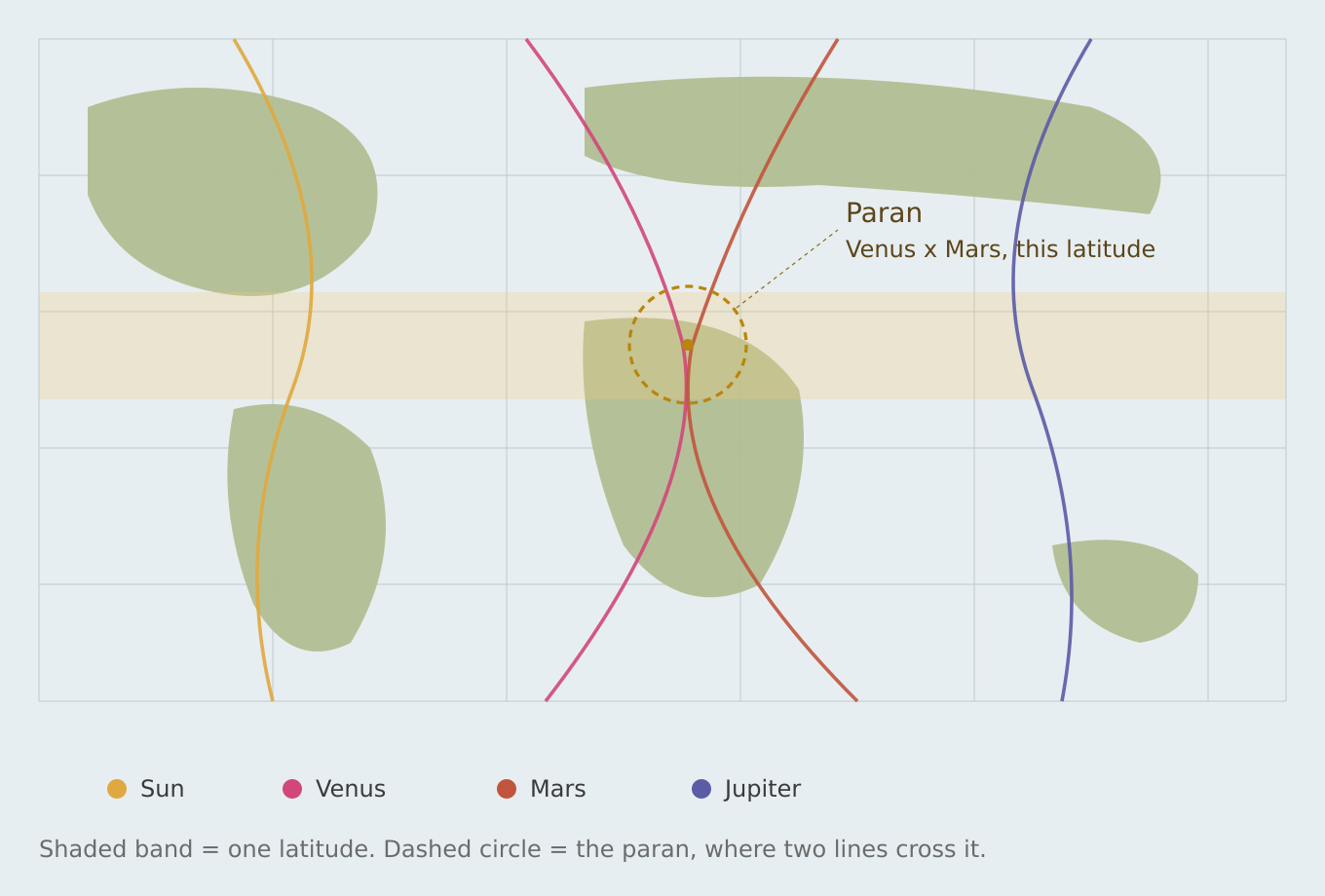
If Astrocartography is the map, parans are the hidden intersections — the back alleys where two planetary energies bump into each other and decide to make trouble (or magic) together.
Astrocartography takes your birth chart and stretches it across a world map. Each planet casts four lines around the globe — corresponding to where that planet was rising, setting, at its highest point (Midheaven), or at its lowest point (IC) at the exact moment you were born. Stand
near a Venus line, the thinking goes, and you might find love blooms easier. Near a Mars line, and your ambition (or temper) turns up the volume.
That part most people have heard of. Parans are the plot twist. A paran happens when two of your planetary lines cross paths — not on the map itself, but in real time, as the Earth rotates beneath the sky of your birth moment. Picture it like this: your Venus was rising in the
east at the exact same instant your Saturn was directly overhead. Those two events happened simultaneously, and that simultaneity gets locked into a specific latitude band that wraps all the way around the planet.
That’s the strange part. A paran isn’t a single line —it’s a horizontal ribbon circling the entire globe, east to west, at one particular latitude. You don’t have to be in France or Fiji to feel it; you just have to be somewhere along that latitude, anywhere on Earth.
Because a paran is really a timing event, not a spatial one. The planets crossed their angles (rising, setting, culminating, or anti-culminating) at the same moment for anyone standing anywhere on that latitude line. Geography is almost incidental — Venus and Saturn don’t
care whether they’re shaking hands over the Sahara or the Andes, as long as it’s happening at that specific slice of latitude.
This is why parans have a reputation among astrocartography enthusiasts for being sneaky-powerful. A city might sit nowhere near one of your major planetary lines, yet fall squarely within a Sun-Jupiter paran band — and suddenly a place that looked “quiet” on the map lights
up with meaning.
Here’s where practitioners diverge a bit, since there’s no universal rulebook. Most Astrocartographers work with an effective range of roughly one degree of latitude in either direction from the exact paran point — which translates to about 60–70 miles (100–110 km) north or south before the influence is considered to meaningfully fade. Some more conservative readers narrow that to a tighter 30-mile buffer; others allow it to breathe a little wider, especially for combinations involving slower-moving planets like Saturn, Uranus, Neptune, or Pluto, whose effects tend to feel more diffuse and long-lasting anyway.
But knowing a paran exists is only half the story. What it actually means — whether it softens your life or sharpens it, whether it echoes something already written in your chart or adds a spark where nothing was there before — depends entirely on what you bring to it.
Every paran is really a conversation between two planets, and like any conversation, the tone depends entirely on who’s talking. Here’s a sampler of some classic pairings and the flavor they tend to bring:
Venus / Mars — Chemistry, Full Stop
This is the paran most people ask about first, and for good reason. Venus is attraction; Mars is pursuit. Land in this band and the general read is heightened magnetism, quicker sparks, and relationships that move with more heat and less hesitation. It doesn’t guarantee romance — but it tends to raise the temperature of whatever’s already in the room.
Jupiter / Pluto — Big Money, Bigger Stakes
Jupiter expands; Pluto intensifies and transforms. Together they’re associated with major financial shifts — windfalls, power plays, high-stakes deals. It’s less “found a lucky penny” and more “rewrote my entire financial trajectory.” The catch: Pluto doesn’t do anything small, so the downside swings can be just as dramatic as the upside.
Sun / Mars — Drive, Ego, and a Short Fuse
The Sun is identity and vitality; Mars is action and aggression. This paran is a double shot of espresso for the ego — confidence, competitiveness, and a strong urge to do something. The flip side is real: tempers run hotter here, and patience isn’t the local specialty. Great for ambition, less great for conflict resolution.
Mercury / Jupiter — The Big Idea Zone
Mercury handles communication and learning; Jupiter is expansion and meaning. Together, this band tends to favor higher education, publishing, teaching, and any pursuit where thinking big and talking well pays off. People often report feeling unusually articulate or intellectually hungry in these locations.
Mars / Saturn — The Grindstone
Mars wants to act; Saturn wants structure, discipline, and results earned the slow way. This is the paran of hard work rewarded — long hours, real achievement, but rarely anything handed over easily. It suits builders and workaholics well; those craving instant gratification may find it frustrating.
Moon / Venus — Emotional Comfort
Worth a mention as a gentler counterpart to the list above: the Moon governs emotional needs, Venus governs pleasure and connection, and together they’re often linked to a sense of ease, domestic contentment, and simple emotional warmth — the “I could just live here” feeling.
Every chart carries dozens of these crossings, most quietly waiting in latitude bands you’ve never thought to look at. That’s the appeal of parans — they don’t announce themselves the way a bold planetary line does. They just sit there, humming, until someone happens to travel through.
Parans matter more than the tap lets on. Here’s the detail that separates a casual glance at astrocartography from a genuinely useful one: parans don’t operate in a vacuum. Their real weight often comes from how they echo — or don’t — what’s already sitting in your natal or progressed chart.
If you were born with Venus and Mars in a tight aspect to each other, and you then travel to a place where their paran crosses, you’re not introducing something new. You’re turning up the volume on a dynamic that’s already wired into you. Same goes for progressed chart activations — if your progressed Mars is currently moving into contact with your natal Saturn, landing in a Mars/Saturn paran location can feel less like a coincidence and more like the universe underlining a sentence you already wrote.
And the effect isn’t always sweetness and light. A paran can soften a line that’s otherwise been rough — Saturn lines, for instance, can feel less restrictive when a warmer planet crosses into the mix at that latitude. But it can just as easily aggravate a line that was already difficult, sharpening tension rather than easing it. The paran doesn’t have a fixed personality; it amplifies whatever direction the existing energy was already leaning.
Even more interesting: a location doesn’t need a major line running through it to be significant. If a paran crosses through an otherwise “quiet” spot on your map — nowhere near a bold Sun or Jupiter line — it can still inject a surprising amount of fuel into that place. It’s a reminder that the absence of an obvious line doesn’t mean the absence of influence.
A personal aside: relocated charts used to be my go-to tool for this kind of work — recasting the chart as if you were born somewhere else, and reading it fresh. It’s still a solid method. But once astrocartography entered the picture, especially with parans layered in, it added a dimension relocation alone never quite captured — the sense of specific, living crossroads scattered across the globe, each one carrying its own quiet story.
Planetary lines tell you where a planet’s energy runs strongest. Parans tell you where two energies quietly agree to meet — and because that agreement stretches around the entire Earth, it turns latitude itself into something worth paying attention to, not just longitude and city names. It’s one of those details that rewards a closer look at your own chart — the kind of thing you don’t notice on a map until, suddenly, you do.

