
What is Cyclo Carto Graphy?
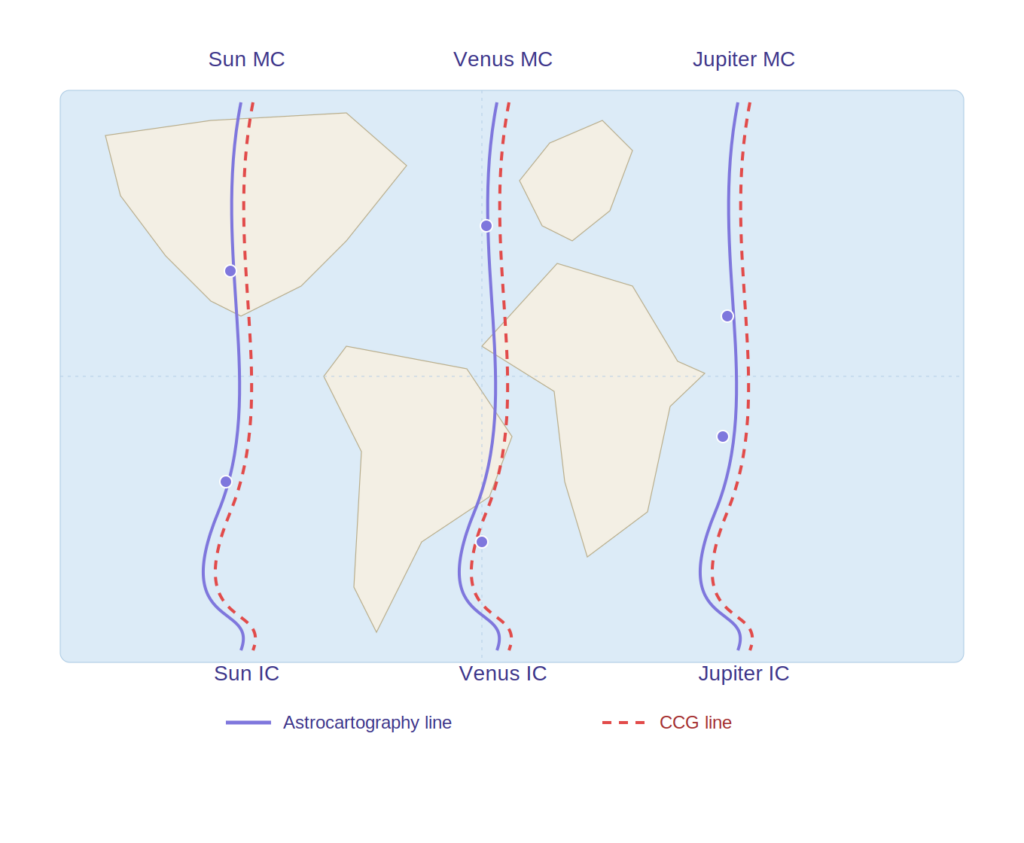
Astrocartography tells you where. Cyclo Carto Graphy tells you when. Put them together and you stop asking “should I move to Barcelona” and start asking “should I move to Barcelona this year.”
What CCG Actually Is
Your natal astrocartography map is frozen in time — it’s built from the sky at the exact moment you were born, and it never changes. Cyclo Carto Graphy (CCG) takes that same map and sets it in motion. Instead of only showing where your natal planets fall around the globe, CCG lays a second, moving layer on top: where the sky is right now — or where it’s slowly drifting toward, decade by decade.
Two very different clocks get used to build that moving layer, and they cover two very different kinds of timing.
The Fast Clock: Transits from Jupiter to Pluto
Transits are simply where the planets are today, mapped the same way your natal chart was — rising, setting, overhead, underfoot, all over again, but using this year’s sky instead of your birth sky. For CCG purposes, the outer five — Jupiter, Saturn, Uranus, Neptune, and Pluto — do most of the talking, because they move at a pace worth tracking. Jupiter can redraw its lines across the globe within about a year; Pluto barely budges over the same stretch, which makes its lines feel more like slow-moving weather fronts than daily forecasts.
When a transiting Jupiter line sweeps across a city that already means something in your natal chart, or when transiting Pluto quietly crosses your natal Sun line, CCG treats that as a live event — a window of time when a particular location is “switched on” in a way it wasn’t the year before, and won’t be again for years to come.
The Slow Clock: Secondary Progressions of the Moon, Sun, Mercury, Venus, and Mars
Progressions work on an entirely different logic: one day after birth is treated as equal to one year of life. That compresses a lifetime into the days just after you were born, and it’s why only the faster-moving personal points — the Moon, Sun, Mercury, Venus, and Mars — are used here. The outer planets barely move at all in the first few months of a life, so progressing them tells you almost nothing. The inner five, though, creep steadily across the sky over decades, and their progressed lines drift across the map right along with them.
A progressed Moon line, for instance, might take roughly a month to fully shift across the globe — meaning your emotional “hot zones” quietly relocate over the years without you ever noticing the change happen in real time. Progressed Venus or Mars lines move even slower, marking long, gradual chapters rather than short-lived weather.
Reading the Two Together
The real craft of CCG is watching for overlap. A transiting line is a quick knock on the door. A progressed line is the door itself, slowly swinging open over years. When both show up in the same place at the same time — say, transiting Jupiter and your progressed Venus line crossing paths over the same city — that’s the kind of layered timing astrologers get genuinely excited about. It’s not just “this place matters to you.” It’s “this place matters to you, and the timing lines up right now.”
A Familiar Example, Stretched Across the Whole Map
Here’s a way to picture what CCG is actually doing, using a method most astrologers already know: the relocated chart.
Say you want to know how this year is shaping up for you in Lisbon. The classic approach is to relocate your chart — recast it as though you were born in Lisbon instead of your actual birthplace — and then run your transits and progressions against that relocated chart. That’ll tell you plenty: maybe transiting Jupiter is crossing your relocated Midheaven, or your progressed Moon has just moved into your relocated fourth house. Useful information, but it only answers the question for Lisbon. Curious about Mexico City instead? Start over — relocate again, recalculate again.
CCG is doing that exact same underlying math, just refusing to stop at one city. Instead of relocating your chart to a single place and checking the timing there, it calculates that timing for every latitude and longitude at once, then draws the results as lines across the whole globe. The Jupiter-crossing-your-Midheaven moment you’d have found for Lisbon is still in there — it’s just one point on a much longer line that happens to also pass through a dozen other cities, all lit up by that same transit at the same time.
In other words: relocating a chart and forecasting it answers “what’s happening for me, here, right now?” one location at a time. CCG asks the same question everywhere simultaneously, and hands you back a map instead of a single answer.
When CCG Meets a Paran
There’s one more layer worth knowing, and it ties straight back to parans. Remember: a natal paran is that horizontal band where two of your birth-chart lines cross — a spot that’s been quietly humming in your chart since the day you were born.
CCG can activate that band directly. When a transiting or progressed line sweeps across a latitude where you already carry a natal paran, it’s not landing on empty ground — it’s stepping into a spot that already had two energies agreeing with each other. That tends to read as louder, more pointed timing than a transit crossing an ordinary stretch of latitude. The natal paran was the stage; the transit is the moment the lights come up on it.
But CCG doesn’t only light up parans that already exist — it can also create brand-new ones, on the spot. If a transiting planet and a progressed planet (or two transiting planets) happen to cross their angles at the exact same latitude at the exact same time, that’s a paran too — just a temporary one, built entirely out of current sky and personal progression rather than your birth moment. These CCG-born parans tend to be more like weather than architecture: real while they’re active, but they’ll dissolve and re-form elsewhere as the planets keep moving. Still, while they’re in effect, they carry the same “two energies agreeing” weight as any natal paran — just with an expiration date attached.
The Takeaway
ACG hands you a map of meaningful places. CCG hands you the calendar to go with it — a way of watching those places light up, dim, and shift as the sky keeps moving long after your birth moment ended. It turns the map from a photograph into something closer to a film, still unfolding.

