
.83¢/min Intro Offer

We Charge 60% LESS than our competitors!

All Psychics tested before hire.

category: Astrology Encyclopedia

University Press, 2001

Definition

“University Press, 2001” is not a recognized astrological term, technique, placement, or configuration. It appears to be part of a bibliographic citation: “University Press” would identify an academic publisher, while “2001” would indicate the publication year. Without an author, book title, or the press’s full name, it does not identify a specific work.

Astrological Meaning

This phrase has no independent meaning in natal, predictive, horary, electional, or traditional astrology. If it appears in an astrological text or reference list, its relevance comes from the publication it describes rather than from the words themselves. The missing work might discuss classical doctrines, terminology, chart interpretation, or the history of astrology, but those subjects cannot be determined reliably from this fragment alone.

Why It Matters

Recognizing incomplete citations helps readers avoid treating editorial or bibliographic material as astrological symbolism. To verify the intended source, look for nearby footnotes, an author’s surname, a book title, a city of publication, or the complete name of the university press. Once the full reference is recovered, its historical period, methods, and scholarly context can be evaluated. This is especially important in traditional astrology, where translations and editions may use different technical vocabulary or present older doctrines in distinct ways.

Related Encyclopedia Entries

Edited and translated by F.E.Robbins

Definition

“Edited and translated by F. E. Robbins” is a bibliographic credit associated with Frank Egleston Robbins’s English edition of Claudius Ptolemy’s Tetrabiblos. Issued in the Loeb Classical Library with Greek and English on facing pages, the edition made a major work of Hellenistic astrology accessible to many modern readers. The phrase identifies the scholar responsible for preparing and translating the text; it is not itself an astrological technique or doctrine.

Astrological Meaning

In astrological study, this credit indicates that a quotation or interpretation may depend on Robbins’s rendering of Ptolemy’s Greek. Translation choices can affect how readers understand technical terms concerning planets, signs, aspects, temperament, and prediction. Robbins’s edition has been influential in the study of traditional astrology, but its English wording should not automatically be treated as Ptolemy’s exact phrasing or as the only possible interpretation of the original text.

Why It Matters

Recognizing the translator and edition helps readers evaluate citations, compare terminology, and separate ancient material from modern editorial decisions. Students examining Ptolemaic methods may benefit from consulting alternative translations, annotations, and historical scholarship, especially where a technical term has several plausible meanings. Careful source identification supports a more nuanced understanding of classical astrology and reduces the risk of building chart interpretations on wording that reflects one translator’s choice.

Related Encyclopedia Entries

Lilly

Definition

Lilly usually refers to William Lilly (1602–1681), an influential English astrologer best known for his work in horary astrology. His major text, Christian Astrology, systematically explains traditional methods for judging questions, natal charts, and annual developments. Lilly’s approach draws heavily on earlier Hellenistic, Arabic, and medieval European astrological traditions.

Astrological Meaning

In astrological study, Lilly is associated particularly with horary technique: casting a chart for the moment a sincere question is received and understood by the astrologer. His method emphasizes planetary dignities, house rulership, aspects, reception, timing, and whether a chart is suitable for judgment. He also discusses natal delineation and predictive practices. Modern practitioners may adapt his rules rather than apply them rigidly, especially when interpreting older terminology within contemporary life.

Why It Matters

Lilly matters because his writings preserve a detailed working model of traditional astrology and show how separate chart factors can be combined into a reasoned judgment. Studying his methods can strengthen understanding of planetary condition, symbolic rulership, and chart synthesis. His historical context is equally important: some assumptions in seventeenth-century texts do not translate directly to modern practice. Reading Lilly critically helps astrologers distinguish enduring techniques from period-specific language and social conventions.

Related Encyclopedia Entries

Astrology claim that they yield excellent results

Definition

The phrase “claim that they yield excellent results” is not a distinct astrological technique. It is evaluative language used in some astrological writings to describe planets, aspects, dignities, yogas, elections, or other chart conditions believed to produce especially favorable outcomes. The pronoun “they” must be identified from the surrounding passage before the statement can be interpreted accurately.

Astrological Meaning

In traditional astrology, favorable results are usually judged through several connected factors rather than through one isolated placement. These may include planetary dignity, house position, sect, reception, aspects, rulership, and the condition of relevant significators. “Excellent” might refer to greater ease, support, prominence, stability, or effectiveness in the life area under examination. The meaning therefore changes according to whether the text concerns a natal chart, horary question, election, transit, or relationship comparison. Such wording often reflects the confidence and conventions of its historical school rather than a universal rule.

Why It Matters

Recognizing this phrase as a claim rather than a guarantee encourages careful chart synthesis. A configuration praised in a source may still be modified by difficult aspects, weak rulers, timing techniques, or the person’s circumstances and choices. Readers should identify exactly which factors are being praised, check the tradition’s interpretive framework, and compare the statement with the whole chart. This approach preserves the useful principle behind the claim while avoiding overly literal or fatalistic conclusions.

Related Encyclopedia Entries

Terms of the planets

Definition

The terms of the planets, also called bounds, are a system of essential dignity used in traditional astrology. Each zodiac sign is divided into five unequal sections, with every section governed by one of the five classical planets other than the Sun and Moon. Egyptian and Ptolemaic term tables are the best-known versions, and their boundaries and rulers differ slightly.

Astrological Meaning

A planet placed within its own terms is considered to have modest authority and practical competence, even if it lacks stronger dignity by sign or exaltation. When a planet occupies another planet’s terms, the term ruler can describe conditions, permissions, limits, or support affecting how that planet acts. Interpretation considers the planet, sign, house, aspects, and the condition of the term ruler rather than treating the dignity in isolation.

Why It Matters

Terms add precision to traditional chart interpretation because they distinguish smaller zones within each sign. They can refine judgments about planetary strength, motivation, and available resources in natal, horary, and electional astrology. Although less influential than domicile or exaltation, this dignity may reveal whether a planet has enough standing to operate constructively within a particular situation.

Related Encyclopedia Entries

Triplicity

Definition

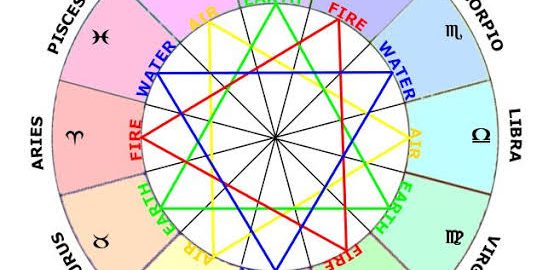
Triplicity is the traditional classification of the twelve zodiac signs into four groups based on the elements: fire, earth, air, and water. Each triplicity contains three signs. Fire includes Aries, Leo, and Sagittarius; earth includes Taurus, Virgo, and Capricorn; air includes Gemini, Libra, and Aquarius; and water includes Cancer, Scorpio, and Pisces. The term may also refer to the planetary rulers assigned to each elemental group.

Astrological Meaning

In classical astrology, every triplicity has specific planetary rulers, often divided into daytime, nighttime, and participating rulers. Their use varies somewhat among traditional sources and techniques. An astrologer may examine the appropriate ruler according to the chart’s sect—the distinction between day and night charts—to evaluate planetary support, dignity, or a topic’s capacity to develop. Triplicity rulership is generally considered a moderate essential dignity: less commanding than domicile or exaltation, but more supportive than having no dignity at all.

Why It Matters

Triplicity adds nuance to chart interpretation by showing how planets may receive support through elemental affinity and sect. It can help assess a planet’s resources, consistency, and ability to operate constructively without implying certain outcomes. The concept also connects elemental symbolism with traditional rulership, making it useful in natal, horary, and electional astrology. It should be considered alongside houses, aspects, condition, and other dignities rather than interpreted alone.

Related Encyclopedia Entries

