
.83¢/min Intro Offer

We Charge 60% LESS than our competitors!

All Psychics tested before hire.

category: Astrology Encyclopedia

Whole Signs

Definition

Whole Signs, more commonly called the whole-sign house system, is a method of dividing a horoscope into twelve houses. The entire zodiac sign containing the Ascendant becomes the first house, the following sign becomes the second house, and so on. Each house therefore begins at 0 degrees of a sign and ends at 30 degrees, rather than starting at a calculated cusp within the sign.

Astrological Meaning

In interpretation, a planet’s house is determined by the sign it occupies in relation to the rising sign. Its meaning is then refined through its zodiac sign, aspects, condition, and the placement of the house ruler. The Ascendant degree remains important, but it does not mark the first-house cusp. Likewise, the Midheaven is treated as a sensitive point and may fall in the ninth, tenth, or eleventh house rather than automatically defining the tenth-house boundary.

Why It Matters

Whole Signs offers a clear framework for connecting signs, houses, and planetary rulers. It is especially important in traditional astrology, although many modern astrologers also use it. Comparing it with other house systems can reveal shifts in house placement and emphasis without making one system universally correct.

Related Encyclopedia Entries

Weak Signs

Definition

Weak Signs is an older astrological expression for zodiac signs considered less forceful, stable, or supportive within a particular traditional method. It does not have one universally accepted list. Some sources associate weakness with mutable signs because they are adaptable rather than fixed, while others use the phrase when discussing a sign’s condition, rulership, element, or suitability for a specific question.

Astrological Meaning

A sign described as weak may indicate that a planet expresses itself with less consistency, authority, or endurance in the matter being judged. This should not be confused with essential debility, which concerns defined conditions such as detriment or fall. Sign quality is also distinct from house strength: a planet in a supposedly weak sign may still be influential if it is angular, dignified, supported by favorable aspects, or otherwise well placed. In horary and electional astrology, the term may emphasize instability or limited staying power rather than failure.

Why It Matters

Understanding this term helps readers interpret older astrological texts without treating historical value judgments as absolute rules. “Weak” is contextual, not a verdict about a person, sign, or entire natal chart. A careful interpretation identifies the system being used and then considers modality, planetary dignity, house position, aspects, sect, and reception. Modern astrologers may prefer terms such as adaptable, less stable, or conditionally supported because they describe the symbolism more precisely.

Related Encyclopedia Entries

Wave Length

Definition

Wave Length is an informal astrological expression for the degree to which people, planets, or chart patterns seem to operate in harmony. It is not a standard technical measurement in classical astrology. Instead, astrologers may use the phrase “on the same wavelength” as shorthand for compatible styles of thinking, feeling, communicating, or responding.

Astrological Meaning

In chart interpretation, a shared wave length may be associated with harmonious aspects, compatible elemental or modal emphases, and supportive links involving Mercury, the Moon, Venus, or the Ascendant. In synastry, one person’s planets are compared with another person’s placements; easy aspects can suggest natural rapport, while challenging aspects may indicate different rhythms that require adjustment. No single contact establishes complete compatibility, and an apparent lack of ease does not rule out understanding.

Why It Matters

The idea helps translate complex chart relationships into accessible language, especially when discussing communication and emotional attunement. It can also describe internal coherence within a natal chart, such as several placements reinforcing a similar temperament. Because Wave Length is metaphorical rather than a formal classical technique, it is best supported with specific chart factors instead of treated as an independent rule or predictive indicator.

Related Encyclopedia Entries

Water Signs

Definition

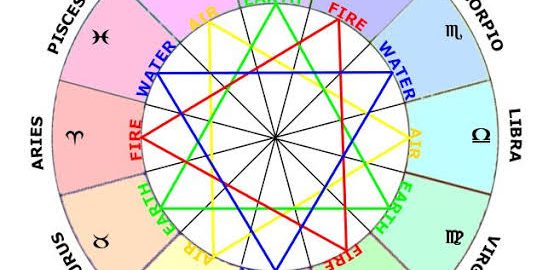
Water signs are Cancer, Scorpio, and Pisces, one of the four elemental groups in Western astrology. Water symbolizes emotion, intuition, sensitivity, receptivity, and the private currents of experience. Although these signs share an element, each expresses it differently: Cancer tends to protect, Scorpio concentrates and transforms, while Pisces dissolves boundaries and imagines possibilities.

Astrological Meaning

A strong water emphasis in a natal chart may suggest emotional awareness, empathy, imagination, and responsiveness to atmosphere. It can also indicate a tendency to absorb impressions deeply or approach situations through feeling before analysis. Water signs differ by modality: Cancer is cardinal and initiates emotional engagement, Scorpio is fixed and sustains intensity, and Pisces is mutable and adapts fluidly. Interpretation should consider the planets involved, their houses and aspects, and the balance of fire, earth, and air elsewhere in the chart. Having little water does not mean lacking emotion; feelings may simply be processed through other elemental styles.

Why It Matters

Understanding water signs helps clarify how a chart handles bonding, vulnerability, intuition, memory, and emotional security. The element can describe a preferred mode of perception rather than a fixed personality type. In relationships, comparing water placements with other elements may reveal differences in emotional pacing and communication, but no single elemental pattern determines compatibility. The whole natal chart provides the necessary context.

Related Encyclopedia Entries

Water-bearer, Waterman

Definition

Water-bearer and Waterman are traditional names for Aquarius, the eleventh sign of the zodiac. Its emblem depicts a human figure carrying or pouring water, and its glyph shows two parallel wavy lines. Despite this watery imagery, Aquarius is classified as a fixed air sign rather than a water sign.

Astrological Meaning

The Water-bearer symbolizes the distribution of something sustaining or enlightening to a wider community. Astrologically, this image is often associated with sharing ideas, knowledge, principles, or social vision. Aquarius combines the intellectual and communicative qualities of air with the persistence of the fixed modality. In traditional astrology, it is ruled by Saturn, emphasizing structure, boundaries, endurance, and collective order. Many modern astrologers also associate Aquarius with Uranus, adding themes of innovation, independence, disruption, and reform. The sign’s actual expression depends on its house placement, planetary occupants, aspects, and the condition of its ruler in a specific chart.

Why It Matters

Understanding the Water-bearer as an image of Aquarius prevents the common mistake of treating the sign as watery or primarily emotional. The symbol helps clarify how Aquarius may circulate ideas, challenge conventions, or contribute to groups while maintaining a distinct viewpoint. It also connects modern interpretations with the sign’s older Saturnian foundations.

Related Encyclopedia Entries

Watchers of the Heavens

Definition

The Watchers of the Heavens are four prominent fixed stars traditionally associated with the four directions or seasonal quarters of the sky. Commonly identified as Aldebaran, Regulus, Antares, and Fomalhaut, they are also known as the Four Royal Stars. Their directional assignments are usually east, north, west, and south respectively, although details can vary among historical sources.

Astrological Meaning

In traditional fixed-star astrology, the Watchers were linked with authority, visibility, guardianship, and exceptional responsibility. A close conjunction between one of these stars and the Sun, Moon, Ascendant, Midheaven, or a personal planet may emphasize the star’s symbolic qualities. Aldebaran is often connected with integrity and ambition, Regulus with leadership and honor, Antares with intensity and courage, and Fomalhaut with ideals and imagination. These meanings are modified by the planet involved, the chart as a whole, and the interpretive tradition being used.

Why It Matters

The Watchers of the Heavens provide historical context for interpreting important fixed stars in natal, mundane, and electional astrology. They can add nuance to themes of recognition, influence, aspiration, and accountability, but they should not be treated as automatic promises of fame or success. Because fixed-star work depends on precise positions and tight conjunctions, accurate chart calculation and careful synthesis are essential.

Related Encyclopedia Entries

