Rahu and Ketu: The Karmic Nodes of Destiny in Vedic Astrology
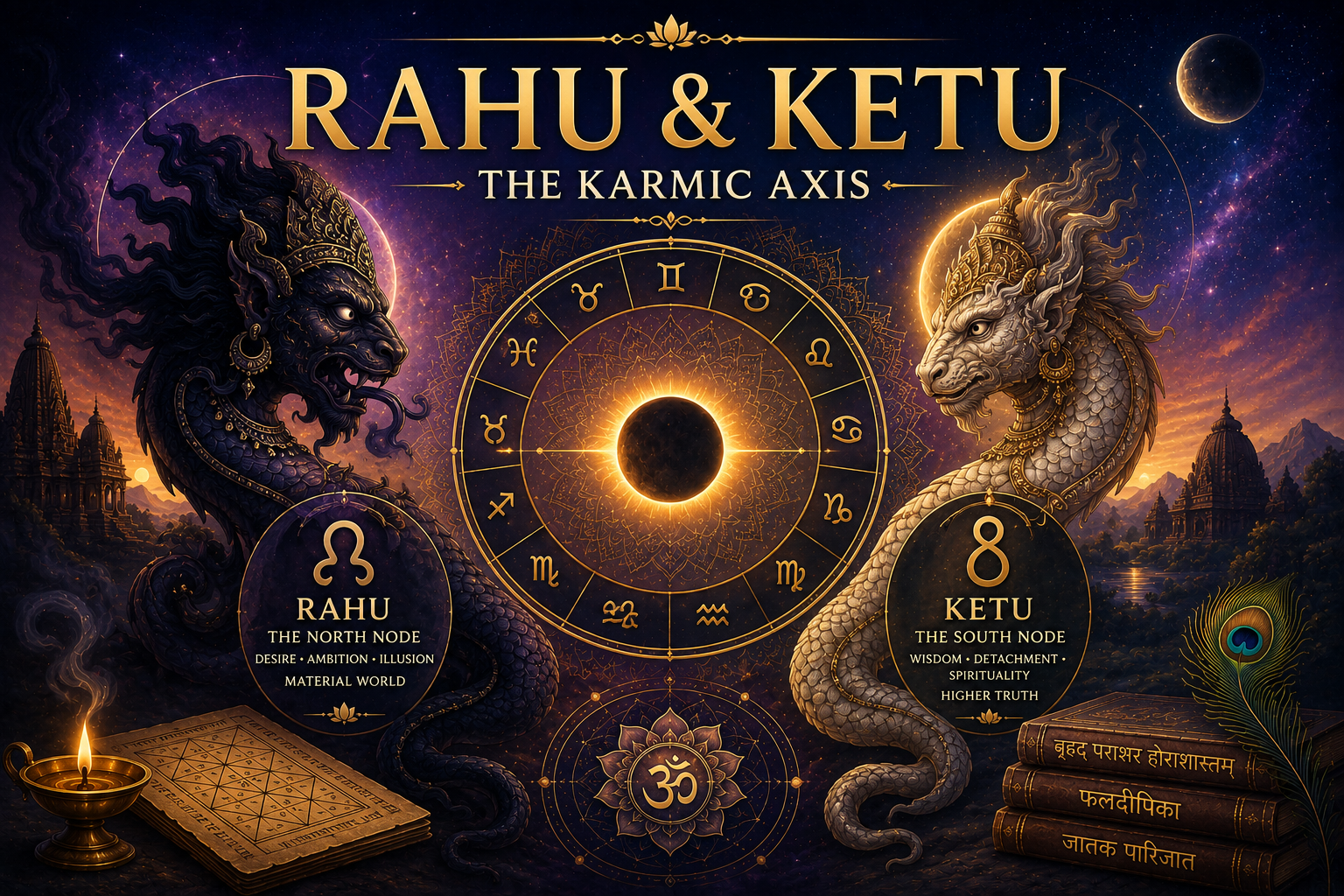
Rahu and Ketu: The Karmic Nodes of Destiny
Among all the influences found in a Vedic birth chart, few generate more fascination than Rahu and Ketu.
Unlike the Sun, Moon, or planets, Rahu and Ketu are not physical celestial bodies. You cannot see them through a telescope. Yet many astrologers consider them among the most important factors in an entire chart.
Why?
Because Rahu and Ketu are believed to reveal the soul’s journey between what is familiar and what is still waiting to be learned.
They form what astrologers often call the Karmic Axis, a symbolic line connecting past experiences, present challenges, and future growth.
While every planet contributes to the story of a birth chart, Rahu and Ketu often reveal why that story is unfolding in the first place.
🔮 Psychic Insight
Many Vedic astrologers view Rahu and Ketu as indicators of the soul’s evolutionary path. Together they highlight where growth is needed and where wisdom has already been gained.
What Are Rahu and Ketu?
Astronomically, Rahu and Ketu represent the points where the orbit of the Moon intersects the apparent path of the Sun.
These points are known as the lunar nodes.
In Western Astrology they are often called the North Node and South Node.
In Vedic Astrology, however, Rahu and Ketu are far more than mathematical points. They are treated as powerful Grahas that influence destiny, life direction, and spiritual development.
Rahu is known as the North Node.
Ketu is known as the South Node.
Together they always appear directly opposite one another in the birth chart.
The Story Behind Rahu and Ketu
Ancient Vedic mythology tells the story of a celestial being who disguised himself among the gods in order to drink the nectar of immortality.
Before he could fully consume it, he was discovered.
The god Vishnu severed his head from his body.
Because the nectar had already touched him, both parts remained immortal.
The head became Rahu.
The body became Ketu.
This symbolism remains deeply embedded within Vedic Astrology.
Rahu, the head without a body, constantly desires more.
Ketu, the body without a head, often represents detachment, wisdom, and experiences that no longer require conscious pursuit.
Rahu: The Great Desire
Rahu is often associated with ambition, obsession, curiosity, innovation, and worldly achievement.
It represents areas where the soul seeks new experiences and unfamiliar lessons.
Rahu wants growth.
Rahu wants expansion.
Rahu wants to explore territory that feels exciting, uncomfortable, and unknown.
Depending on its placement, Rahu may create strong desires involving:
- Career success
- Recognition
- Relationships
- Wealth
- Technology
- Travel
- Spiritual knowledge
- Personal achievement
Because Rahu is associated with desire, it can sometimes create restlessness.
No matter how much is achieved, Rahu often continues searching for more.
✨ Did You Know?
Many astrologers associate Rahu with innovation, foreign cultures, technology, media, and unconventional life paths. Rahu often encourages people to explore experiences outside their comfort zone.
Ketu: The Wise Sage
If Rahu represents the future, Ketu often represents the past.
Ketu is associated with wisdom, detachment, spirituality, introspection, and inner understanding.
Where Rahu seeks experience, Ketu seeks meaning.
Where Rahu says “I want more,” Ketu often says “I’ve already been there.”
Ketu may indicate natural talents or areas where the soul already possesses experience and familiarity.
Because of this, Ketu can create both strengths and challenges.
While it often grants insight and intuition, it can also produce feelings of boredom or detachment toward areas that once seemed important.
Its lessons frequently involve learning when to release attachment and trust inner wisdom.
The Karmic Axis
The true power of Rahu and Ketu emerges when viewed together.
They form a single axis connecting past and future.
Comfort and growth.
Wisdom and exploration.
Familiarity and discovery.
Imagine a person who feels naturally comfortable in one area of life but repeatedly encounters opportunities pushing them toward something entirely different.
That tension often reflects the dynamic relationship between Rahu and Ketu.
The soul may already understand one side of the axis while still learning the lessons represented by the other.
🌙 Spiritual Lesson
Growth often requires moving beyond what feels comfortable. Rahu invites exploration, while Ketu reminds us to carry wisdom from the past into the future.
Rahu and Ketu Through The Houses
The house placement of Rahu and Ketu reveals where these karmic themes are most likely to appear.
For example:
- Rahu in the 10th House may emphasize career growth and public recognition.
- Ketu in the 4th House may create lessons involving family, roots, and emotional security.
- Rahu in the 7th House may intensify relationship experiences.
- Ketu in the 1st House may encourage spiritual development and self-understanding.
Every placement tells a different story, which is why the entire chart must be considered before drawing conclusions.
Rahu and Ketu During Dashas
The influence of Rahu and Ketu often becomes especially noticeable during their planetary periods, known as Dashas.
Many people report significant life changes during Rahu or Ketu Dashas.
These periods may involve:
- Major career shifts
- New relationships
- Spiritual awakenings
- Unexpected opportunities
- Changes in priorities
- Life-changing decisions
Because Rahu and Ketu operate on a karmic level, their Dashas often feel particularly meaningful and transformative.
Are Rahu and Ketu Good or Bad?
This is one of the most common questions asked by astrology students.
The answer is surprisingly simple:
Neither.
Rahu and Ketu are not inherently positive or negative.
They are teachers.
Like all teachers, they may challenge us.
They may push us beyond familiar territory.
Yet those very experiences often produce tremendous growth and self-awareness.
Understanding Rahu and Ketu requires looking beyond simple labels and recognizing their role in the soul’s evolution.
Final Thoughts
Rahu and Ketu occupy a unique place within Vedic Astrology.
They represent the tension between where we have been and where we are going.
One points toward growth and new experiences.
The other points toward wisdom and understanding already gained.
Together they create one of the most powerful indicators of destiny found within a birth chart.
By understanding this karmic axis, we gain insight into the lessons, opportunities, and experiences shaping our life’s journey.
🌟 Personalized Insight
The placement of Rahu and Ketu is highly personal. While general interpretations provide useful guidance, a complete birth chart reveals how these karmic forces uniquely influence your relationships, career, spiritual growth, and life direction.
Related Vedic Astrology Topics
- The Nine Grahas
- Understanding Karma Through Vedic Astrology
- What Are Nakshatras?
- What Is Vimshottari Dasha?
- The Navamsa Chart
Continue Exploring Astrology
Deepen your understanding of astrology by exploring the birth chart, natal chart, horoscope, zodiac signs, astrology houses, planetary aspects, Ascendant, Midheaven, MC, rising sign, house rulers, house cusps, synastry, compatibility, transits, retrograde planets, and chart interpretation.
Planets in Astrology
Study the Sun, Moon, Mercury, Venus, Mars, Jupiter, Saturn, Uranus, Neptune, and Pluto to understand how each planet shapes personality, emotions, relationships, career, purpose, growth, and transformation.
Zodiac Signs and Houses
Explore Aries, Taurus, Gemini, Cancer, Leo, Virgo, Libra, Scorpio, Sagittarius, Capricorn, Aquarius, and Pisces. Then compare the 1st House, 2nd House, 3rd House, 4th House, 5th House, 6th House, 7th House, 8th House, 9th House, 10th House, 11th House, and 12th House.
Major Astrology Aspects
Learn how a conjunction, opposition, square, trine, sextile, and quincunx change the way planets interact. Comparing conjunct, opposite, square, trine, sextile, and quincunx aspects helps reveal the full pattern of a chart.

