
83¢/min
Intro Offer
We charge 60% LESS than our competitors!
Tons of spot-on predictions in our newsletter.

category: Astrology Encyclopedia

Elongation

Definition

Elongation is the angular distance between a celestial body and the Sun as observed from Earth. It is measured in degrees along the sky, from 0° at conjunction to 180° at opposition. A body may have eastern or western elongation, indicating which side of the Sun it occupies. Mercury and Venus have limited maximum elongations because their orbits lie inside Earth’s orbit.

Astrological Meaning

In astrology, elongation helps describe a planet’s relationship to the Sun and its visibility in the sky. Small elongation may place a planet near conjunction with the Sun, bringing concepts such as combustion, under the beams, or cazimi into consideration according to the tradition and exact distance involved. Greater elongation generally makes Mercury or Venus more visible as a morning or evening star. For the Moon, elongation corresponds closely with lunar phase: conjunction marks the New Moon, about 90° indicates a quarter phase, and opposition marks the Full Moon.

Why It Matters

Elongation provides astronomical context for astrological interpretation. It helps an astrologer distinguish a planet hidden in solar glare from one that is visibly established in the morning or evening sky. In natal, electional, and mundane work, this information can refine assessments of planetary condition and lunar phase, though its significance depends on the astrological system, the planet involved, and other chart factors.

Related Encyclopedia Entries

Eleveation by House Position

Definition

Eleveation by House Position refers to the traditional assessment of a planet’s prominence or strength according to its location among the twelve houses. It is a form of accidental dignity: the planet’s circumstances in the chart affect how readily it can act, rather than changing its underlying nature. Planets in angular houses—especially near the Ascendant or Midheaven—are generally considered more elevated and effective than planets in succedent or cadent houses.

Astrological Meaning

A planet elevated by house position tends to have greater visibility and influence over the matters it signifies. Angularity can make its themes conspicuous, active, or capable of producing noticeable results. This does not automatically make the planet beneficial. A dignified Venus may express its constructive qualities more openly, while a difficult Mars could make conflict or urgency more apparent. Interpretation should also consider the planet’s sign, rulership, aspects, sect, speed, and proximity to a house cusp.

Why It Matters

This concept helps distinguish a planet’s essential condition from its practical ability to operate. A planet may be strong by sign but placed in a less active house, or weak by sign yet highly prominent because it is angular. Comparing both forms of dignity produces a more balanced natal, horary, or electional interpretation and prevents house placement from being judged in isolation.

Related Encyclopedia Entries

Elevation by Latitude

Definition

Elevation by Latitude is a traditional astrological condition in which one planet is considered elevated above another because of its greater celestial latitude, usually its position farther north of the ecliptic. Celestial latitude measures angular distance north or south of the ecliptic and should not be confused with geographic latitude or declination.

Astrological Meaning

In classical interpretation, the elevated planet may be granted a measure of prominence, authority, or advantage over the planet situated at a lower latitude. This is a relative comparison between planets rather than a complete judgment about either planet’s strength. Its significance depends on the method of the astrologer, since historical authorities did not always define or weigh elevation identically. Sign, house, aspects, sect, motion, and essential dignity remain important parts of the assessment.

Why It Matters

Elevation by Latitude shows how traditional astrology can consider a planet’s three-dimensional position rather than relying only on zodiacal longitude. It may refine judgments about which planet has the stronger voice in an aspect, configuration, or contest of significators. Because it is a specialized and usually secondary testimony, it is best used to supplement clearer indications in the natal chart rather than override them.

Related Encyclopedia Entries

Elevation of the Pole

Definition

Elevation of the Pole is the angular height of the celestial pole above the local horizon. At a given location, this angle is equal to the observer’s geographic latitude. The term belongs to the astronomical framework underlying traditional chart construction and should not be confused with a planet’s elevation, prominence, or accidental dignity.

Astrological Meaning

In classical astrology, the elevation of the pole helps relate the celestial sphere to a specific place on Earth. Because the horizon and meridian change with latitude, pole elevation affects the Ascendant, house cusps, rising times, and other location-dependent measurements. It is especially relevant to traditional house calculation, mundane position, and some methods of primary direction. Certain directional techniques may also assign a pole to a planet or point, using a calculated value rather than simply the birthplace latitude; the exact procedure depends on the method employed.

Why It Matters

This concept explains why charts cast for the same moment can differ when calculated for different locations. It also helps students understand that many traditional techniques depend on spherical astronomy, not symbolism alone. Accurate latitude, calculation methods, and terminology are therefore important when reconstructing older charts or applying classical predictive systems.

Related Encyclopedia Entries

Elements

Definition

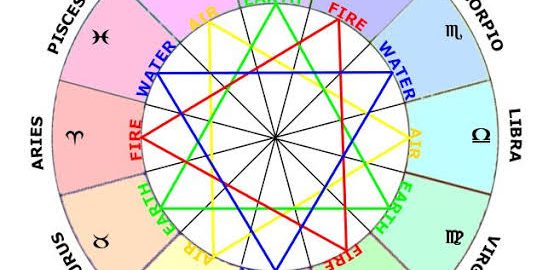
In astrology, the elements are four fundamental categories used to classify the zodiac signs: Fire, Earth, Air, and Water. Aries, Leo, and Sagittarius are Fire signs; Taurus, Virgo, and Capricorn are Earth signs; Gemini, Libra, and Aquarius are Air signs; Cancer, Scorpio, and Pisces are Water signs. Each element represents a broad style of expression and experience.

Astrological Meaning

Fire is associated with initiative, enthusiasm, confidence, and inspiration. Earth emphasizes practicality, stability, patience, and tangible results. Air relates to thought, communication, social exchange, and objectivity, while Water concerns emotion, intuition, sensitivity, and connection. Astrologers examine the elemental distribution of planets in a natal chart, especially the Sun, Moon, Ascendant, and personal planets. A strongly represented element may describe familiar strengths or preferred responses. An element with little representation does not indicate a defect; it may point to qualities developed more consciously, expressed through house placements, or supported by relationships and life experience.

Why It Matters

Elemental balance offers a quick way to understand a chart’s overall temperament before studying finer details. It can clarify how someone tends to approach decisions, relationships, challenges, and creative activity. Elements also help compare signs in synastry and organize traditional ideas about compatibility, although planetary aspects, houses, modalities, and the complete charts provide essential context.

Related Encyclopedia Entries

Electric planets

Definition

Electric planets are planets classified in some older or esoteric astrological systems as active, projective, stimulating, or outwardly expressive. The term is symbolic rather than a scientific claim about planetary electricity. Lists differ by author, but the Sun, Mars, and Jupiter are commonly placed in the electric group; Uranus may be included in modernized versions. Mercury is often treated as variable or neutral. Electric planets are usually contrasted with magnetic planets, which represent receptive, attractive, consolidating, or inward-moving qualities.

Astrological Meaning

When this classification is used, an electric planet emphasizes initiative, release, assertion, visibility, and the impulse to act upon circumstances. Its expression still depends on the planet itself, its sign, house, aspects, dignity, and condition. Mars may project force through decisive action, for example, while Jupiter may express an expansive or encouraging influence. Calling either planet electric does not replace its established astrological meanings or determine whether its effects will be constructive.

Why It Matters

The concept is most useful when reading historical, occult, or specialized astrological texts that organize planets by polarity. It can clarify why an author describes certain planetary influences as active and others as receptive. Because the terminology is not standardized in classical astrology, practitioners should identify the source’s exact planetary assignments before applying it to a natal chart. Used carefully, electric polarity adds descriptive nuance; it should not be treated as a standalone predictive technique.

Related Encyclopedia Entries

