
All posts by admin

New Year’s Day

Definition

New Year's Day is the first day of a civil calendar year. In the Gregorian calendar, it falls on January 1, although other cultural and religious calendars begin the year on different dates. It is a calendrical observance rather than an astronomical event, so it should not be confused with a solstice, equinox, zodiacal ingress, or planetary return.

Astrological Meaning

Astrologers may cast a chart for midnight on January 1 at a particular location to explore themes associated with the coming civil year. Interpretation considers the Ascendant, its ruler, planetary placements, houses, and major aspects. Because the chart depends on location and the chosen time standard, it is best treated as a symbolic event chart rather than a universal forecast. Traditional mundane astrology more commonly gives special weight to seasonal ingresses, especially the Sun’s entry into Aries, when assessing collective trends.

Why It Matters

New Year's Day matters astrologically because it illustrates the difference between human calendar systems and cycles measured in the sky. A January 1 chart can support reflection on intentions, public moods, or local concerns, but it does not replace a natal chart, solar return, transit analysis, or an Aries ingress chart. Recognizing those distinctions helps keep interpretation precise and prevents cultural convention from being mistaken for a fixed celestial beginning.

Related Encyclopedia Entries

Neomenium

Definition

Neomenium is an older term for the New Moon or the beginning of a lunar month. It derives from Greek language associated with the “new month.” Historical usage varies: it may indicate the astronomical conjunction of the Sun and Moon, when they share the same zodiacal longitude, or the first visible lunar crescent that follows conjunction. The intended meaning therefore depends on the calendar and astrological tradition being consulted.

Astrological Meaning

In astrology, the neomenium marks the opening of a lunation cycle. A chart cast for the exact Sun–Moon conjunction is interpreted as a symbolic outline for themes developing until the next New Moon, with particular attention often given to its zodiac sign, house placement, aspects, and local angles. Traditional practitioners may also examine the first crescent or use the lunation in mundane, electional, and natal work. When a neomenium closely contacts a natal planet or angle, it may emphasize matters associated with that point, though the wider chart and current transits shape how this emphasis is expressed.

Why It Matters

Understanding this term helps readers interpret older astrological texts without assuming that every reference uses the same definition of “New Moon.” Distinguishing exact conjunction from first visibility is especially important when calculating charts or comparing traditions. The neomenium also provides a practical timing framework for observing beginnings, setting intentions, and tracking how a monthly theme develops, without treating the lunation as a fixed prediction.

Related Encyclopedia Entries

Negative Sign

Definition

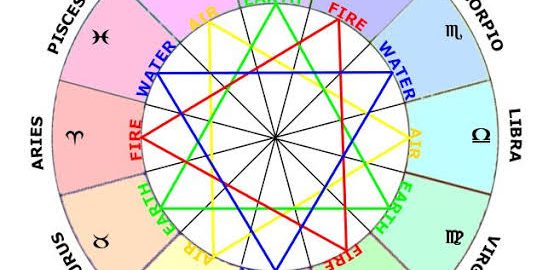
A negative sign is a zodiac sign traditionally classified as receptive, inwardly directed, or responsive. The six negative signs are the earth signs—Taurus, Virgo, and Capricorn—and the water signs—Cancer, Scorpio, and Pisces. Here, “negative” describes one side of astrological polarity; it does not mean harmful, unfortunate, or inferior. Many contemporary astrologers instead use the terms receptive, yin, or feminine polarity.

Astrological Meaning

Negative signs tend to process experience by absorbing, containing, consolidating, or responding rather than immediately projecting energy outward. Earth signs often express this polarity through practicality, stability, and attention to tangible conditions. Water signs may express it through feeling, intuition, emotional sensitivity, and adaptation. In a natal chart, an emphasis on negative signs can suggest a reflective or reserved orientation, but it should not be interpreted alone. The planets involved, their houses and aspects, and the balance of elements and modalities all modify how this polarity appears.

Why It Matters

Understanding negative signs helps clarify the zodiac’s alternating polarity and prevents the term from being mistaken for a judgment. Comparing the chart’s receptive and active signs can reveal how a person takes in experience, initiates action, and balances contemplation with outward expression. An apparent imbalance is not automatically a weakness; it describes a style that may be supported or redirected by other chart factors.

Related Encyclopedia Entries

Nebulae

Definition

Nebulae are clouds of gas and dust in space. In older astronomical and astrological texts, however, the term could also describe hazy-looking star clusters or indistinct celestial patches that had not yet been resolved into separate objects. Their astrological use therefore belongs mainly to traditional fixed-star practice rather than to planets, signs, or houses.

Astrological Meaning

Traditional astrologers sometimes treated nebulae as sensitive regions whose blurred appearance symbolized obscurity, distraction, uncertainty, or difficulty perceiving a situation clearly. Certain objects historically classified as nebulous, including Praesepe and the Pleiades, received their own interpretations based on their location and associated stars. Older texts occasionally connected these regions with impaired sight or misfortune, but such statements are best understood as historical symbolism rather than medical diagnosis or inevitable prediction. In a natal chart, astrologers usually consider a nebula only when it closely conjoins the Sun, Moon, Ascendant, Midheaven, or a planet. Interpretation should include the specific object, conjunction orb, planetary condition, and wider chart context.

Why It Matters

Nebulae illustrate how astrology developed alongside changing astronomical knowledge. Recognizing the older meaning of the term helps readers interpret traditional sources accurately and avoid treating every modern astronomical nebula as an established astrological factor. When used today, nebulae can add a subtle fixed-star layer to chart analysis, but they should not outweigh clearer planetary, angular, and house indications.

Related Encyclopedia Entries

Nebuchadnezzar, Temple of

Definition

“Temple of Nebuchadnezzar” is a historical rather than a standard technical term in astrology. It generally refers to the Babylonian temples restored or constructed under Nebuchadnezzar II, who ruled from 605 to 562 BCE. These included major sacred complexes associated with Marduk and other deities in a culture where celestial events carried religious and political significance.

Astrological Meaning

Its astrological relevance comes from the setting of Babylonian celestial scholarship. Learned scribes observed the Moon, planets, eclipses, weather phenomena, and unusual events, recording patterns and interpreting omens, often for the king and state. Temple institutions helped preserve this specialized knowledge. However, the phrase does not denote a planet, zodiac sign, house, aspect, natal placement, or recognized chart-reading method.

Why It Matters

Understanding this term provides historical context for the development of astrology. Babylonian omen traditions contributed to increasingly systematic celestial observation and later forms of horoscopic practice. Nebuchadnezzar’s era should not be treated as identical to modern natal astrology, which developed through later stages. The term is therefore most useful when studying ancient Mesopotamian religion, scholarly institutions, and the long transition from celestial omens to formal astrological techniques.

Related Encyclopedia Entries

Nebo

Definition

Nebo is an older name for Nabu, the Mesopotamian deity of writing, learning, record-keeping, and divine communication. Through historical correspondences between Mesopotamian, Greek, and Roman traditions, Nebo became associated with the planet Mercury. The term may appear in older astrological, mythological, biblical, or occult texts, but it is not commonly used as a separate factor in modern natal charts.

Astrological Meaning

When Nebo is used astrologically, it generally points to Mercurial themes: language, reasoning, calculation, messages, scholarship, and the transmission of knowledge. Its historical background adds particular emphasis to scribes, archives, interpretation, and intellectual authority. Nebo should therefore be understood as a cultural or symbolic designation connected with Mercury rather than as an additional planet, sign, house, or aspect. Interpretation still depends on Mercury’s zodiac sign, house position, aspects, condition, and the wider chart context.

Why It Matters

Recognizing Nebo helps readers understand older astrological terminology without mistakenly adding a new chart component. The name also preserves an important link between astrology and Mesopotamian traditions, where planets were understood through divine and civic symbolism. In historical study, Nebo can enrich the interpretation of Mercury by highlighting disciplined learning, written records, and the responsibilities attached to communication. In practical chart work, however, standard Mercury techniques remain the clearest basis for analysis.

Related Encyclopedia Entries

