
83¢/min
Intro Offer
We charge 60% LESS than our competitors!
Tons of spot-on predictions in our newsletter.

category: Astrology Encyclopedia

Saturn 19, Mercury 17

Definition

“Saturn 19, Mercury 17” is shorthand that most likely records Saturn at 19 degrees and Mercury at 17 degrees in an astrological chart or table. The notation is incomplete without the zodiac signs, houses, chart type, and degree system. The two-degree numerical difference alone does not establish an aspect, because planetary relationships are measured by their full zodiacal positions.

Astrological Meaning

Saturn symbolizes structure, limits, responsibility, time, and sustained effort. Mercury represents speech, reasoning, learning, calculation, commerce, and messages. If both planets occupy the same sign at 19 and 17 degrees, they form a close conjunction with an orb of about two degrees. This may suggest disciplined thought, careful communication, serious study, or a tendency to review ideas cautiously. If they are in different signs, the relationship could be another aspect—or no recognized aspect at all—depending on their actual longitudes. Traditional interpretation may also consider sign rulership, dignity, house placement, sect, speed, and whether Mercury is applying to or separating from Saturn.

Why It Matters

Accurate interpretation requires reconstructing the complete notation rather than treating the numbers as a self-contained prediction. A close Mercury–Saturn contact can describe focused mental habits, but its expression varies with the condition of both planets and the topics governed by their houses. Checking the original chart context helps distinguish a conjunction from unrelated degree placements and prevents an overly narrow reading.

Related Encyclopedia Entries

Hindu Astrology

Definition

Hindu Astrology is a broad term for the astrological traditions of India, more precisely called Jyotisha. It encompasses natal interpretation, electional astrology, horary methods, compatibility analysis, and predictive timing. Many practitioners use a sidereal zodiac, although techniques and calculations vary among lineages and regional schools.

Astrological Meaning

A Jyotisha reading commonly considers the nine grahas, or planetary influences; the twelve houses; zodiac signs; and the lunar mansions known as nakshatras. The ascendant, Moon, and planetary rulers often receive particular attention. Divisional charts may explore specific areas of life, while dasha systems describe periods in which certain planetary themes become more prominent. Transits are usually interpreted alongside the natal chart and its timing cycles rather than in isolation. Concepts such as planetary strength, aspects, combinations called yogas, and supportive or challenging conditions add further detail. No single factor determines an outcome, and interpretive priorities can differ between traditions.

Why It Matters

Hindu Astrology offers a structured way to examine temperament, relationships, responsibilities, opportunities, and changing life periods. Its value lies in combining natal symbolism with detailed timing methods and a philosophical emphasis on awareness, choice, and purposeful action. Understanding its distinct terminology and framework helps prevent it from being treated as merely a different zodiac calculation.

Related Encyclopedia Entries

Hexagon

Definition

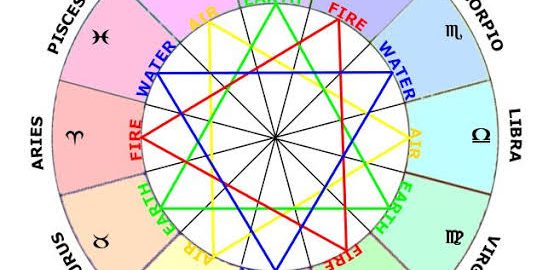
In astrological geometry, a hexagon is a six-sided figure created by dividing the zodiac’s 360-degree circle into six equal sections. Each section spans 60 degrees, the angular distance associated with the sextile aspect. The term may describe this geometric principle or, more rarely, a chart pattern formed by six interconnected sextiles.

Astrological Meaning

The hexagon expresses the symbolism of the number six: coordination, proportion, and the productive linking of different chart factors. Its primary aspect, the sextile, connects planets or points approximately 60 degrees apart. Astrologers generally regard this relationship as supportive, although its possibilities often require attention or initiative to become visible. When six placements form a complete hexagonal pattern—commonly called a Grand Sextile—the chart may contain an unusual network of sextiles, trines, and oppositions. Interpretation depends on the planets, signs, houses, aspect orbs, and overall chart context rather than on the shape alone.

Why It Matters

Understanding the hexagon clarifies why the sextile belongs to the traditional aspect system: it arises from an exact mathematical division of the zodiac. It also helps separate a single sextile from a complex Grand Sextile configuration. In practical chart reading, the geometry can reveal channels of cooperation and complementary abilities, but it does not guarantee ease or success. The people and life areas represented by the connected planets and houses show where constructive exchange may be developed.

Related Encyclopedia Entries

Herschel

Definition

Herschel is an old astronomical and astrological name for Uranus, honoring William Herschel, who identified the planet in 1781. The term appears mainly in historical ephemerides, chart tables, and nineteenth-century writings. It does not denote a separate planet or hypothetical point; in most astrological contexts, Herschel and Uranus refer to the same celestial body.

Astrological Meaning

When Herschel appears in an older horoscope, it is generally interpreted according to the astrological role assigned to Uranus. Modern astrology associates Uranus with independence, innovation, sudden change, unconventional choices, disruption, and breakthroughs in awareness. Its expression is refined through its zodiac sign, house position, and aspects to other planets. Because Uranus was unknown to ancient astrologers, it is not one of the seven traditional planets. Some traditional astrologers exclude it, while others use it as a supplementary influence without assigning it rulership over classical techniques.

Why It Matters

Recognizing Herschel as Uranus helps readers interpret historical charts accurately and prevents the same planet from being counted twice. The term also reflects astrology’s changing vocabulary after the discovery of planets beyond Saturn. Understanding that historical context makes older texts easier to compare with modern chart notation and clarifies the difference between classical planetary frameworks and later astrological practice.

Related Encyclopedia Entries

Hermetic

Definition

Hermetic describes teachings associated with Hermes Trismegistus, a legendary figure linking the Greek Hermes with the Egyptian Thoth. Hermetic traditions explore the relationship between mind, nature, the divine, and the cosmos. In esoteric contexts, the term often suggests hidden or initiatory knowledge, although it can also refer more broadly to a philosophical tradition built around cosmic order and correspondence.

Astrological Meaning

In astrology, Hermetic usually identifies ideas or practices influenced by this philosophical heritage rather than a specific planet, sign, house, or aspect. A central Hermetic theme is correspondence between different levels of existence, which supports the astrological view that celestial patterns can symbolically reflect earthly experience. Hermetic influence is especially visible in traditional cosmology, planetary symbolism, alchemy, and some forms of astrological magic. Not every traditional technique is strictly Hermetic, however, and the term should not be used as a blanket label for all ancient astrology.

Why It Matters

Understanding the term helps place astrology within its wider intellectual and spiritual history. It clarifies why planets have accumulated symbolic links with metals, deities, virtues, colors, and other categories. For chart readers, a Hermetic perspective can encourage an integrated interpretation in which planetary factors are considered as interconnected symbols. Its value is primarily philosophical and contextual; it does not replace the practical analysis of chart placements, aspects, timing methods, or personal circumstances.

Related Encyclopedia Entries

Hermes

Definition

Hermes is the Greek deity associated with communication, language, travel, trade, boundaries, interpretation, and the carrying of messages. In classical astrology, Hermes corresponds to the planet Mercury. The Roman name Mercury became standard in much Western astrological terminology, but Greek and Hellenistic texts often refer to the planetary god as Hermes.

Astrological Meaning

As a planetary archetype, Hermes describes how information is gathered, translated, exchanged, and applied. His symbolism includes speech, writing, calculation, bargaining, movement, wit, and mediation between different realms or viewpoints. In a natal chart, these functions are primarily interpreted through Mercury’s zodiac sign, house, aspects, condition, and relationship to the Sun. A strongly placed Mercury may emphasize intellectual agility or communicative skill, while a challenged Mercury can suggest areas requiring greater care, reflection, or precision. Neither condition determines intelligence or honesty by itself.

Why It Matters

Understanding Hermes adds cultural depth to Mercury’s astrological meaning. The image of a swift messenger and boundary-crosser explains why Mercury is linked not only with thinking and speaking, but also with commerce, travel, translation, and adaptability. This background can help astrologers interpret Mercury as an active process connecting people, ideas, and circumstances rather than simply as a symbol of the mind.

Related Encyclopedia Entries

