
Vedic Astrology vs Western Astrology: Understanding the Key Differences
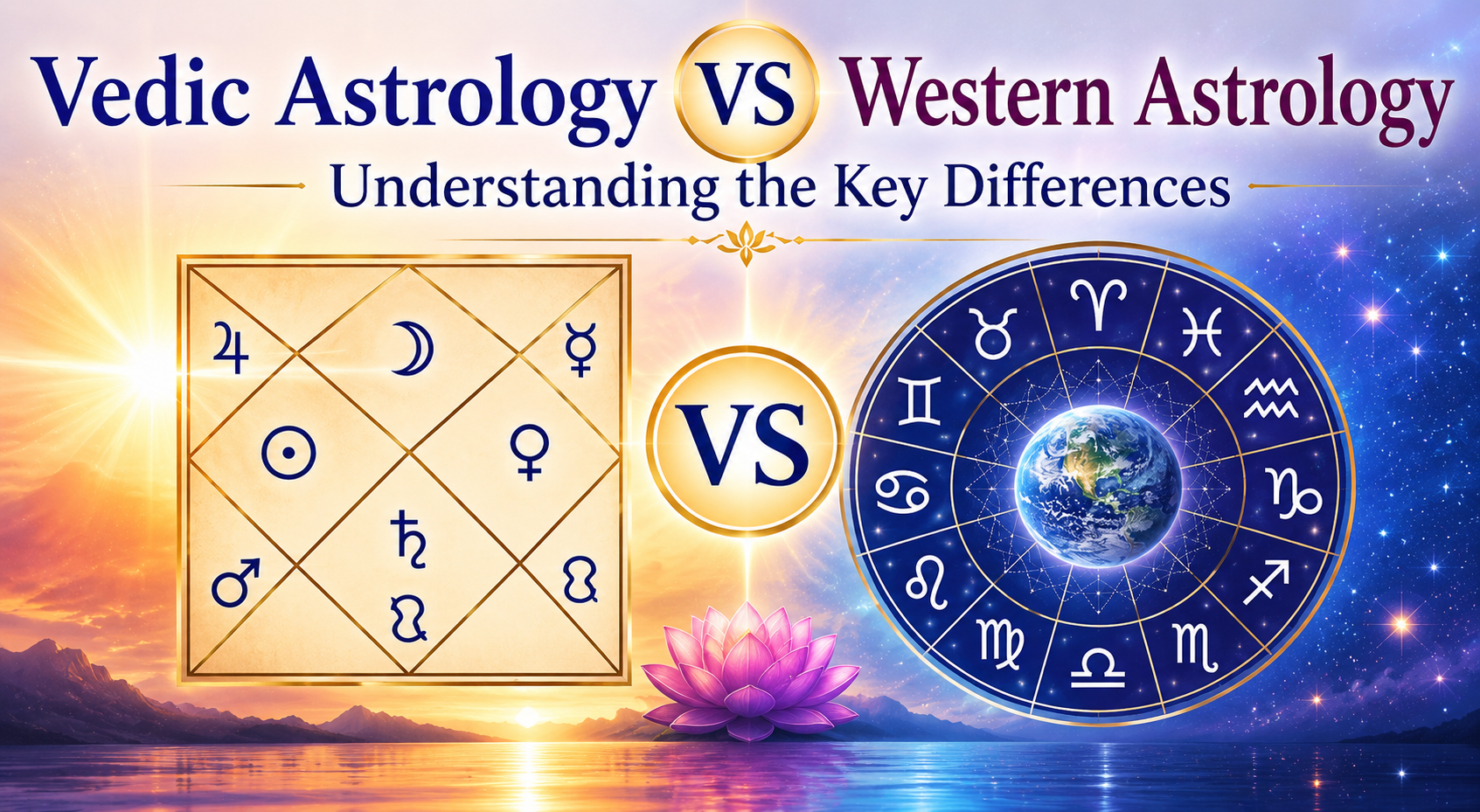
Vedic Astrology vs Western Astrology: Understanding the Key Differences
If you’ve ever compared your Vedic birth chart to your Western astrology chart, you may have noticed something surprising.
Your zodiac sign may have changed.
A person who identifies as a Leo in Western Astrology might discover they are actually a Cancer in Vedic Astrology. A Sagittarius could become a Scorpio. For many people, this creates confusion and raises an important question:
Which system is correct?
The answer may surprise you.
According to most astrologers, both systems can offer valuable insight. The real difference lies not in whether one is right and the other is wrong, but in what each system is designed to reveal.
While Western Astrology often focuses on personality, psychology, and self-expression, Vedic Astrology places greater emphasis on karma, destiny, timing, and spiritual growth.
Think of them as two different maps describing the same journey.
🔮 Psychic Insight
Many professional astrologers study both systems. Rather than competing with one another, they often provide different perspectives on the same life experiences.
A Shared Beginning
Many people assume Vedic Astrology and Western Astrology developed completely independently. In reality, both systems share many similarities.
Both use:
- Twelve zodiac signs
- Planetary symbolism
- Houses representing different areas of life
- Birth charts calculated from the time and place of birth
In both traditions, Mars symbolizes action, Venus relates to love, and Saturn is associated with responsibility and discipline.
Despite these similarities, the two systems eventually evolved in different directions.
The Biggest Difference: The Zodiac
The most obvious difference between the two systems involves the zodiac itself.
Western Astrology primarily uses the Tropical Zodiac.
The Tropical Zodiac is tied to the seasons and begins at the Spring Equinox.
Vedic Astrology uses the Sidereal Zodiac, which is aligned with the actual constellations in the sky.
Because the Earth slowly wobbles on its axis over thousands of years, the constellations have gradually shifted relative to the seasonal zodiac. This phenomenon is known as the Precession of the Equinoxes.
As a result, there is currently a difference of roughly twenty-four degrees between the two systems.
This is why your Sun sign may appear different when calculated using Vedic Astrology.
✨ Did You Know?
Many people who discover their Vedic sign for the first time are surprised by how strongly they relate to it, especially when they learn about their Moon sign and Nakshatra.
Personality Versus Destiny
One of the easiest ways to understand the difference between these two systems is to examine their primary focus.
Western Astrology often asks:
- Who am I?
- How do I express myself?
- What motivates me?
- How do I relate to others?
Vedic Astrology often asks:
- Why am I here?
- What lessons am I meant to learn?
- What karmic patterns am I carrying?
- What opportunities are unfolding at this stage of life?
Neither approach is superior.
They simply emphasize different aspects of the human experience.
The Importance of the Moon
In Western Astrology, the Sun sign receives most of the attention.
In Vedic Astrology, the Moon often plays an equally important—and sometimes greater—role.
The Moon represents:
- Emotions
- Habits
- Mental patterns
- Intuition
- Daily experiences
Many predictive systems begin with the Moon’s placement because it reflects how life is actually experienced from moment to moment.
This emphasis on the Moon is one reason Vedic Astrology often feels deeply personal and emotionally accurate.
Vedic Astrology’s Secret Weapon: Dashas
One of the most powerful features of Vedic Astrology is a timing system known as Dashas.
Dashas divide life into planetary chapters that unfold over time.
Imagine reading a book.
Each chapter focuses on a different theme.
Life, according to Vedic Astrology, unfolds in much the same way.
- A Venus period may emphasize relationships and creativity.
- A Saturn period may focus on responsibility and maturity.
- A Jupiter period may bring growth, learning, and opportunity.
- A Rahu period may introduce dramatic changes and new experiences.
This timing system is one reason many people seek Vedic Astrology when facing major life decisions.
Rather than feeling lost, they gain a framework for understanding why certain experiences are occurring now.
🌙 Spiritual Lesson
Life unfolds in seasons. Vedic Astrology teaches that every chapter serves a purpose, even those that initially appear difficult or confusing.
Nakshatras: The Missing Layer
Another unique feature of Vedic Astrology is its use of Nakshatras, often called Lunar Mansions.
The zodiac is divided into twenty-seven Nakshatras, each carrying its own symbolism, mythology, strengths, and challenges.
This creates a level of detail rarely found in mainstream astrology.
Two people may share the same zodiac sign yet have completely different Nakshatras, resulting in very different personalities and life experiences.
Many astrologers consider the Nakshatras among the most revealing features of a Vedic chart.
Which System Should You Choose?
This is one of the most common questions asked by astrology enthusiasts.
The truth is that many professional astrologers study both systems.
Western Astrology often excels at understanding personality dynamics, relationships, and psychological development.
Vedic Astrology often excels at timing, karmic analysis, and life-path interpretation.
Rather than choosing one over the other, many people find value in exploring both perspectives.
Together, they can provide a more complete picture of who you are and where your life may be headed.
Final Thoughts
Vedic Astrology and Western Astrology are not rivals.
They are different languages describing the same sky.
One focuses more heavily on psychological insight. The other places greater emphasis on karma, destiny, and spiritual evolution.
Whether you choose one system or study both, each offers valuable tools for understanding yourself and your life’s journey.
The real question is not which system is correct.
The real question is which perspective helps you better understand your unique path.
🌟 Personalized Insight
General astrology articles can explain the differences between Vedic and Western Astrology, but your personal birth chart reveals how these systems uniquely apply to your life. Two people may share the same sign yet experience very different opportunities, relationships, and life lessons based on their complete chart.
Related Vedic Astrology Topics
- What Is Vedic Astrology?
- Understanding Karma Through Vedic Astrology
- The Sidereal Zodiac Explained
- What Are Nakshatras?
- What Is Vimshottari Dasha?
Continue Exploring Astrology
Deepen your understanding of astrology by exploring the birth chart, natal chart, horoscope, zodiac signs, astrology houses, planetary aspects, Ascendant, Midheaven, MC, rising sign, house rulers, house cusps, synastry, compatibility, transits, retrograde planets, and chart interpretation.
Planets in Astrology
Study the Sun, Moon, Mercury, Venus, Mars, Jupiter, Saturn, Uranus, Neptune, and Pluto to understand how each planet shapes personality, emotions, relationships, career, purpose, growth, and transformation.
Zodiac Signs and Houses
Explore Aries, Taurus, Gemini, Cancer, Leo, Virgo, Libra, Scorpio, Sagittarius, Capricorn, Aquarius, and Pisces. Then compare the 1st House, 2nd House, 3rd House, 4th House, 5th House, 6th House, 7th House, 8th House, 9th House, 10th House, 11th House, and 12th House.
Major Astrology Aspects
Learn how a conjunction, opposition, square, trine, sextile, and quincunx change the way planets interact. Comparing conjunct, opposite, square, trine, sextile, and quincunx aspects helps reveal the full pattern of a chart.

