
The Nine Grahas: Understanding the Planets of Vedic Astrology
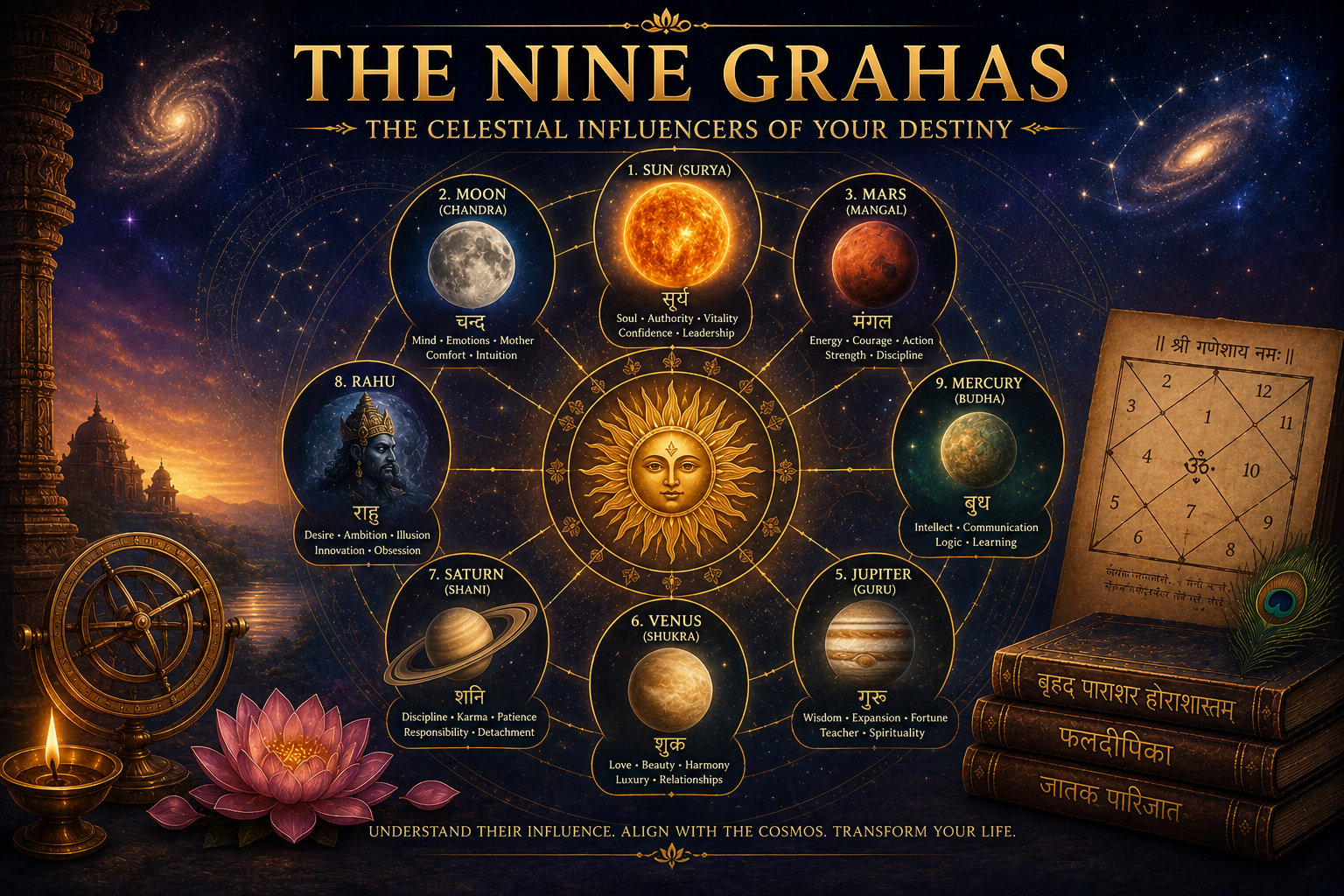
The Nine Grahas: Understanding the Planets of Vedic Astrology
Imagine meeting nine powerful teachers, each carrying a different lesson about life.
One teaches confidence and leadership.
Another teaches patience and responsibility.
One inspires love and creativity.
Another pushes you toward growth through challenge.
In Vedic Astrology, these cosmic teachers are known as the Nine Grahas.
The Sanskrit word Graha is often translated as “planet,” but its meaning is actually broader. Graha literally means “that which grasps” or “that which influences.”
Rather than viewing planets as giant rocks floating through space, Vedic Astrology sees them as symbolic forces that shape human experience.
Together, the Nine Grahas create the energetic blueprint that astrologers interpret within a birth chart.
🔮 Psychic Insight
In Vedic Astrology, planets are not considered “good” or “bad.” Each Graha represents a teacher. Some lessons are easier than others, but every Graha contributes to personal growth and spiritual evolution.
What Are The Nine Grahas?
The Nine Grahas include seven visible celestial bodies and two karmic points known as the lunar nodes.
- Sun (Surya)
- Moon (Chandra)
- Mars (Mangala)
- Mercury (Budha)
- Jupiter (Guru)
- Venus (Shukra)
- Saturn (Shani)
- Rahu
- Ketu
Each Graha governs specific qualities, life experiences, and areas of personal development.
Surya: The Sun
The Sun represents identity, vitality, confidence, leadership, and personal authority.
It symbolizes the soul’s desire to shine and express its unique purpose.
A strong Sun often indicates natural leadership abilities, confidence, and a desire to make an impact.
When challenged, the Sun may bring lessons involving ego, pride, self-esteem, or personal recognition.
In many ways, the Sun asks:
“How will you express your true self?”
Chandra: The Moon
The Moon governs emotions, intuition, habits, memories, and daily experiences.
While the Sun reflects identity, the Moon reflects how life is emotionally experienced.
This is one reason the Moon plays such an important role in Vedic Astrology.
The Moon often reveals:
- Emotional needs
- Instinctive reactions
- Comfort zones
- Mental patterns
- Inner security
Many astrologers consider the Moon one of the most important placements in an entire chart.
Mangala: Mars
Mars represents energy, ambition, courage, determination, and action.
It governs the drive to pursue goals and overcome obstacles.
A strong Mars can create confidence, leadership, and competitive spirit.
When poorly expressed, Mars may manifest as impatience, conflict, or impulsive behavior.
Mars constantly asks:
“What are you willing to fight for?”
✨ Did You Know?
Mars is often associated with warriors, athletes, entrepreneurs, and anyone willing to take decisive action toward their goals.
Budha: Mercury
Mercury governs communication, learning, reasoning, business, and intellectual pursuits.
It reflects how information is processed and shared.
People with strong Mercury placements often enjoy:
- Writing
- Teaching
- Languages
- Sales
- Problem-solving
- Negotiation
Mercury thrives on curiosity and adaptability.
Guru: Jupiter
Jupiter is considered one of the most beneficial planets in Vedic Astrology.
Known as Guru, Jupiter symbolizes wisdom, knowledge, growth, abundance, and spiritual understanding.
Jupiter encourages expansion in both material and spiritual dimensions of life.
Its lessons often involve:
- Faith
- Learning
- Ethics
- Teaching
- Generosity
- Personal growth
Jupiter reminds us that true success often begins with wisdom.
Shukra: Venus
Venus governs beauty, love, pleasure, relationships, art, creativity, and enjoyment.
It reflects what we value and how we connect with others.
Venus often influences:
- Romance
- Marriage
- Aesthetics
- Luxury
- Artistic expression
- Personal values
While Venus enjoys life’s pleasures, it also teaches the importance of balance and meaningful connection.
Shani: Saturn
Few planets inspire more curiosity than Saturn.
Known as Shani, Saturn is often associated with responsibility, discipline, structure, patience, and long-term growth.
Although Saturn sometimes receives a fearful reputation, many astrologers consider it one of life’s greatest teachers.
Saturn teaches:
- Persistence
- Commitment
- Maturity
- Accountability
- Wisdom through experience
Its lessons may take time, but they often produce lasting results.
🌙 Spiritual Lesson
Saturn reminds us that some of life’s greatest rewards require patience, perseverance, and personal responsibility.
Rahu: The Great Desire
Rahu is not a physical planet.
It is one of the lunar nodes and represents ambition, desire, obsession, innovation, and unfamiliar experiences.
Rahu often pushes people beyond their comfort zones.
Its influence may create a strong desire for growth, achievement, recognition, or exploration.
In many charts, Rahu points toward areas where significant growth and learning will occur.
Ketu: The Wise Sage
Ketu forms the opposite end of the karmic axis.
While Rahu seeks new experiences, Ketu often represents wisdom gained through past experiences.
Ketu is associated with:
- Detachment
- Spirituality
- Introspection
- Past-life themes
- Inner wisdom
Where Rahu says “more,” Ketu often says “you’ve already been here.”
Together, Rahu and Ketu reveal powerful clues about the soul’s journey.
Why The Grahas Matter
Every birth chart contains all nine Grahas.
Their positions, relationships, strengths, and timing cycles create a unique pattern that influences personality, relationships, career, finances, spiritual growth, and life experiences.
No single Graha determines destiny.
Instead, astrologers study how all nine interact with one another to understand the larger story unfolding within the chart.
Final Thoughts
The Nine Grahas form the foundation of Vedic Astrology.
Each represents a different aspect of life and consciousness.
Some teach through opportunity.
Others teach through challenge.
All contribute to the soul’s journey.
Understanding these cosmic influences provides a deeper appreciation for the complexity and wisdom contained within the Vedic birth chart.
🌟 Personalized Insight
While understanding the Nine Grahas provides valuable insight, their true meaning emerges through their placement in your unique birth chart. The same planet can express itself very differently depending on its sign, house, and relationships with other Grahas.
Related Vedic Astrology Topics
- Rahu and Ketu: The Karmic Nodes of Destiny
- What Are Nakshatras?
- What Is Vimshottari Dasha?
- Vedic Astrology Houses
- The Navamsa Chart
Continue Exploring Astrology
Deepen your understanding of astrology by exploring the birth chart, natal chart, horoscope, zodiac signs, astrology houses, planetary aspects, Ascendant, Midheaven, MC, rising sign, house rulers, house cusps, synastry, compatibility, transits, retrograde planets, and chart interpretation.
Planets in Astrology
Study the Sun, Moon, Mercury, Venus, Mars, Jupiter, Saturn, Uranus, Neptune, and Pluto to understand how each planet shapes personality, emotions, relationships, career, purpose, growth, and transformation.
Zodiac Signs and Houses
Explore Aries, Taurus, Gemini, Cancer, Leo, Virgo, Libra, Scorpio, Sagittarius, Capricorn, Aquarius, and Pisces. Then compare the 1st House, 2nd House, 3rd House, 4th House, 5th House, 6th House, 7th House, 8th House, 9th House, 10th House, 11th House, and 12th House.
Major Astrology Aspects
Learn how a conjunction, opposition, square, trine, sextile, and quincunx change the way planets interact. Comparing conjunct, opposite, square, trine, sextile, and quincunx aspects helps reveal the full pattern of a chart.

